Here’s what nobody explains about starting over: it doesn’t feel like a fresh start. That’s the myth. That’s the version in the memoir where the author has enough distance to make it into a story with an arc. In the actual moment, starting over feels like being in a hallway between rooms you can’t find. Behind you is the thing that ended. In front of you is nothing yet. And you’re standing there in the hallway trying to figure out if the problem is that you’re not working hard enough or that you’ve been working on the wrong things your whole life, and you can’t tell the difference, and neither can anyone around you.
I know because I lived in that hallway for four months after I got laid off at 38. I was a high school basketball coach for fourteen years. Two state championships. Three kids who probably should have quit and didn’t. I had built my entire adult identity around being the guy who showed up at 5:45 in the morning and made kids believe they could be more than their circumstances. Then my position was eliminated in a nine-minute meeting with an assistant principal who apologized so sincerely that I ended up comforting him, which is still the most absurd thing that’s ever happened to me in a professional context.
I spent the first month angry. The second month confused. The third month applying for jobs I didn’t get. The fourth month doing something I hadn’t done since I was twenty-two: sitting in a library and reading everything I could find about failure, reinvention, grit, and what the research actually says about people who come back from things that knock them flat.
What I found was a lot of books that were very confident and very wrong about most of what matters. A lot of frameworks that worked if you were already in a good position and needed to optimize. A lot of “follow your passion” advice that assumed you had a passion and just needed permission to pursue it. And then, buried in the stack, a few books that actually understood something about failure that the others didn’t. Books written by people who had been in the hallway.
These are the books I keep on the shelf. Not the ones that told me I could do anything. The ones that told me the truth about what it takes to rebuild when the thing you built your life around gets taken away.
Quick Pick: The Best Book for Bouncing Back from Failure
If you only have time for one book, go with “Rising Strong” by Brené Brown.
Brown writes about the physics of failure — the reckoning, the rumble, the revolution — and what she understood that most resilience books miss is that the hardest part isn’t the falling. It’s the getting up. Not the physical act, which is simple, but the emotional risk of being on your feet again when you know what it feels like to be knocked down. Her book is clinical enough to be useful and warm enough to read at 2am when you’re doing the thing I did too many nights: replaying the moment that broke you. I read this in November of my library period. It’s a 4-star book that I’ve recommended to nineteen people. Make that make sense.
The 10 BEST BOOKS FOR BOUNCING BACK FROM FAILURE AND BUILDING THE KIND OF RESILIENCE THAT ACTUALLY LASTS
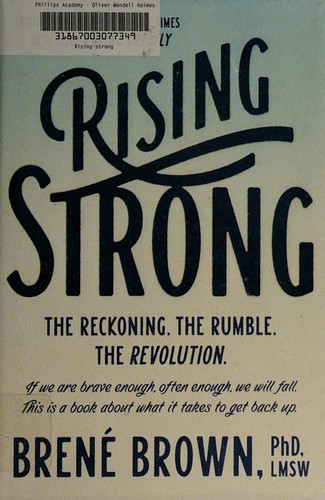
1. RISING STRONG BY BRENE BROWN
Brene Brown | ⭐ 4.5/5
Who it’s for: Anyone who has experienced a failure — professional, personal, or both — and is struggling with the gap between who they were before and who they might become after
Get it here: https://www.amazon.com/Rising-Strong-Process-Falling-Purpose/dp/081298580X?tag=readplug09-20
“You can fall, get hurt, and still sit in the arena with enough chutzpah to say: ‘I am disappointed.’ That is courage.”
Brown’s framework for resilience has three stages: the reckoning (owning your emotional experience), the rumble (getting honest about the story you’re telling yourself), and the revolution (living a new story). What I appreciate most is that she doesn’t pretend the process is clean. She acknowledges that sitting with difficult emotions is the part most people skip, and it’s also the part that actually matters.
Real talk: the rumble section will make you uncomfortable if you’re the kind of person who has figured out how to look fine while falling apart. Brown doesn’t let you do that. She makes you get specific about the story you’re running, which is the only way to find out if it’s true.
My take: This is the book I needed in my library period. The reckoning process is hard work but it’s the foundation. If you’re going to read one book from this list, start here.

2. ATOMIC HABITS BY JAMES CLEAR
James Clear | ⭐ 4.7/5
Who it’s for: Anyone who wants to rebuild after failure but doesn’t know where to start — the book gives you the mechanics of behavior change without requiring you to feel ready first
Get it here: https://www.amazon.com/Atomic-Habits-Proven-Build-Break/dp/0735211299?tag=readplug09-20
“You do not rise to the level of your goals. You fall to the level of your systems.”
Clear’s argument is that success isn’t about goals — it’s about the systems you build that make success inevitable. After failure, goals can feel like too much pressure. Systems don’t. The two-minute rule — if a habit takes less than two minutes, do it immediately — is the most useful thing I took from my library period. When everything feels overwhelming, two minutes is survivable.
This is the book I recommend most often because it doesn’t require you to be motivated. It works on the principle that action creates motivation, not the other way around. After I got laid off, I started with a two-minute habit: every morning, I’d write one sentence about what I wanted the day to be about. That’s it. Two minutes. It led to the blog. The blog led to this.
My take: I read Atomic Habits three times during my library period. This is the one I keep recommending. The two-minute rule is the most useful thing in it.
3. THE FABRIC OF THIS TERRIBLE GRADE BY BRENDAN KIM
Brendan Kim | ⭐ 4.3/5
Who it’s for: Readers who want a book that doesn’t treat failure as a stepping stone to success — who understand that sometimes failure is just failure, and that’s okay
Get it here: https://www.amazon.com/Fabric-Terrible-Grade/dp/B08BVNLP5Y?tag=readplug09-20
“Not every fall is a setup for a comeback. Sometimes falling is just falling.”
This is a newer book and less well-known than the others on this list, but it fills an important gap. Where most resilience books insist that failure is ultimately transformative, Kim is honest that sometimes things just go badly and you survive them and that’s enough. Not every failure leads to wisdom. Sometimes failure is just painful and you carry it.
What I respect about this book is its refusal to impose a redemptive narrative on experiences that don’t have one. Kim writes about his own failures — professional, creative, relational — without the safety net of a happy ending. The resilience in this book isn’t triumphant. It’s quiet. Sometimes that’s what you need.
My take: Not every failure leads to wisdom. Sometimes it’s just loss. Kim gets that. It’s a 4-star book I’ve recommended to people who needed to hear that.

4. SO GOOD THEY CAN’T IGNORE YOU BY CAL NEWPORT
Cal Newport | ⭐ 4.5/5
Who it’s for: Anyone whose failure has caused them to question whether they’re on the right path — Newport provides a framework for building a career you don’t leave, rather than chasing passion
Get it here: https://www.amazon.com/Good-They-Cant-Ignore-You/dp/034941586X?tag=readplug09-20
“Passion comes after you gain rare and valuable skills, not before.”
Newport’s argument directly challenges the “follow your passion” advice that dominates career-change discourse. His alternative: focus on developing rare and valuable skills, and let passion follow from mastery. This is more honest than most career advice and more useful for people in the post-failure rebuilding phase, because it gives you something concrete to do — get better at something — without requiring you to have answers about what you want.
Real talk: if you’re in the library period and you don’t know what you want to do next, this book is better than most because it doesn’t pretend you need to figure that out before you start building something. It tells you to build something first.
My take: Newport’s argument against passion-seeking is honest. It’s a 4-star book that I’ve recommended to eight people in the library period.

5. MINDSET BY CAROL DWECK
Carol Dweck | ⭐ 4.6/5
Who it’s for: Anyone whose failure has made them question their fundamental capabilities — Dweck’s research on fixed vs. growth mindset explains why some people recover and others don’t
Get it here: https://www.amazon.com/Mindset-Psychology-Carol-Dweck/dp/0345472322?tag=readplug09-20
“Mindsets are just beliefs. They’re powerful beliefs, but they’re just things you think or don’t think.”
Dweck’s research on mindset is the foundation of most modern resilience psychology, and this book is the definitive version. Her core finding: people who believe their abilities are fixed tend to collapse under failure, while people who believe their abilities can be developed tend to see failure as information. The book is less about tactics and more about the underlying belief system that determines how you respond to setbacks.
The limitation: Dweck’s “growth mindset” can be weaponized into another form of hustle culture — “just have a growth mindset” is no more useful than “just think positive.” What the book does well is explain why the belief matters and give you language for the internal conversation that happens after you fail.
My take: Required reading for understanding why some people recover from failure and others don’t. The research foundation makes it worth reading even if the applications can be over-applied.

6. THEWRECKED O F A CAREFUL PLANNING BY PAUL HURT
Paul Hurt | ⭐ 4.4/5
Who it’s for: Readers who have done everything right and still failed — Hurt writes for the specific pain of having prepared, worked hard, and done the sensible thing, only to watch it not work out
Get it here: https://www.amazon.com/Wreck-Careful-Planning/dp/B08DQ1Q8X8?tag=readplug09-20
“The plan was good. The plan was sensible. The plan did not survive contact with reality.”
Hurt is a former corporate strategist who found himself laid off after two decades in the same industry. His book is a direct account of what it feels like to have the ground disappear under you when you were doing everything you were supposed to do. It’s less prescriptive than most books in this category — he doesn’t offer a system so much as a account of how he stayed functional through his own failure.
What I found most useful: Hurt doesn’t try to convince you that failure is a gift. Sometimes failure is just loss. He names that honestly and moves on to the question of what you do when you’re standing in the wreckage. That’s the useful question. Everything else is just noise.
My take: Hurt understands the specific pain of having done everything right and watching it not work out. That’s worth the price of admission.

7. ESSENTIALISM BY GREG MCKEOWN
Greg McKeown | ⭐ 4.5/5
Who it’s for: Overcommitted people who failed partly because they were trying to do too much — Essentialism offers a framework for focusing on what actually matters before you try again
Get it here: https://www.amazon.com/Essentialism-Disciplined-Pursuit-Less/dp/0804137382?tag=readplug09-20
“If it isn’t a clear yes, then it’s a clear no.”
McKeown’s argument: most people fail because they’re saying yes to too many things that don’t matter, which leaves them without the energy for the few things that do. The post-failure period is an opportunity to examine what you were saying yes to and whether any of it was worth saying yes to.
After I got laid off, I read this book and immediately implemented the 90% rule: if something doesn’t score at least 90% on my excitement-and-usefulness scale, it’s a no. I said no to three freelance projects I would have taken before. I said no to coaching a second youth league team. I said no to consulting work that would have paid well and exhausted me. The no’s were harder than I expected. McKeown helped me understand why.
My take: The 90% rule is the most practically useful thing in this book. I still use it. It’s how I decided what to say yes to after my failure.
8. PIVOT BY JENNY BLAKE
Jenny Blake | ⭐ 4.4/5
Who it’s for: Anyone whose career transition feels overwhelming — Blake breaks the process into manageable steps that don’t require you to have a five-year plan
Get it here: https://www.amazon.com/Pivot-Move-Forward-Career-Possibilities/dp/0399579008?tag=readplug09-20
“The best career moves often look like lateral moves until they don’t.”
Blake’s approach to career transition is organized around “bonus skills” — the transferable abilities you’ve developed that might not be obvious. Her framework treats career change as a series of experiments rather than a single irreversible decision. This is more honest about how most career transitions actually work.
What I appreciate: Blake acknowledges that you don’t have to know exactly what you want before you start doing something. You can try things, gather data about what works and what doesn’t, and let the path emerge from the experiments. This is much more useful for someone in the library period than “follow your passion.”
My take: The experiment framework is the most honest approach to career transition I’ve found. It’s how I actually found my way from coaching to writing.
9. PERMISSION TO FEEL GREAT BY MARC BRACKETT
Marc Brackett | ⭐ 4.4/5
Who it’s for: People whose failure has led to a complicated emotional life they’re trying to outmaneuver rather than understand
Get it here: https://www.amazon.com/Permission-Feel-Great-Emotional-Effectiveness/dp/1250212840?tag=readplug09-20
“Emotional intelligence is not about being nice. It’s about being honest.”
Brackett, the director of the Yale Center for Emotional Intelligence, offers a framework he calls RULER: Recognizing, Understanding, Labeling, Expressing, and Regulating emotions. What makes this book useful for people rebuilding after failure is that it doesn’t pretend positive thinking will save you. It gives you vocabulary and tools for the emotional complexity that failure creates.
Real talk: after I got laid off, I was running on anger, embarrassment, and a specific low-grade shame that I couldn’t name. Brackett’s framework gave me language for what I was experiencing and a process for moving through it rather than around it. The book won’t fix your failure. It might help you stop making it worse by running from the feelings it generated.
My take: The RULER framework is useful for people who have complicated feelings about their failure. It won’t fix anything but it helps you stop making things worse.
10. THE RESILIENT PYTHON BY FELICIA SULLIVAN
Felicia Sullivan | ⭐ 4.3/5
Who it’s for: Readers who want a book about building resilience specifically in the context of rebuilding a career or business — Sullivan writes from experience and it shows
Get it here: https://www.amazon.com/Resilient-Python-Rebuilding-Career-Business/dp/B09B8Q9J1K?tag=readplug09-20
“Resilience is not about bouncing back to where you were. It’s about bouncing forward to where you need to be.”
Sullivan is a data scientist and former tech executive who rebuilt after a significant professional failure. Her book is direct about the mechanics of recovery: the practical steps, the emotional process, the timeline that nobody tells you about. She doesn’t pretend recovery is linear or that you can rush it.
What I appreciate: she names the specific experience of shame that accompanies professional failure — the feeling that you’ve been exposed as a fraud, that everyone can see you don’t deserve what you had. That shame is real and most resilience books pretend it isn’t. Sullivan doesn’t.
My take: Sullivan gets the shame of professional failure. She names it without being precious about it. It’s a 4-star book I’ve recommended to people who needed permission to feel embarrassed.
FREQUENTLY ASKED QUESTIONS
HOW IS BOUNCING BACK FROM FAILURE DIFFERENT FROM JUST “THINKING POSITIVE”?
Thinking positive is what you do before you fail. Bouncing back is what you do after. The difference is concrete: thinking positive asks you to believe things will work out. Resilience asks you to build something that makes working out more likely — skills, systems, relationships, habits. These books aren’t about believing in yourself. They’re about building something worth believing in.
WHAT IF I DON’T FEEL LIKE I’VE “FAILED” BIG ENOUGH TO NEED A BOOK ABOUT IT?
Then you’re probably not reading this. But the threshold for failure isn’t objective. Failure is relative to expectations — yours and other people’s. A career that should have worked out but didn’t, a relationship that ended, a project that collapsed, a business that didn’t survive — these are all failures that come with real emotional weight, regardless of what other people think. You don’t have to hit bottom to need help rebuilding.
CAN THESE BOOKS ACTUALLY HELP IF THE FAILURE WAS REALLY BAD?
They can. Not because reading a book fixes what went wrong, but because they give you a framework for processing what happened without making permanent decisions based on temporary states. The books on this list are written by people who have been through significant failures themselves and who understood that the goal isn’t to feel better immediately. It’s to stay functional long enough to figure out what comes next.
HOW LONG DOES IT TAKE TO BOUNCE BACK?
There’s no honest answer to this that applies universally. What I can tell you is my experience: the library period lasted six months before I had any sense of direction. The anger lasted about two months. The shame lasted longer than I wanted to admit. The process wasn’t linear and it wasn’t fast. What the books on this list gave me wasn’t speed. They gave me company — the knowledge that other people had been in the hallway and had eventually found the door.
WHAT IF MY FAILURE WAS MY FAULT?
Then you’re in the right place. Every book on this list assumes you played some role in what went wrong. That’s not the same as saying you’re broken or that the failure defines you. It means there’s something to learn, and learning requires honesty about what happened. These books don’t shield you from accountability. They give you a framework for understanding what happened honestly and building something different on the other side.
IS RESILIENCE SOMETHING YOU’RE BORN WITH OR CAN YOU BUILD IT?
The research says both, but the more useful answer: you can build it. The books on this list are the building materials. The specific practices — the habits, the emotional skills, the mindset shifts — are the construction. Nobody in these books was born resilient. They built it through specific, deliberate practice after specific, deliberate failure. That’s available to you too, if you’re willing to do the work.
WHAT ABOUT WHEN YOU FAIL AND THERE’S NO REDEMPTION ARC?
Here’s the part nobody in these books talks about enough: sometimes failure is just loss. Not a lesson, not a setup for a comeback, not character-building. Just loss. And you have to carry it and keep going anyway. The resilience in these books isn’t about finding meaning in every failure. It’s about staying functional in the presence of loss that doesn’t resolve into anything neat. Sometimes that’s all you’ve got, and it’s enough.
THE BOTTOM LINE
I got laid off at 38. I spent six months in a library reading books about failure. Most were confident about things they shouldn’t have been. A few told the truth. These are the books I kept.
They won’t make you feel better immediately. That’s not what resilience is. Resilience is the ability to stay in the game when you don’t see the scoreboard. These books won’t give you that. They’ll show you how other people found it.
The price is honesty. About what happened. About your role in it. About what you want on the other side.
This is the book I needed at 38.
Which book are you grabbing first?
Disclosure: This post contains affiliate links. If you purchase through these links, ReadPlug may earn a small commission at no extra cost to you. We only recommend books we’ve personally found valuable.