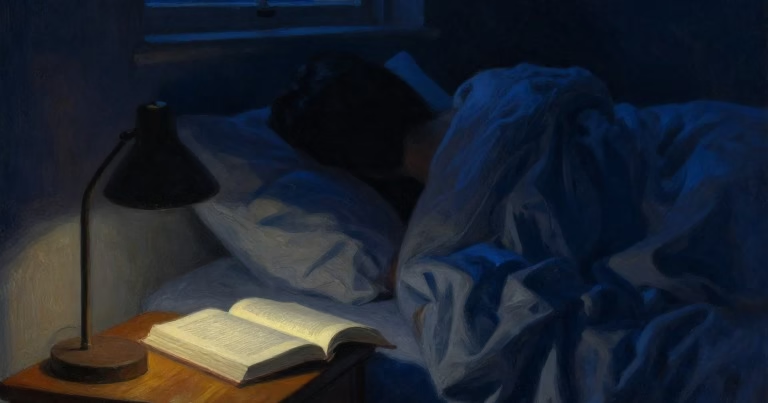
There is a specific kind of 2am that I know too well. The kind where you’ve been lying in bed for two hours and your body is tired but your brain has decided that now is the perfect time to replay every conversation you had today and also calculate how many hours of sleep you’ll get if you fall asleep RIGHT NOW — which is a calculation that guarantees you will not fall asleep right now.
I’ve been a bad sleeper for most of my adult life. Not the glamorous kind, where you’re up writing a novel. The boring kind. The kind where you lie in the dark and your brain runs a highlight reel of every embarrassing thing you’ve ever said, on a loop, with no off switch.
My therapist — Dr. Nair, the one I started seeing after my divorce — brought up my sleep in our fourth session. She pointed out that I was coming to every session exhausted, that I mentioned not sleeping almost as often as I mentioned my kids, that I was treating sleep deprivation as a normal state rather than a problem.
She was right. I’d been running on five to six hours a night for years. It wasn’t until Eli started having nightmares at four and I was up with him at 3am and then at Lincoln Elementary by 7:30am counseling other people’s children that I thought: something has to change. I was starting to forget things. I forgot Nora’s dentist appointment. I forgot my own mother’s birthday for about six hours before the panic set in.
If you’re here because you can’t sleep — not because you don’t want to, but because your body or your brain won’t let you — I want you to know that what you’re experiencing is common, it’s not your fault, and there are books that can actually help. Not the “just drink chamomile and turn off your phone” kind of help. Real, evidence-based, specific help.
These are the ten that helped me.
Quick Pick: The Best Book for Better Sleep
If you only have time for one book, go with “Why We Sleep” by Matthew Walker. It won’t give you a step-by-step sleep plan, but it will give you the single most persuasive argument for taking sleep seriously that exists in print. After reading it, I stopped treating sleep as negotiable.
THE 10 BEST BOOKS FOR BUILDING BETTER SLEEP HABITS NATURALLY AND FINALLY GETTING REST

1. WHY WE SLEEP BY MATTHEW WALKER
Matthew Walker | ⭐ 4.7/5
Who it’s for: Anyone who treats sleep as optional and needs to understand why it isn’t. If you pride yourself on running on little sleep, this book will change your mind.
“The shorter your sleep, the shorter your life. The leading causes of disease and death in developed nations — diseases that are crippling health care systems — all have recognized causal links to a lack of sleep.”
Walker is a neuroscientist, and this book is the most comprehensive and alarming case for sleep I’ve ever read. Chronic sleep deprivation increases risk of Alzheimer’s, heart disease, cancer, and mental health disorders. The research isn’t ambiguous.
But he also covers the beauty of sleep — how it consolidates memories, processes emotions, and clears metabolic waste from the brain. The chapter on dreaming got me: REM sleep is when your brain processes emotional experiences. When you don’t get enough, you carry the raw emotional charge of your day into the next one. That’s why everything feels worse when you’re tired.
This book didn’t give me a sleep plan. It gave me the reason to take sleep seriously enough to find one.
My take: The most important book on this list. Not practical, but foundational. Read it and you’ll never say “I’ll sleep when I’m dead” again.

2. SAY GOOD NIGHT TO INSOMNIA BY GREGG JACOBS
Gregg Jacobs | ⭐ 4.5/5
Who it’s for: Anyone with chronic insomnia — not occasional bad nights, but a persistent pattern of difficulty falling or staying asleep. If you’ve had insomnia for months or years, this is your book.
“Insomnia is not a disease. It is a habit. And habits can be changed.”
Jacobs developed his program at Harvard Medical School, and it’s based on Cognitive Behavioral Therapy for Insomnia (CBT-I), which is now the first-line treatment for chronic insomnia — recommended over medication by the American College of Physicians. The program is six weeks long and completely drug-free.
The most counterintuitive thing I learned: spending less time in bed actually helps you sleep more. Jacobs’s “sleep restriction” technique limits your time in bed to the amount of time you’re actually sleeping. If you’re sleeping five hours but spending nine hours in bed, you start by only allowing yourself five hours in bed. Your body builds sleep pressure, and within a week or two, your sleep efficiency improves. Then you gradually increase your time in bed.
I tried this. The first three nights were miserable. By the second week, I was falling asleep in twenty minutes instead of ninety. By the fourth week, I was sleeping seven hours. The program is structured, evidence-based, and doesn’t require any supplements or gadgets.
My take: The best book specifically for insomnia. If you can’t sleep and you’ve tried everything, this is the clinical approach that actually works.

3. THE SLEEP SOLUTION BY W. CHRIS WINTER
W. Chris Winter | ⭐ 4.4/5
Who it’s for: People who have a complicated relationship with sleep — not just insomnia, but anxiety about sleep itself. If you’re afraid of not sleeping, this book will help you stop being afraid.
“Your brain knows how to sleep. You just keep getting in its way.”
Winter is a sleep neurologist, and his approach is to remove the anxiety around sleep rather than add more rules. His argument: most insomnia is maintained by the fear of insomnia. You can’t sleep because you’re worried about not sleeping, and the worry is more damaging than the missed sleep.
The concept that changed my practice was “sleep effort.” Winter explains that trying to sleep is like trying to digest — the harder you try, the worse it works. Sleep is something your brain does when you stop interfering with it. All the elaborate bedtime rituals, the perfect mattress temperature, the white noise machine set to exactly the right frequency — these can help, but they can also create anxiety when they don’t work perfectly. His advice: simplify. Stop treating sleep as a project to be optimized.
My take: The most reassuring book on this list. If sleep books make you anxious about sleep, this one will calm you down.

4. SLEEP SMARTER BY SHAWN STEVENSON
Shawn Stevenson | ⭐ 4.3/5
Who it’s for: People who want practical, actionable tips they can implement tonight. If you don’t want a deep dive into sleep science — you just want to know what to do — this is your book.
“Sleep is the greatest legal performance-enhancing drug that most people are neglecting.”
Stevenson organizes his advice into twenty-one strategies, each backed by research but presented in a quick, accessible format. He covers everything from sunlight exposure and exercise timing to bedroom environment and nutrition. Each chapter is short — about ten pages — and ends with specific action steps.
The tip that made the biggest difference for me: morning sunlight. Stevenson explains that getting bright light in your eyes within the first thirty minutes of waking resets your circadian clock and improves sleep quality that night. I started walking Nora and Eli to school instead of driving, and within a week I was falling asleep faster. The morning light did more than any supplement I’d tried.
Not everything in this book is rigorously sourced. Some of the later tips feel like filler. But the core strategies — light exposure, consistent wake times, temperature management, caffeine timing — are well-supported and immediately useful.
My take: The most practical book on this list. Read it for the tips; don’t expect the depth of Walker or Jacobs.

5. HELLO SLEEP BY JADE WU
Jade Wu | ⭐ 4.5/5
Who it’s for: Anyone who’s tried sleep hygiene tips and found they don’t work. If “turn off your phone and drink tea” hasn’t fixed your insomnia, Wu’s CBT-I approach goes deeper.
“Sleep hygiene is not insomnia treatment. It’s like telling someone with clinical depression to ‘think positive.'”
Wu is a sleep psychologist, and her book is a more accessible, warmer version of CBT-I than Jacobs’s clinical text. She writes with empathy and humor, and she’s honest about her own sleep struggles. Her approach combines cognitive techniques (addressing anxious thoughts about sleep) with behavioral strategies (sleep restriction, stimulus control) and a deep understanding of the circadian system.
The chapter on “sleep effort” reinforced what Winter says but added a crucial insight: Wu explains that perfectionism about sleep — needing exactly eight hours, needing to fall asleep within fifteen minutes, needing to wake up feeling refreshed — actually creates insomnia. The standards themselves become the problem. Her advice: aim for “good enough” sleep, not perfect sleep. I’ve recommended this book to three different people in the last month, which is the only endorsement that matters.
My take: The best modern CBT-I book. Warmer than Jacobs, more rigorous than Stevenson.

6. THE PROMISE OF SLEEP BY WILLIAM DEMENT
William Dement | ⭐ 4.3/5
Who it’s for: Anyone who wants to understand the history of sleep science — the researcher who started it all. If you’re curious about why we know so little about something we spend a third of our lives doing, this book explains.
“Healthy sleep is a birthright that has been stolen from us by the modern world.”
Dement is considered the father of sleep medicine. He founded the first sleep disorders clinic, discovered REM sleep, and spent sixty years advocating for sleep as a public health priority. This book is part memoir, part science, part plea for society to take sleep seriously.
What makes this different from Walker’s book is the historical perspective. Dement describes what it was like to study sleep when nobody thought it mattered — when the medical establishment considered sleep a passive state, a waste of research funding. The fact that we now know so much about sleep is largely because of his persistence. The chapter on sleep disorders — narcolepsy, sleep apnea, restless legs — is the most accessible clinical overview I’ve found.
My take: Best for people who love the “how we figured this out” story. Less practical than the others but deeply interesting.

7. DREAMLAND BY DAVID K. RANDALL
David K. Randall | ⭐ 4.2/5
Who it’s for: Casual readers who want an engaging, well-written tour of sleep science without the clinical density. If Walker’s book feels like too much, Randall’s is the lighter version.
“We spend a third of our lives asleep, and we know almost nothing about what happens when we close our eyes.”
Randall is a journalist, not a scientist, and his book reads like a series of fascinating magazine articles about different aspects of sleep: why we dream, how sleep varies across cultures, what happens during sleepwalking, how mattresses were invented, why some people are night owls and others are early birds. It’s entertaining and surprisingly informative.
The chapter on biphasic sleep — the historical pattern of sleeping in two chunks with a wakeful period in the middle — made me feel less broken. Randall describes how, before industrialization, people commonly slept for three to four hours, woke for one to two hours, and then slept again. My 3am wakefulness, which I’d been treating as insomnia, might actually be a vestige of a natural sleep pattern. That reframe alone reduced my anxiety about waking up at night.
My take: The most enjoyable read on this list. Perfect for people who want to understand sleep without studying it.

8. THE NOCTURNAL BRAIN BY GUY LESCHZINER
Guy Leschziner | ⭐ 4.4/5
Who it’s for: Anyone whose sleep problems are unusual — sleepwalking, night terrors, sleep paralysis, narcolepsy, or other parasomnias. If your sleep problem isn’t just “I can’t fall asleep,” this book covers the stranger territory.
“The sleeping brain is not a passive organ. It is a seething, active, and often bewilderingly complex system.”
Leschziner is a neurologist who runs a sleep disorders clinic, and his book is a collection of case studies from his patients. Each chapter describes a different sleep disorder through the story of a real patient — the woman who ate in her sleep, the man who acted out his dreams violently, the teenager who couldn’t stop falling asleep during the day.
The chapter on sleep paralysis was the one I needed. I’d experienced it twice — waking up unable to move, with a sensation of pressure on my chest and a feeling of terror — and I’d been terrified it was a sign of something serious. Leschziner explains the neuroscience: it’s a glitch in the transition between sleep and wakefulness, where your brain wakes up before your body’s paralysis mechanism turns off. It’s harmless. It’s also extremely common. Knowing the mechanism removed the fear.
My take: The best book for unusual sleep problems. If your sleep issue feels weird or scary, Leschziner will explain it and reassure you.

9. THE INSOMNIA WORKBOOK BY STEPHANIE SILBERMAN
Stephanie Silberman | ⭐ 4.2/5
Who it’s for: People who learn by doing, not reading. If you want exercises, worksheets, and a structured program you can follow on your own, this workbook delivers.
“Sleep is a skill. Like any skill, it can be learned and improved with practice.”
Silberman’s workbook is the most hands-on resource on this list. It includes sleep diaries, relaxation exercises, cognitive restructuring worksheets, and stimulus control protocols. It’s designed to be used over six to eight weeks.
I used this alongside Jacobs’s book and found the combination effective. The sleep diary was particularly useful — tracking my patterns for two weeks revealed I slept best on nights when I went for a walk after dinner and worst on nights when I worked until 9pm.
My take: The most actionable book on this list. Pair it with “Say Good Night to Insomnia” for the complete CBT-I experience.

10. THE SLEEP REVOLUTION BY ARIANNA HUFFINGTON
Arianna Huffington | ⭐ 4.0/5
Who it’s for: People who need to be convinced that sleep matters more than hustle. If you’re part of the “I’ll sleep when I’m dead” culture, Huffington’s argument is the intervention you need.
“We are in the midst of a sleep deprivation crisis, and the consequences go far beyond feeling tired.”
Huffington collapsed from exhaustion in 2007 and broke her cheekbone. That led her to write this book — part manifesto, part cultural critique. She argues that our culture’s glorification of sleeplessness is killing us.
The book is weaker on science than Walker and weaker on practical solutions than Jacobs. But its strength is the cultural argument: sleeping enough is not laziness. The most productive people are the ones who rest. I read this while I was still at the consulting firm, still averaging five hours, still treating exhaustion as proof I was serious. It planted the seed that became, eventually, the recognition Dr. Nair gave me: being tired is not a personality trait. It’s a problem.
My take: The book to give to the person in your life who won’t stop bragging about how little they sleep. The cultural argument is the real contribution.
FREQUENTLY ASKED QUESTIONS
HOW MUCH SLEEP DO I ACTUALLY NEED?
Walker’s research suggests that most adults need seven to nine hours. Not “function on” — actually need for cognitive performance, emotional regulation, immune function, and long-term health. The idea that some people are “short sleepers” who only need five or six hours is largely a myth. Genetic short sleepers exist, but they represent less than one percent of the population. If you think you’re fine on six hours, you’re probably just used to the impairment.
WHAT IS CBT-I AND WHY IS IT THE RECOMMENDED TREATMENT?
Cognitive Behavioral Therapy for Insomnia (CBT-I) is a structured program that addresses the thoughts and behaviors that maintain insomnia. It includes sleep restriction (limiting time in bed), stimulus control (using the bed only for sleep), cognitive restructuring (challenging anxious thoughts about sleep), and relaxation training. It’s recommended as the first-line treatment for chronic insomnia by every major medical organization because it works as well as medication in the short term and better in the long term, without side effects.
SHOULD I TAKE SLEEP MEDICATION?
That’s a conversation for you and your doctor. What I can tell you is that most sleep medications are designed for short-term use and can create dependency with long-term use. CBT-I is the recommended first-line treatment because it produces lasting changes without medication. If your insomnia is severe enough that you can’t function, medication may be appropriate as a bridge while you work on the behavioral and cognitive changes. But the goal should be to not need the medication eventually.
WHAT IF I WAKE UP IN THE MIDDLE OF THE NIGHT AND CAN’T GO BACK TO SLEEP?
Winter’s advice: get out of bed. If you’ve been awake for more than twenty minutes, leave the bedroom and do something quiet and boring in dim light — read a dull book, fold laundry, sit in a chair. Don’t turn on bright lights. Don’t check your phone. Don’t do anything stimulating. Return to bed only when you feel sleepy. This “stimulus control” technique retrains your brain to associate your bed with sleep, not with wakefulness and frustration.
IS NAPPING GOOD OR BAD FOR SLEEP?
It depends. Short naps (20-30 minutes) in the early afternoon can boost alertness and performance without affecting nighttime sleep. Long naps or naps taken late in the day reduce your “sleep drive” and can make it harder to fall asleep at night. If you have insomnia, most sleep experts recommend avoiding naps entirely until your nighttime sleep stabilizes. After that, short naps are fine.
CAN EXERCISE HELP ME SLEEP BETTER?
Yes, but timing matters. Regular exercise improves sleep quality, reduces the time it takes to fall asleep, and increases the amount of deep sleep you get. However, vigorous exercise within two to three hours of bedtime can be stimulating and make it harder to fall asleep. Morning exercise is ideal — it strengthens your circadian rhythm and the benefits accumulate over time. Even a thirty-minute walk makes a difference.
WHAT IF MY SLEEP PROBLEM IS CAUSED BY MY KIDS?
Then you have my complete sympathy. Children — especially babies, toddlers, and kids with nightmares — disrupt sleep in ways that no book can fully address. What I can say is that the principles still apply to whatever sleep you can get: consistency of wake time (even on weekends), light exposure in the morning, a cool dark bedroom, and limiting screen time before bed. And if your child’s sleep issues are chronic, consider consulting a pediatric sleep specialist. Fixing their sleep often fixes yours.
THE BOTTOM LINE
Sleep is not a luxury. It is not a reward for productivity. It is the foundation on which everything else — your mood, your memory, your health, your relationships, your ability to parent, teach, work, and think — is built.
If I had to hand you three books, I’d start with “Why We Sleep” by Matthew Walker for the science, move to “Hello Sleep” by Jade Wu for the practical CBT-I approach, and finish with “The Sleep Solution” by W. Chris Winter for the reassurance that your brain knows how to do this.
I spent years treating not-sleeping as a personality trait. It wasn’t. It was a problem, and like most problems, it had solutions I hadn’t tried yet. These books were the beginning of trying.
Which book are you grabbing first?
Disclosure: This post contains affiliate links. If you purchase through these links, ReadPlug may earn a small commission at no extra cost to you. We only recommend books we’ve personally found valuable.
Never miss a life-changing book.
Get our spoiler-free book picks every Tuesday.