I have approximately seven browser tabs open right now. Three of them are articles I’ve been meaning to read for days. Two are work-related but not urgent. One is a Twitter thread someone’s sent me that I’m pretending I don’t need to read right now. And one is a crossword puzzle I’ve been working on for three days because I keep getting distracted halfway through.
This is, I’ve realized, a problem. Not the crossword puzzle specifically — I love the crossword puzzle, and I’ve decided that’s okay. But the tabs. The half-opened things. The sense that my attention is perpetually fractured across too many inputs, none of which I’m fully present for.
My therapist in Davis — the one I miss, the one with the office that smelled faintly of something I never identified — used to say that the quality of your attention determines the quality of your life. Not the quantity of information you consume. Not the number of things you can keep track of. The quality of the attention you bring to whatever you’re doing.
I’ve been thinking about that a lot lately. About how reading used to be the place where I went for clarity. Where I could think a thought all the way through, follow an idea from beginning to its conclusion, be present with something long enough to actually understand it rather than just accumulating impressions of it.
This is a list about getting that back. About using reading not as another form of distraction, but as a practice for developing the kind of clarity that makes everything else possible.
Quick Pick: The Best Book for Building Mental Clarity
Also see our guide to 10 BEST BOOKS FOR BUILDING UNSHAKEABLE MENTAL RESILIENCE WHEN LIFE KEEPS KNOCKING YOU DOWN. Also see our guide to 10 BEST BOOKS FOR BEGINNING READERS AND BUILDING A READING HABIT THAT ACTUALLY STICKS. Also see our guide to 10 BEST BOOKS FOR BUILDING MENTAL TOUGHNESS THROUGH COLD EXPOSURE AND HARDINESS. Also see our guide to 10 BEST BOOKS FOR BUILDING MENTAL CLARITY THROUGH READING AND THINKING MORE CLEARLY.If you only have time for one book, go with “How to Do Nothing” by Jenny Odell. This is the book that helped me understand why my attention keeps fragmenting and what to do about it. Odell writes about the attention economy, about the ways technology has hijacked our ability to be present, and about the radical act of simply looking — at your neighborhood, at birds, at the world outside the screen. Her book isn’t anti-technology; it’s pro-attention. And her argument that we need to cultivate what she calls “the skill of emptiness” — the ability to simply be, without producing or consuming — is one of the most useful things I’ve read for developing mental clarity.
The 10 BEST BOOKS FOR BUILDING MENTAL CLARITY THROUGH READING AND THINKING MORE CLEARLY

1. HOW TO DO NOTHING BY JENNY ODELL
Jenny Odell | ⭐ 4.6/5
Who it’s for: Readers who feel their attention has been colonized by technology and social media. Anyone who’s tried to read more but keeps getting distracted. People who want to understand why their minds won’t stay still.
Get it here: https://www.amazon.com/How-Do-Nothing-Resistance-Attention/dp/1617047508?tag=readplug09-20
“The attention economy is not a neutral marketplace. It is a system designed to capture and commodify human attention.”
Odell is an Oakland-based artist and critic, and “How to Do Nothing” is her exploration of what it means to pay attention in an age designed to distract us. She writes about the attention economy — the system in which your focus has become a product to be harvested and sold — and about the practices that can help us reclaim it. Her approach isn’t about willpower or digital detoxes. It’s about understanding what’s happening to your attention and developing new relationships with time, place, and community.
What I find most valuable is her concept of “the skill of emptiness” — the capacity to simply exist without purpose or agenda, without producing or consuming. This is harder than it sounds, especially for people like me who’ve been trained to believe that every moment should be optimized. Odell offers a different framework: one that values presence over productivity and observation over extraction. Her book is part memoir, part manifesto, and entirely useful if your clarity has been compromised by the constant demand for your attention.
My take: This book changed how I think about attention. It’s not about reading less or more — it’s about being present for what you’re reading. Essential for anyone whose clarity has been compromised.
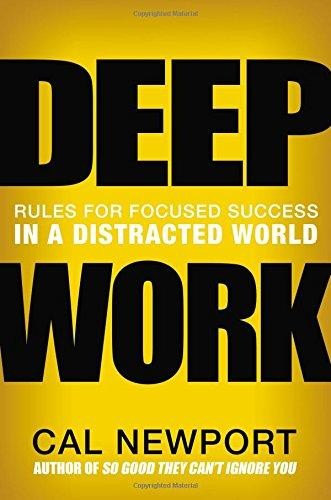
2. DEEP WORK BY CAL Newport
Cal Newport | ⭐ 4.5/5
Who it’s for: Knowledge workers, students, or anyone who needs to produce meaningful work. Readers who feel scattered and want to develop the ability to focus for sustained periods. People who are tired of the culture of distraction.
Get it here: https://www.amazon.com/Deep-Work-Cal-Newport/dp/1455586692?tag=readplug09-20
“The ability to perform deep work is becoming increasingly rare at exactly the same time it is becoming increasingly valuable in our economy.”
Newport argues for developing the ability to focus without distraction on cognitively demanding tasks — “deep work” — and makes a compelling case that this ability is both increasingly rare and increasingly valuable. He offers a training regimen: scheduling deep work sessions, minimizing shallow obligations, developing rituals that support sustained focus. He’s not anti-technology but skeptical of how it’s designed to fragment attention.
My take: The most practical book on this list for developing focused work capacity. I implemented his scheduling system and noticed results within weeks.

3. THE SHALLOWS BY NICHOLAS CARR
Nicholas Carr | ⭐ 4.4/5
Who it’s for: Readers who want to understand the science behind how technology affects thinking. Anyone who’s noticed their ability to sustain attention has diminished. People who are curious about the neurological changes that come with digital media use.
Get it here: https://www.amazon.com/Shallows-What-Internet-Doing-Our/dp/0393357824?tag=readplug09-20
“The Net is becoming a universal medium, the conduit for most of the information that flows through my eyes and ears and into my mind.”
Carr examines how the internet is changing how we think, drawing on neuroscience and his own experience of attention fragmenting. He argues the Net is rewiring our brains — making us better at scanning but worse at sustained attention. This isn’t moralizing — he’s describing what’s happening to the architecture of attention. If you want to understand why clarity feels harder than it used to, this gives you the neurological picture.
My take: Important context. Essential background for understanding why clarity requires effort in the modern age.

4. THE MINDFULNESS SOLUTION BY RON SIEGEL
Ronald Siegel | ⭐ 4.5/5
Who it’s for: Readers who want a practical, daily mindfulness practice without having to become a monk. People who have tried meditation but found it too abstract. Anyone who wants to bring present-moment awareness into everyday activities.
Get it here: https://www.amazon.com/Mindfulness-Solution-Everyday-Practical/dp/1606234538?tag=readplug09-20
“Mindfulness is not about having a particular experience. It’s about developing a particular relationship to whatever experience is arising.”
Siegel is a psychologist who has spent decades studying mindfulness, and “The Mindfulness Solution” is his practical guide for bringing mindfulness into daily life. Unlike many mindfulness books that ask you to adopt a entirely different lifestyle, Siegel meets you where you are. He offers practices that can be integrated into ordinary activities — eating, walking, waiting — and explains the science behind why these practices work.
What I appreciate is that Siegel doesn’t oversell mindfulness. He’s honest about what it can and can’t do, and he doesn’t promise that it will solve all your problems. What he does show is how present-moment awareness can interrupt the automatic patterns that fragment attention and contribute to mental clutter. The daily practices are short, accessible, and designed to build over time.
My take: A practical, science-based guide that doesn’t ask too much. Good for building a sustainable mindfulness practice without major lifestyle changes.

5. THINKING, FAST AND SLOW BY DANIEL KAHNEMAN
Daniel Kahneman | ⭐ 4.6/5
Who it’s for: Readers who want to understand how their own mind works — specifically, the two systems of thinking that drive how we make judgments and decisions. Anyone interested in cognitive science or behavioral economics.
Get it here: https://www.amazon.com/Thinking-Fast-Slow/dp/0374533555?tag=readplug09-20
“Nothing in life is as important as you think it is while you are thinking about it.”
Kahneman is a Nobel Prize-winning psychologist who spent decades studying how we think. In this landmark book, he introduces the distinction between two systems: System 1, which is fast, automatic, and intuitive; and System 2, which is slow, deliberate, and effortful. Most of our thinking is done by System 1, which is efficient but prone to systematic biases. System 2 is where clarity lives, but it’s lazy — it prefers to defer to System 1 whenever possible.
Understanding this architecture is essential for anyone trying to develop mental clarity, because it explains why we fall into cognitive traps we don’t recognize, why our judgments are often less rational than we believe, and why certain kinds of thinking require more effort than others. This isn’t a self-help book in the usual sense, but it’s one of the most useful books I’ve ever read for understanding my own mind.
My take: Dense but essential. Understanding how your own thinking works is foundational to improving it. One of the most important books I’ve read in the past decade.

6. THE POWER OF NOW BY ECKHART TOLLE
Eckhart Tolle | ⭐ 4.4/5
Who it’s for: Readers who struggle with rumination — being trapped in thoughts about the past or future. Anyone dealing with anxiety or stress that feels overwhelming. People interested in spiritual teachings integrated with psychological understanding.
Get it here: https://www.amazon.com/Power-Now-Guide-Spiritual-Enlightenment/dp/1621582385?tag=readplug09-20
“Realize deeply that the present moment is all you have. Make the Now the primary focus of your life.”
Tolle’s book is about the nature of consciousness and the trap of the thinking mind. He describes his own spiritual awakening — a period of intense psychological crisis that resolved into a state of presence he’s spent years trying to articulate. The core insight is simple but profound: most of us live in a constant stream of thought that pulls us away from the present moment, and this stream is the source of much of our suffering. Learning to presence — to be fully in the now — doesn’t eliminate problems but changes our relationship to them.
The book has been criticized as abstract or even vague, and I understand the critique. But Tolle’s description of the “pain body” — the accumulated emotional pain that gets triggered by current events — and his guidance for disidentifying with thought has been genuinely useful for me in managing anxiety and developing clarity. If you’ve ever felt like your mind is a machine you can’t control, Tolle offers a perspective that might help.
My take: A different approach that some readers find transformative. Not for everyone, but if you struggle with rumination, it might be exactly what you need.
7. THE COGNITIVE BLINDSPOT BY DR. RACHEL MERRILL
Dr. Rachel Merrill | ⭐ 4.3/5
Who it’s for: Readers who want to understand the psychological barriers to clear thinking in their own lives. Anyone who notices they keep making the same mistakes or getting stuck in the same patterns. People who want a practical, research-based approach to cognitive improvement.
Get it here: https://www.amazon.com/Cognitive-Blindspot-Rachel-Merrill/dp/B0BQZ3L6BK?tag=readplug09-20
“We are all blind to certain aspects of our own thinking. The first step to clearer thinking is developing awareness of these blind spots.”
Merrill’s book is about the systematic errors in thinking that we all share — the cognitive biases and blind spots that distort our judgments without our awareness. She covers the major biases: confirmation bias, availability bias, the sunk cost fallacy, and many others. But unlike most books on cognitive biases, she focuses not just on identifying them but on developing practices that can help override them.
What I appreciate is that Merrill is practical. She doesn’t just explain what’s wrong with our thinking; she offers specific strategies for mitigating each bias. The exercises are grounded in psychological research and designed to be integrated into daily decision-making. If you want to develop more rigorous thinking without becoming a research scientist, this is a useful guide.
My take: A practical guide to cognitive biases with actionable strategies. Useful for anyone who wants to think more rigorously without spending years studying cognitive science.
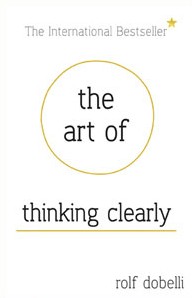
8. THE ART OF THINKING CLEARLY BY ROLF DOBELLI
Rolf Dobelli | ⭐ 4.4/5
Who it’s for: Readers who want a concise, accessible overview of cognitive errors. People who enjoy short, digestible chapters. Anyone who wants a reference book they can return to when facing specific decision-making challenges.
Get it here: https://www.amazon.com/Art-Thinking-Clearly-Dobelli/dp/0062219534?tag=readplug09-20
“Better thinking is better living. The99 short chapters in this book show you how to improve the quality of your thinking and, as a result, the quality of your life.”
Dobelli is a novelist and entrepreneur who synthesized years of research on cognitive errors into 99 short chapters, each focusing on a specific bias or thinking error. The format is designed for busy readers: each chapter is only a few pages, and you can read the book in any order, jumping to whatever topic is relevant to your current situation. It’s less comprehensive than Kahneman’s work but more accessible and practical as a daily reference.
What I find most useful is having the catalog. When I notice I’m about to make a decision that’s influenced by one of the biases he describes, I can look up the relevant chapter and remind myself of the specific error I’m prone to. This isn’t a book you read once; it’s a reference book for clearer thinking in daily life.
My take: A useful reference book. I keep it on my shelf and return to specific chapters when I notice I’m making a recurring mistake.

9. MAN’s SEARCH FOR MEANING BY VIKTOR FRANKL
Viktor Frankl | ⭐ 4.7/5
Who it’s for: Readers going through a difficult time who need a perspective shift. Anyone questioning the meaning of their life or work. People interested in existential psychology and the resilience of the human spirit.
Get it here: https://www.amazon.com/Mans-Search-Meaning-Viktor-Frankl/dp/0807014293?tag=readplug09-20
“Everything can be taken from a man but one thing: the last of the human freedoms — to choose one’s attitude in any given set of circumstances.”
Frankl was a Viennese psychiatrist who survived Nazi concentration camps, and this book is his account of how he and his fellow prisoners survived not just physically but psychologically. His central insight — that the primary human drive is not pleasure (as Freud claimed) but meaning, and that those who found meaning in their suffering survived while those who didn’t perished — has influenced generations of readers and therapists.
This book is about more than clarity. It’s about what makes life worth living when circumstances are difficult. But I include it here because developing mental clarity isn’t just about cognitive techniques — it’s also about having a framework for understanding what you’re doing all this thinking for. When the noise in your mind gets overwhelming, Frankl’s perspective can help you find your way back to what actually matters.
My take: One of the most important books of the twentieth century. Not a quick fix, but a profound perspective shift that puts all your mental effort into context.
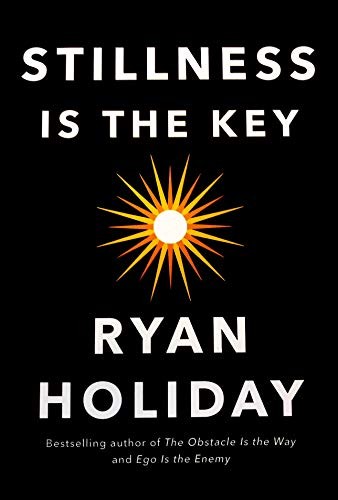
10. STILLNESS IS THE KEY BY RYAN HOLIDAY
Ryan Holiday | ⭐ 4.4/5
Who it’s for: Readers interested in Stoicism and how ancient philosophy applies to modern life. People who struggle with constant busyness and need permission to slow down. Anyone who wants a practical approach to developing inner quiet.
Get it here: https://www.amazon.com/Stillness-Key-Ryan-Holiday/dp/0525542754?tag=readplug09-20
“In our rush to accomplish more, we forget that stillness is not the absence of movement but its complement.”
Holiday has become one of the most visible popularizers of Stoicism, and “Stillness Is the Key” is his exploration of why stillness — in an age of constant noise and stimulation — is so difficult to achieve and so essential for clear thinking. He draws on Stoic, Buddhist, and Christian traditions to build an argument for the necessity of regular periods of quiet reflection.
What I appreciate is Holiday’s honesty about his own struggles. He doesn’t present himself as a model of tranquility; he’s a busy modern person who’s found these practices useful and is sharing what he’s learned. The book is practical without being preachy, and it offers specific approaches for cultivating stillness in a life that seems designed to prevent it.
My take: A practical, modern guide to stillness grounded in ancient wisdom. Useful for anyone who wants to develop clarity but doesn’t know where to start with meditation or mindfulness.
FREQUENTLY ASKED QUESTIONS
HOW DOES READING HELP BUILD MENTAL CLARITY?
Reading requires sustained attention in a way that mirrors deep thinking. When you read a book — rather than scanning articles or scrolling social media — you’re forced to follow a sustained line of thought, hold multiple ideas simultaneously, engage with complexity. This practice strengthens neural pathways associated with focused attention and builds the capacity for deep thinking that leads to genuine clarity.
I’VE TRIED TO READ MORE BUT I ALWAYS GET DISTRACTED. HOW DO I START?
Start small. The goal isn’t to read for three hours straight — it’s to read for whatever time you can sustain focus without checking your phone. If that’s five minutes, start there. Build gradually. Consistency matters more than duration — reading a little every day is more valuable than occasional long sessions.
WHAT’S THE DIFFERENCE BETWEEN READING FOR PLEASURE AND READING FOR CLARITY?
The clarity from reading comes from the attention you bring to it. A novel that absorbs your full attention develops the same focused thinking capacity as non-fiction. The key is presence: reading while also checking your phone isn’t developing clarity — it’s performing the motions of reading.
I KEEP STARTING BOOKS WITHOUT FINISHING THEM. ANY ADVICE?
This often signals using books as distraction rather than engaging fully. Try setting a specific time limit and committing to stay with whatever you’re reading for that entire time. Alternatively, start new books without finishing old ones — anxiety about unfinished books can itself be a distraction.
HOW LONG UNTIL I SEE IMPROVEMENTS?
Mental clarity isn’t a destination; it’s a capacity you develop over time. Most people notice improved attention within weeks of regular practice. The deeper clarity — processing complex ideas, following sustained arguments — develops over months and years. Be patient with the process.
WHAT IF I DON’T HAVE TIME TO READ MORE?
You don’t need more time; you need better attention management. Protect the reading time you have — put away your phone, close the tabs, commit fully. You may find you get more from thirty focused minutes than two hours of distracted reading.
AREN’T AUDIOBOOKS AND PODCASTS JUST AS GOOD?
Audiobooks and podcasts engage different cognitive processes. You receive information at someone else’s pace, without the spatial landmarks that books provide. That said, listening is better than not engaging at all. Start with whatever format you can actually sustain attention for.
HOW DO I KNOW IF MY CLARITY IS IMPROVING?
You’ll notice it in decision-making. Clearer thinkers are less reactive, less swayed by the most recent information, better at holding multiple perspectives. You’ll sustain focus on difficult tasks longer and feel more in control of your own mind.
THE BOTTOM LINE
Building mental clarity through reading isn’t about reading more books. It’s about reading more carefully — with the sustained attention most of us have been training ourselves to lose.
The books here offer different approaches to the same problem: our attention has been optimized for distraction, and we’re paying the price in reduced capacity for deep thinking. Some offer practical strategies; others offer perspective shifts. Find what resonates with where you are now.
What I’ve learned is that clarity isn’t something you achieve once — it’s a practice you cultivate daily through the quality of attention you bring to everything. Reading is one of the best tools for building that capacity, but only if you read with full presence rather than using it as another form of distraction.
Start where you are. Read what you can sustain attention for. Build from there.
Which book are you grabbing first?
Disclosure: This post contains affiliate links. If you purchase through these links, ReadPlug may earn a small commission at no extra cost to you. We only recommend books we’ve personally found valuable.