There is a particular kind of confidence that I used to see in other people and that I wanted badly enough to imitate. It was the kind that looked effortless — the person who walked into a room and seemed to belong there without having to prove anything, who spoke up in meetings without calculating first, who could be wrong without it feeling like an emergency. I watched people like this for years, trying to reverse-engineer how they did it, and what I eventually understood is that I was looking at the wrong thing entirely.
The confidence I was trying to build was conditional. It depended on me being prepared, on me having done the work, on me being in a context where my competence was already established. Take any of those things away and the confidence collapsed, because it was not actually confidence — it was competence relying on familiar conditions to feel real. What I needed, and did not know how to want, was something more like what I have now: a sense of my own worth that exists before I have proven anything, that survives being wrong, that does not require the world to reflect me accurately in order to feel solid.
That kind of confidence is not built in a weekend workshop or by repeating affirmations in the mirror, though neither of those things will necessarily hurt you. It is built through the slow work of understanding why you lost it in the first place, and then doing the work to reclaim it. These are the books that helped me understand that process, and that I return to when I feel my own confidence starting to depend on conditions that are not actually in my control.
Quick Pick: The Best Book for Building Real Confidence
If you only have time for one book, go with “The Gifts of Imperfection” by Brene Brown. This is the book I give to almost everyone who asks me where to start, which is often. Brown spent years researching shame and vulnerability, and what she found is that the thing most of us are calling confidence is actually just the absence of shame — we feel confident when we are not ashamed of ourselves, and we lose it the moment something triggers that old feeling. Her argument is that real confidence is built through embracing imperfection, not through achieving the appearance of having no flaws. This is simple to say and very hard to practice, and her book is the best guide I have found for starting that practice.
[Get it here:] https://www.amazon.com/Gifts-Imperfection-10th-Anniversary/dp/0593084642?tag=readplug09-20
The 10 BEST BOOKS FOR BUILDING UNSHAKEABLE CONFIDENCE AND SELF-WORTH
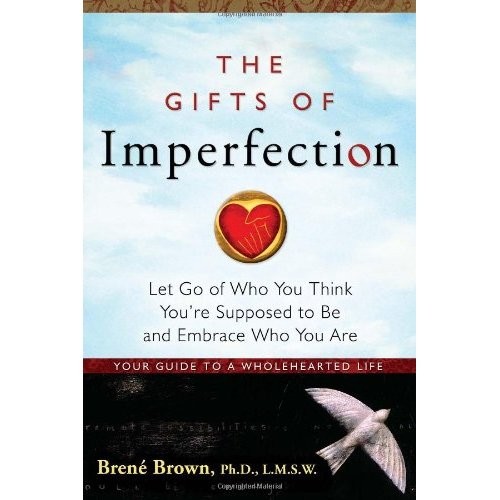
1. THE GIFTS OF IMPERFECTION BY BRENE BROWN
BRENE BROWN | * 4.8/5
Who it’s for: People who have achieved a lot but still feel like a fraud. People who confuse vulnerability with weakness. People who are tired of performing okay-ness and want to feel actually okay.
Get it here: https://www.amazon.com/Gifts-Imperfection-10th-Anniversary/dp/0593084642?tag=readplug09-20
“Owning our story can be hard but not nearly as difficult as spending our lives running from it.”
The Gifts of Imperfection is built around what Brown calls the ten guideposts for wholehearted living — ways of being that she found differentiated people with deep self-worth from those without. The guideposts include cultivating authenticity, letting go of comparison, and developing self-compassion. Each gets a chapter combining research with Brown’s personal story, which she tells without excessive sentiment.
What I find most useful is Brown’s framing of “fitting in” versus “belonging.” Most confidence problems are problems of trying to fit in — meeting criteria set by someone else. Brown’s distinction clarifies the actual problem.
My take: The best starting point for almost anyone on this list. Brown is warm and research-backed in equal measure, and her clarity about what she’s describing makes the book easy to apply.

2. SELF-COMPASSION BY KRISTIN NEFF
KRISTIN NEFF | * 4.7/5
Who it’s for: People who are much harder on themselves than they would ever be on someone else. People whose inner critic runs constantly and loudly. People who think self-compassion is the same as self-indulgence.
Get it here: https://www.amazon.com/Self-Compassion-Kristin-Neff/dp/0061733520?tag=readplug09-20
“You cannot hate yourself into a version of yourself that you will love.”
Kristin Neff defines self-compassion as being supportive toward yourself rather than harshly self-critical, particularly in moments of failure or inadequacy. This is simple to understand and extremely hard to practice if you have spent your life believing that harsh self-criticism is what motivates you.
The book is organized around three components: self-kindness, common humanity, and mindfulness. Neff distinguishes self-compassion from self-pity (getting lost in your own suffering) and from self-esteem (depending on feeling better than others). Self-compassion is available regardless of how you compare to others, producing more stable confidence.
My take: Essential for people whose confidence problems are rooted in perfectionism and harsh self-criticism. Neff’s research is solid and her exercises are genuinely applicable.

3. THE IMPOSTER SYNDROME BY KAILEY CORCORAN
KAILEY CORCORAN | * 4.3/5
Who it’s for: People who feel like they are waiting to be found out. People who attribute their successes to luck rather than competence. People who feel that any moment now someone will realize they do not belong where they are.
Get it here: https://www.amazon.com/Imposter-Syndrome-Kailey-Corcoran/dp/1667886516?tag=readplug09-20
“You are not pretending to be competent. You are competent.”
Kailey Corcoran’s book on impostor syndrome is one of the most practical recent treatments of the topic. Corcoran is direct about what impostor syndrome is — a pattern of thinking rather than a description of reality — and how to change it. The book is organized around identifying impostor stories, examining evidence, and building a more accurate self-assessment.
What I appreciate is that Corcoran skips the origin stories and focuses on what to do about it practically, in daily life. The exercises are concrete and the language is accessible.
My take: The most practical book on impostor syndrome I have read recently. If you know you have this problem and want something that gives you specific things to do rather than just understanding, this is the book.
4. FEARLESS BY GORDIE KARRIER
GORDIE KARRER | * 4.4/5
Who it’s for: People whose confidence problems show up specifically as fear of judgment from others. People who avoid situations where they might be evaluated. People who have difficulty speaking up in groups.
Get it here: https://www.amazon.com/Fearless-Stop-People-Pleasing-Comparison/dp/1641521485?tag=readplug09-20
“The opinion you fear most is usually held by someone who is not thinking about you at all.”
Fearless is a practical guide to building confidence in social situations, with a focus on people-pleasing and the fear of judgment. Karrier draws on CBT techniques to help readers identify thought patterns that maintain social anxiety, and provides exercises for building tolerance for being seen.
The book is particularly good on people-pleasing as a confidence strategy — the idea that if you make other people happy enough, they will not notice your inadequacy. Karrier argues that people-pleasing outsources your sense of worth to other people’s approval, avoiding the harder work of building actual confidence.
My take: Best for people whose confidence issues are specifically social — fear of judgment, people-pleasing, difficulty with conflict. The CBT approach is evidence-based and the exercises are specific.

5. THE CONFIDENCE CODE BY KATty KAY AND CLAIRE SHIPMAN
KATTY KAY AND CLAIRE SHIPMAN | * 4.5/5
Who it’s for: Women who have noticed a pattern of underestimating themselves relative to male colleagues. People who want to understand the research on gender and confidence. People who want a book that names structural issues without stopping there.
Get it here: https://www.amazon.com/Confidence-Code-Science-Consequences/dp/0062230631?tag=readplug09-20
“Confidence is about what you think you can do. Competence is about what you actually can do. The gap between those is where confidence lives.”
The Confidence Code is a research-driven book about the gender confidence gap — women rating their abilities lower than men of comparable competence. Kay and Shipman report studies showing this gap exists even when performance is identical, and they explore what it costs women professionally.
What I find most useful is the section on what actually builds confidence versus what looks like confidence. Their argument is that confidence requires action — involving risk and failure — rather than just positive thinking.
My take: Essential reading for women who want to understand the structural context of their confidence struggles. Kay and Shipman are careful not to let the structural argument become an excuse, but they are equally careful not to pretend the structure does not exist.

6. QUIET BY SUSAN CAIN
SUSAN CAIN | * 4.6/5
Who it’s for: Introverts who have internalized the idea that extroversion is the ideal. Extroverts who want to understand introverted colleagues. Anyone who has been told they need to be more outgoing to be successful.
Get it here: https://www.amazon.com/Quiet-Power-Introverts-World-Talking/dp/0307352153?tag=readplug09-20
“There’s zero correlation between being the best talker and having the best ideas.”
Quiet is not primarily a confidence book, but it is one of the most confidence-building books I have ever read for introverts who feel something is wrong with them. Cain argues that the Western bias toward extroversion has led us to undervalue introverts’ strengths — depth of focus, independence, the ability to listen — and that much of what looks like a confidence deficit in introverts is actually a mismatch between their actual strengths and a narrow cultural definition of confidence.
What Quiet did for me was validate that my version of confidence did not need to look like someone else’s, and that the traits I had been trying to suppress were actually where my real confidence would come from.
My take: One of the most validating books I have ever read. Essential for introverts who have been trying to become extroverts, which is a very exhausting and usually unsuccessful project.

7. THE SIX PILLARS OF SELF-ESTEEM BY NATHANIEL BRANDEN
NATHANIEL BRANDEN | * 4.7/5
Who it’s for: People who want a comprehensive and rigorous understanding of self-esteem. People who are comfortable with a book that requires active engagement. People who want to understand both the psychology and the practice of building self-esteem.
Get it here: https://www.amazon.com/Six-Pillars-Self-Esteem-Nathaniel-Branden/dp/0553374397?tag=readplug09-20
“The greatest barrier to building self-esteem is the belief that you do not deserve to be happy.”
Nathaniel Branden developed the modern concept of self-esteem as a psychological construct. The Six Pillars of Self-Esteem is his most comprehensive work, both more academic and more practical than most popular books on this list. Branden defines self-esteem as two components: personal efficacy (I can handle this) and personal worth (I deserve to be here).
The book covers six practices: conscious awareness, self-acceptance, self-responsibility, self-assertion, living purposefully, and personal integrity. Each is connected to the others in a way that makes the whole framework coherent.
My take: The most comprehensive treatment of self-esteem available in popular form. For readers who want depth and rigor, this is the book.

8. CITIZEN BY CLAUDIA RANKINE
CLAUDIA RANKINE | * 4.8/5
Who it’s for: People who want to understand how systemic inequality affects individual confidence. Readers who are interested in the intersection of race, identity, and self-worth. People who want to read a book that is also a work of literature.
Get it here: https://www.amazon.com/Citizen-Claudia-Rankine/dp/0814256026?tag=readplug09-20
“You are not dangerous, and I am not innocent.”
I include Citizen on this list with some hesitation, because it is not a confidence book in the conventional sense, and because Claudia Rankine would likely resist the framing. But I include it because it is the book I return to when I want to remember that confidence is shaped by contexts and systems beyond what any individual can control.
Citizen is a work of nonfiction poetry about the daily experience of racism in American life. Rankine writes about moments of being rendered invisible, of the accumulation of small slights that wear down self-worth over time.
What this book does for confidence is help you understand that some of what you have been interpreting as personal inadequacy is actually the result of contexts not your fault. Clarity about the problem is a prerequisite for building confidence that is actually yours.
My take: Essential for anyone who wants to understand how structural inequality shapes individual confidence. Read it alongside the more practical books on this list.
9. THE WAR OF ART BY STEVEN PRESSFIELD
STEVEN PRESSFIELD | * 4.5/5
Who it’s for: Creative people who have difficulty starting or finishing their work. People who use self-doubt as an excuse not to act. People who want to understand resistance as a force that can be outmaneuvered.
Get it here: https://www.amazon.com/War-Art-Overcoming-Creative/dp/1936891114?tag=readplug09-20
“Resistance is always lying to you.”
The War of Art is the best book on creative resistance — the force that stops you from doing the work you want to do, that tells you you are not ready. Pressfield frames resistance as an external force, not an internal weakness, and treating it as external gives you a better chance of moving past it.
The book is short and intense. Pressfield is particularly good on the difference between amateur and professional — not in terms of skill level but in terms of relationship to the work. The amateur waits to feel ready. The professional shows up regardless.
My take: Best for creative people stopped by self-doubt. Pressfield’s frame: show up anyway.

10. MINDSET BY CAROL DWECK
CAROL DWECK | * 4.7/5
Who it’s for: People who want to understand the research behind the growth mindset. Parents who want to raise confident children. Anyone who tends to give up when things get difficult.
Get it here: https://www.amazon.com/Mindset-New-Psychology-Success/dp/0345472322?tag=readplug09-20
“Becoming is better than being.”
Carol Dweck’s Mindset is built around a distinction between fixed mindset (abilities are static) and growth mindset (abilities can be developed through effort and strategy). The research Dweck cites suggests that people with growth mindsets achieve more — not because they are more talented but because they do not give up as easily when things are hard.
The book is at its best when Dweck is reporting on her research. The studies are genuinely interesting. The practical applications are less fully developed but useful enough to implement.
What I find most useful is Dweck’s distinction between healthy struggle (a sign you are learning) and unproductive struggle (a sign you need a different strategy). Her framework helps you see difficulty as information rather than verdict.
My take: Essential background reading for understanding why some people recover from failure and others do not. Dweck’s research is foundational.
FREQUENTLY ASKED QUESTIONS
IS CONFIDENCE SOMETHING YOU ARE BORN WITH OR SOMETHING YOU BUILD?
Research suggests that both genetics and environment play a role in baseline confidence levels, but that the confidence you have as an adult is substantially shaped by your experiences, particularly in childhood and adolescence. The good news is that this means confidence is not fixed — it can be built through deliberate practice, usually through the process of doing difficult things and surviving them. Books on confidence work by giving you frameworks for understanding your existing patterns and tools for changing them.
WHAT IS THE DIFFERENCE BETWEEN CONFIDENCE AND SELF-ESTEEM?
Self-esteem refers to your overall sense of your own worth — whether you believe you deserve good things, whether you feel you are a valuable person. Confidence is more specific — it refers to your belief that you can do particular things. You can have high self-esteem but low confidence in a particular area (I am a worthy person but I cannot public speak), or high confidence in a specific skill while having low self-esteem. Both matter, and building one often helps build the other, but they are distinct.
HOW DO I BUILD CONFIDENCE IF I HAVE BEEN TOLD I WAS NOT GOOD ENOUGH AS A CHILD?
The research on this is clear that early messages about your worth do significant damage, but it is also clear that the damage can be repaired through the right kind of work. This usually involves both understanding the origin of the early messages (why your parents or caregivers said what they said) and actively building new evidence about your worth and capabilities through repeated action. Books like The Gifts of Imperfection, Self-Compassion, and The Six Pillars of Self-Esteem are all useful for this work. Therapy can accelerate the process considerably.
CAN YOU BE TOO CONFIDENT?
Yes. Overconfidence, particularly the kind that comes from never being challenged or never being allowed to fail, can be as problematic as underconfidence. The healthiest form of confidence is grounded in an accurate self-assessment — knowing your actual strengths and actual limitations, and feeling okay about both. The confidence that matters is not the kind that prevents you from seeing yourself clearly. It is the kind that allows you to act despite uncertainty.
WHAT IF I FEEL CONFIDENT IN SOME AREAS BUT NOT OTHERS?
This is normal and actually healthy. Domain-specific confidence is more realistic than global confidence. You might feel very confident in your professional abilities but less confident in social situations, or very confident physically but less confident intellectually. The goal is not to feel equally confident about everything — that would require either delusion or an impossibly broad competence. The goal is to build confidence in the areas that matter most to you, and to build a general sense of self-worth that does not depend on being good at everything.
HOW LONG DOES IT TAKE TO BUILD LASTING CONFIDENCE?
This depends entirely on how deep the roots of your confidence problems go. Someone with mild situational confidence issues — they freeze up in presentations but are fine otherwise — might see significant improvement in a few months of deliberate practice. Someone whose confidence problems are rooted in childhood experiences of conditional approval or invalidation is looking at years of work, not months. The important thing is to start and to be patient with the process. Confidence built quickly usually collapses quickly. The slow version is the real version.
THE BOTTOM LINE
The books on this list agree on more than they disagree on: confidence is not about believing you are better than other people, it is about believing you have value independent of how you compare to anyone else. It is not about never feeling doubt, it is about not letting doubt stop you. And it is not built by reading books — it is built by doing things that are hard and surviving them, over and over, until the evidence accumulates that you can handle what life puts in front of you.
The book I recommend first is The Gifts of Imperfection by Brene Brown, because it gives you the framework for understanding why you might have confused other people’s approval with your own worth, and because it is the most accessible entry point to the kind of inner work that actually changes things. Pair it with Self-Compassion by Kristin Neff if your inner critic is particularly loud, and with Quiet by Susan Cain if you suspect that some of your confidence problem is actually a mismatch between who you are and who you have been trying to become.
Start with one book. Do the exercises. Notice what happens in your life as you practice. That is the only process that actually works.
Which book are you grabbing first?
Disclosure: This post contains affiliate links. If you purchase through these links, ReadPlug may earn a small commission at no extra cost to you. We only recommend books we’ve personally found valuable.