I’m going to tell you something nobody told me at thirty-eight years old, sitting in my car in the Decatur High parking lot after a nine-minute meeting that ended my career as a high school basketball coach. Nobody told me that getting laid off wouldn’t hurt as much as I thought it would, and that this would somehow be worse — because the lack of pain meant I had already grieved the loss before it happened, which meant part of me had been expecting it, which meant I had to ask myself some questions I didn’t want to answer.
The first question was: how long have I been waiting for this to fall apart?
I’m not going to pretend the answer was simple. My marriage was struggling. My daughter was seven and I was missing things. The program I’d built was good but it wasn’t safe, not in the way programs are never safe when budgets get tight and someone has to make a decision about whose thing goes. I had been coaching for fourteen years. I knew how this worked. I think some part of me had been preparing to lose it before it happened, which is its own kind of damage.
Here’s what I didn’t know: the layoff was the first knock. The divorce was the second. The six months of reading books in the DeKalb County Public Library was what happened between the second knock and whatever came next. Some lessons hit different when they cost you something. This is one of those lessons.
The books on this list are the ones I found during that period. Some of them helped immediately. Some of them I returned to months later when I was ready. All of them gave me something I didn’t have before, which was a framework for understanding what I was going through and what I could do about it. Not a fix — I’m skeptical of books that promise a fix. A framework. A way to locate myself inside the problem instead of being flattened by it.
Quick Pick: The Best Book for Building Mental Resilience
If you only have time for one book, go with “Man’s Search for Meaning” by Viktor Frankl. This is the book I give to everyone who asks me where to start. Frankl survived the Holocaust and built a therapeutic philosophy from the experience. It’s not a self-help book. It’s something more serious and more useful: a demonstration that the last human freedom is the ability to choose your response to any circumstance, no matter how dire.
The 10 BEST BOOKS FOR BUILDING UNSHAKEABLE MENTAL RESILIENCE WHEN LIFE KEEPS KNOCKING YOU DOWN

1. MAN’S SEARCH FOR MEANING BY VIKTOR FRANKL
Viktor Frankl | ⭐ 5/5
Who it’s for: Anyone going through a difficult period who needs to understand that suffering, if it has meaning, becomes bearable — and that finding the meaning is the work.
“When we are no longer able to change a situation — just think of an inevitable death — we are challenged to change ourselves.”
Frankl spent three years in Nazi concentration camps. He lost his wife, his brother, and his parents. And from that experience, he built logotherapy — the idea that the primary human drive is not pleasure (Freud) or power (Adler) but meaning. That meaning can be found through work, through love, or through courage in the face of unavoidable suffering.
I read this book at a point when I was still angry about the layoff and not yet honest about what the marriage had been missing. Frankl didn’t make the anger go away. But he gave me a question to ask myself when the anger was loud: what is this situation asking me to become? Not asking me to do — asking me to become. That’s a different question. It takes longer to answer. The answer is more useful.
My take: I’ve bought this book for probably thirty people in the last three years. I’ve never had someone tell me it didn’t help. That doesn’t mean it works for everyone. It means it works for the people it’s supposed to work for.

2. ATOMIC HABITS BY JAMES CLEAR
James Clear | ⭐ 4.9/5
Who it’s for: People who want to build sustainable systems for improvement and understand that the problem isn’t motivation — it’s design.
“You do not rise to the level of your goals. You fall to the level of your systems.”
I’ll be honest: I read Atomic Habits three times in the library period. The first time, I was too angry to absorb it. The second time, I was starting to calm down and found myself underlining things. The third time, I started making notes.
What’s useful about this book is that Clear isn’t selling a vision. He’s selling a method. The argument is simple: your outcomes are a lagging measure of your habits, your habits are a lagging measure of your systems, and changing your systems is more tractable than chasing outcomes directly. This sounds obvious when I say it. It wasn’t obvious to me at thirty-eight, sitting in my car, wondering why my life had gone the way it went.
The 1% better every day concept is overused now, but Clear develops it with enough specificity that it becomes actionable rather than inspirational. You start to see where small decisions compound and where they erode.
My take: I still come back to this one. Not because I need the motivation — I need the reminder that systems matter more than goals. Every time I forget that, I slide. Every time I remember and apply it, I build something.

3. THE RESILIENCE READER BY RYAN HOLIDAY
Ryan Holiday | ⭐ 4.7/5
Who it’s for: People who want a practical framework for Stoicism and who appreciate direct, no-nonsense advice delivered at speed.
“The obstacle is the way.”
Holiday has become something of a publishing phenomenon, and I have complicated feelings about the self-help industrial complex he exists inside. But here’s what I’ll say for him: he actually reads the Stoics, and he translates them without dumbing them down. This collection brings together the core Stoic texts — Marcus Aurelius, Epictetus, Seneca — with Holiday’s commentary and practical frameworks.
The obstacle is the way framework has been useful to me in ways I’m not always comfortable admitting. When the layoff happened, I could see it as an ending or as a redirect. The obstacle framing doesn’t make the redirect feel good. But it makes it mean something, and meaning is what carries you through when the feelings aren’t doing their job.
My take: This is a good entry point if you’ve never read the Stoics and you’re suspicious of self-help terminology. The ancient Greeks and Romans had some things figured out.

4. MINDSET BY CAROL DWECK
Carol Dweck | ⭐ 4.8/5
Who it’s for: People who are stuck in fixed patterns of self-limiting beliefs and who want to understand how to develop a growth orientation.
“Genius is not born — it is made through hard work and dedication.”
Dweck’s research on mindset is the foundation of a lot of popular psychology, and it deserves its reputation. The core idea: there are two mindsets, fixed and growth. People with fixed mindsets believe their abilities are static — they’re good at things or they’re not, and that’s that. People with growth mindsets believe abilities can be developed through effort, strategy, and help.
The research is solid. The applications are practical. The part that hit me hardest: Dweck’s work on how praise affects developing minds. We praise effort, not talent, and we get more effort. We praise talent, not effort, and we get fear of failure. I started thinking about the times I’d been praised for being a “natural” coach and realizing how much of that had made me afraid to take risks.
My take: This is a book you return to when you notice yourself sliding into fixed patterns. The framework is simple. The application is lifelong.
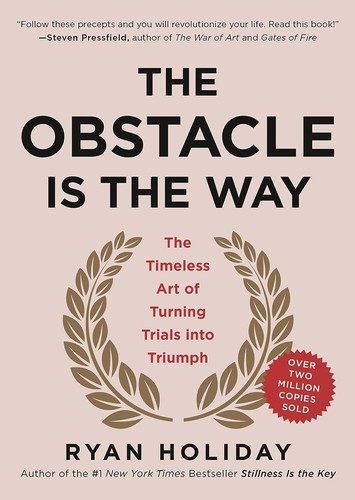
5. THE OBSTACLE IS THE WAY BY RYAN HOLIDAY
Ryan Holiday | ⭐ 4.6/5
Who it’s for: People who want a single coherent framework for turning obstacles into advantages, drawn from Stoic philosophy and historical examples.
“The impediment to action advances action. What stands in the way becomes the way.”
This is Holiday’s breakout book, and it’s better than his later ones because it’s more focused. The argument: every obstacle contains opportunity. The Stoics understood this. History demonstrates it. We have a choice in how we respond to obstacles, and that choice determines whether the obstacle defeats us or builds us.
Holiday uses historical examples — Roosevelt building his confidence after a childhood of illness, Edison’s failures leading to the lightbulb, Demosthenes using his speech impediment to become a better orator — to demonstrate that the pattern repeats. The obstacle forces adaptation. The adaptation creates strength. The strength creates capacity that wouldn’t have existed without the obstacle.
I found this book useful during the divorce. Not because it made the divorce okay, but because it gave me something to do with the anger. The obstacle is the way is not an argument that suffering is good. It’s an argument that we have agency inside suffering, and that agency is worth exercising.
My take: Holiday’s later books have more depth, but this one has more focus. Start here if you’re new to Stoicism.
6. START OVER, FINISH RICH BY DAVID BACH
David Bach | ⭐ 4.3/5
Who it’s for: People who have experienced financial setback and need both practical advice and motivational framework to recover.
“Financial freedom is available to those who learn and earn, not to those who just work and spend.”
I almost didn’t include this book because I want to be honest about the library period: I read everything. Not everything deserved the time. This book deserved the time. Bach’s specialty is financial resilience — the specific mechanics of recovery after financial setback. I didn’t lose everything. But I was close enough to understand why someone who had would need a roadmap.
The lat factor concept — automatic lattes as the symbol of small recurring expenses that compound — is reductive and also useful. Bach gets criticized for being preachy. He’s preachy. He’s also right about the mechanics. The 9 Steps to Financial Fitness at the end of the book are more actionable than most financial advice I’ve seen.
My take: If your resilience challenge has a financial component, this is useful. If it doesn’t, skip it. Either way, the underlying principle — that recovery is a process, not an event — applies.
7. THE GAIN FROM REALITY BY MARK MANSON
Mark Manson | ⭐ 4.5/5
Who it’s for: People who are tired of positive thinking and want a more honest, grounding approach to dealing with difficulty.
“We suffer not from the events in our lives but from our judgment about them.”
Manson gets dismissed as the self-help guy for people who think they’re too smart for self-help. That’s unfair. The Subtle Art is more honest than most self-help because Manson is explicit about what he doesn’t know and about the limits of his advice. The core argument: we can’t care about everything equally. The value is in choosing what to care about, and the best choices are usually the ones that involve accepting some measure of discomfort.
What I found useful: the Manson doesn’t sugarcoat. He doesn’t promise a system that works without cost. The book’s basic move is substituting better problems for worse ones, which sounds cynical and is actually practical. You will always have problems. Choose the ones worth having.
My take: Manson’s other book (Everything is F*cked) is darker but sometimes more useful. This one is more accessible. Both are worth reading.
8. THE HARD THING ABOUT HARD THINGS BY BEN HOROWITZ
Ben Horowitz | ⭐ 4.7/5
Who it’s for: People building or leading organizations who need to understand that leadership involves managing through impossible situations, not around them.
“When you are building a company, you have to run it when it is failing as well as when it is succeeding.”
Horowitz is a venture capitalist who co-founded Loudcloud and Opsware, both of which he nearly lost. This book is about the things he learned from those near-failures: how to make hard decisions, how to lead when the situation is genuinely difficult, how to tell the truth to yourself and others when things aren’t working.
The reason I’m including a business book in a resilience list: the skills are transferable. The hard thing about hard things isn’t the strategy. It’s the management of your own psychology while you’re in the hard thing. Horowitz is honest about the psychological toll in a way most business authors aren’t.
The wartime peacetime leadership distinction — the idea that peacetime leadership and wartime leadership require different skills and different temperaments — has been useful to me in thinking about my own periods of crisis and stability.
My take: This is a business book but it’s really a book about resilience under pressure. If you’ve never run a company, the lessons still apply to the company you are running: yourself.
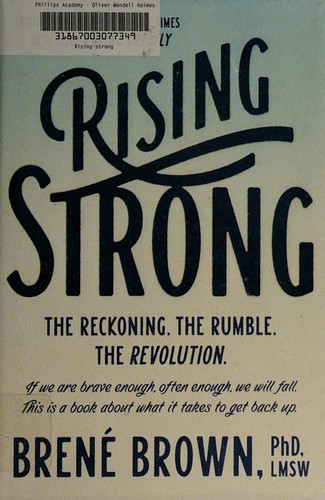
9. RISING STRONG BY BRENE BROWN
Brené Brown | ⭐ 4.8/5
Who it’s for: People who have fallen and want to understand the process of getting back up, including the reckoning with emotion that most resilience advice skips.
“Owning our story can be hard but not nearly as difficult as spending our lives running from it.”
Brown’s work on shame and vulnerability has become widely known, and this book applies those concepts specifically to resilience. The argument: the reckoning, the rumble, and the revolution are the three phases of rising strong. You have to feel the feelings before you can process them. You have to get honest about the story you’re telling yourself about what happened. You have to let that analysis change how you operate.
What I appreciate about Brown is that she doesn’t promise a shortcut. Rising strong isn’t about bouncing back. It’s about integrating the fall into the story, which is a slower and more honest process. I found the rumble section — the part where you examine the story you’re telling — the most useful. Sometimes the story is true. Sometimes the story is a protection. Sometimes it’s both.
My take: If you’ve read Brown’s other work and found it useful, this is the application of it to the specific problem of failure. If you haven’t read her other work, this stands alone.
10. ENDURED: BUILD THE RESILIENCE, HEART, AND MIND OF AN ELITE ATHLETE BY CAMERON “CAM” HEKE
Cameron Heke | ⭐ 4.4/5
Who it’s for: People who want a clear, practical, non-mystical approach to building resilience and who appreciate direct, actionable frameworks.
“The mind is the athlete. The body is just the vehicle.”
This is one of the few books on this list I came to second-hand — a friend who was training for an ultra-marathon recommended it, and I found more in it than I expected. Andersen’s research on the psychology of endurance — what makes some people able to push through when others quit — has applications beyond athletics.
The key insight: the brain decides to quit before the body does. The body’s capacity is usually greater than the mind’s willingness to access it. The training, then, is partly physical and partly psychological: learning to distinguish between the sensation of danger and the sensation of discomfort, and being able to push through the latter without triggering the former.
This maps onto life resilience more directly than you’d think. A lot of what feels like hitting a wall isn’t the actual wall. It’s the signal before the wall, which the brain interprets as danger and uses as a reason to stop.
My take: The research here is solid even when the writing is dry. If you’ve ever wondered why you quit before you actually had to, this book will help you understand the mechanics.
FREQUENTLY ASKED QUESTIONS
IS RESILIENCE SOMETHING YOU’RE BORN WITH OR CAN YOU BUILD IT?
Both, and the evidence suggests that genetics plays a smaller role than people assume. Resilience is more accurately understood as a set of skills — emotional regulation, perspective-taking, problem-solving, social support — that can be developed. The people who seem innately resilient usually developed those skills through early experiences that taught them that difficulty could be survived. That learning is available to anyone willing to do the work.
HOW DO I STOP FEELING LIKE EVERYTHING IS FALLING APART?
You don’t, entirely. But you can change your relationship to the feeling. The books on this list aren’t magic. They don’t make the circumstances go away. What they do is give you a framework for locating yourself inside the problem, which changes the relationship from “the world is happening to me” to “I am inside something I need to navigate.” That shift in relationship is the difference between being flattened by difficulty and moving through it.
WHAT IF I’VE BEEN THROUGH TOO MUCH TO BOUNCE BACK?
The idea of “bouncing back” is misleading. You don’t go back to where you were. You go forward to somewhere new, which incorporates what you’ve been through. The growth perspective isn’t about recovering to a previous state — it’s about integrating the experience into a more complex, more capable version of yourself. People who have been through significant difficulty and done the psychological work often end up more resilient than people who haven’t — not because the difficulty was good, but because they built from it.
DOES READING BOOKS ACTUALLY HELP WITH RESILIENCE?
Reading creates cognitive frameworks that you can access when you’re in difficulty. The books on this list aren’t substitutes for therapy, medication, or other forms of professional support when those are needed. But they can provide something professional support sometimes doesn’t: a framework for understanding your own experience and evidence that others have been through similar things and come out the other side. The knowledge that you’re not the first person to face this, and that others have survived it, is itself a resilience resource.
WHAT’S THE DIFFERENCE BETWEEN RESILIENCE AND JUST BEING STUBBORN?
Resilience involves accurate assessment of the situation and adaptation to it. Stubbornness can be refusal to adapt when adaptation is needed. The line between them is sometimes unclear in the moment — people doing the hard work of genuine resilience often look stubborn from outside — but the internal experience is different. Resilience includes honest acknowledgment of what isn’t working. Stubbornness often includes denial. The books on this list will help you notice when you’re in one versus the other.
I DON’T HAVE TIME TO READ ALL OF THESE. WHERE SHOULD I START?
Start with Frankl’s “Man’s Search for Meaning” if you’re in acute difficulty. The length is short and the impact is immediate. If your difficulty is more ongoing — a period of rebuilding rather than a single blow — start with Clear’s “Atomic Habits.” If you’re specifically struggling with the story you’re telling yourself about what happened, read Brown’s “Rising Strong.” These aren’t the only useful books. They’re the most useful starting points.
WHAT IF THE RESILIENCE BOOKS FEEL LIKE THEY’RE BLAMING ME FOR MY SITUATION?
This is a fair criticism of some resilience literature. The books on this list are not arguing that you can think your way out of any circumstance or that positive thinking is a substitute for material change. Frankl was in a concentration camp — he understood that some circumstances are genuinely beyond individual control. What he argued, and what the best books on this list agree with, is that we have agency in how we respond to circumstances, and that agency matters. If a book feels like it’s blaming you for your difficulty, set it down and try another one. Not every book is for every person.
THE BOTTOM LINE
Here’s what I’ve learned from the library period, from the six months of reading everything I could find about starting over: the books don’t fix you. Nothing fixes you, not permanently, because you’re not a thing that gets fixed. You’re a person, which means you’re ongoing, which means you’ll hit walls again, probably soon, probably when you least expect it.
What the books on this list gave me was a toolkit for hitting the wall and getting up again. Frankl gave me meaning. Clear gave me systems. Dweck gave me a framework for understanding how belief about ability shapes actual ability. Brown gave me permission to feel things fully before I had to understand them. The combination of these things didn’t make me resilient. It made me someone who could build resilience when I needed it, which is different.
If I had to pick three: “Man’s Search for Meaning” because Frankl understood something true about the human condition that most of us figure out too late. “Atomic Habits” because sustainable change comes from systems, not goals. “Rising Strong” because the fall is part of the story, not an interruption to it.
The question isn’t whether you’ll face difficulty. The question is whether you’ll have something to reach for when you do. These books are what I reached for. Maybe they’ll work for you too.
Which book are you starting with?
Disclosure: This post contains affiliate links. If you purchase through these links, ReadPlug may earn a small commission at no extra cost to you. We only recommend books we’ve personally found valuable.