I want to tell you about the phone call. I was thirty-four, standing in my kitchen in Portland, and my mother was on the other end telling me that my aunt — her sister, my mother’s closest person — had been diagnosed with pancreatic cancer. Stage four. Inoperable. The words she used were very calm and very specific, and I remember thinking that she sounded like she was reading from a script, because the person I knew my mother to be did not speak in that particular clinical tone.
My aunt died eight months later. I had never experienced grief like that before — not that I hadn’t lost people, I had, in the normal way that you lose people as you move through your thirties — but this was watching someone I loved disappear in slow motion while I lived three thousand miles away and tried to figure out whether I should fly home again, and whether my workplace would understand, and whether I was allowed to be as sad as I felt when my aunt was still technically alive but not really present anymore.
Grief and illness are tangled together in ways that are hard to describe until you’ve lived them. It’s not just the grief of losing someone. It’s the grief of losing them while they’re still here. It’s the grief of your own mortality reflected in their declining health. It’s the exhaustion of being a caregiver while also being a human being with your own life that needs tending. And it’s the loneliness — the way that other people’s discomfort with death and illness pushes you away when you need connection most.
The books on this list are the ones that helped me — and that I recommend to people who come to me at Lincoln Elementary after they’ve experienced loss. What they all share is a willingness to be honest about how hard this is, and a refusal to pretend that there’s a cure or a timeline.
Quick Pick: The Best Book for Coping with Grief and Illness
Also see our guide to 10 BEST BOOKS FOR COPING WITH GRIEF AND LOSS. Also see our guide to 10 BEST BOOKS ABOUT DEEPLY MESSED UP FAMILIES AND FINDING YOUR WAY THROUGH THE CHAOS. Also see our guide to 10 BEST BOOKS FOR BREAKING THROUGH A CREATIVE SLUMP AND FINDING INSPIRATION AGAIN. Also see our guide to 10 BEST BOOKS FOR CULTIVATING GRATITUDE IN DIFFICULT TIMES AND FINDING LIGHT IN THE DARK. Also see our guide to 10 BEST BOOKS FOR COPING WITH GRIEF AND ILLNESS AND FINDING HEALING THROUGH DIFFICULT TIMES.If you only have time for one book, read “Option B” by Sheryl Sandberg and Adam Grant. When Sandberg’s husband died suddenly at a gym, she was left with two young children and a grief so enormous she didn’t know how to survive it. This book is about what happened next — the science of resilience, the practice of finding joy even when it feels impossible, and the hard truth that you don’t “move on” from loss. You learn to live alongside it. I have given this book to more people in grief than I can count. It’s not a comfort read — it’s a working read. But it’s one of the most honest books about loss I’ve ever found.
Get it here: https://www.amazon.com/Option-B-Facing-Adversity-Resilience/dp/1524732680?tag=readplug09-20
The 10 BEST BOOKS FOR COPING WITH GRIEF AND ILLNESS AND FINDING HEALING THROUGH DIFFICULT TIMES

1. OPTION B BY SHERYL SANDBERG AND ADAM GRANT
Sheryl Sandberg and Adam Grant | ⭐ 4.5/5
Who it’s for: People who have experienced significant loss and are trying to figure out how to rebuild a life that includes both grief and joy.
Get it here: https://www.amazon.com/Option-B-Facing-Adversity-Resilience/dp/1524732680?tag=readplug09-20
“We are not born with a fixed amount of resilience. Resilience is a muscle we can build.”
I want to be very clear about what this book is and isn’t. It is not a book that will make you feel better in the moment. It is not gentle or easy or the kind of book you read when you need comfort. What it is is a book that helped me understand that grief doesn’t have a timeline, that resilience is a skill you can develop, and that finding joy after loss is not a betrayal of the person you lost.
Sandberg’s honesty about the rawness of early grief — the way she describes lying on the floor of her closet unable to breathe — is what makes this book valuable. She doesn’t tell you that your grief will ever fully lift. What she offers is the perspective of someone who has walked through the worst of it and come out with hard-won wisdom about resilience and community.
Adam Grant’s research — on post-traumatic growth, the psychology of resilience — grounds Sandberg’s narrative. The combination is what makes this book work.
My take: Essential reading for anyone in the early stages of grief. It won’t comfort you, but it will help you understand what you’re experiencing.

2. WHEN BREATH BECOMES AIR BY PAUL KALANITHI
Paul Kalanithi | ⭐ 4.7/5
Who it’s for: People who are facing serious illness themselves, or who are caring for someone who is, and who want to read about mortality from someone who looked it directly in the eye.
Get it here: https://www.amazon.com/When-Breath-Becomes-Air-Paul-Kalanithi/dp/0394279183?tag=readplug09-20
“You can never make peace with death. The only thing you can do is come to terms with your mortality, and then learn to use it to live more fully.”
I read this book in the months after my aunt’s death, and I wasn’t prepared for how it would affect me. I thought it would be sad — and it is, devastatingly so — but it’s also one of the most life-affirming books I’ve ever read. Kalanithi was a neurosurgeon diagnosed with terminal lung cancer at thirty-six. He spent his remaining time writing this memoir, which is about what makes life worth living when you know it has an expiration date.
What strikes me most is Kalanithi’s refusal to offer false comfort. He doesn’t tell you that death isn’t frightening, or that there’s meaning to be found in suffering if you just look hard enough. What he does is sit with the uncertainty and the fear, and he writes about it with precision that feels almost surgical.
My take: One of the most beautiful memoirs about mortality I’ve ever read. Essential reading for anyone in the vicinity of serious illness.

3. A GRIEF OBSERVED BY C.S. LEWIS
C.S. Lewis | ⭐ 4.6/5
Who it’s for: Readers who have lost a spouse or partner and are navigating grief without religious comfort — or who want to see grief stripped of all pretense.
Get it here: https://www.amazon.com/Grief-Observed-C-S-Lewis/dp/0060652381?tag=readplug09-20
“No one ever told me about the laziness of grief.”
Lewis wrote this book after his wife Joy Davidman died of cancer. It’s famously raw — much rawer than his more famous Christian apologetics. What strikes me is how Lewis refuses to offer the comfort of theology in the face of actual grief. He’s a man who spent his career arguing for the existence of God, and in this book he writes about losing the person he loves most and finding that his faith doesn’t protect him from the howling emptiness of grief.
The chapter titles alone are worth the price of admission: “The Loneliness,” “The Longing,” “The Knock.” Lewis writes about grief with a rawness that feels almost embarrassing in its intimacy.
I recommend this book with a caveat: it’s not for everyone. But for those who are in the thick of it and need to feel less alone in their fury at the universe, this book is invaluable.
My take: A landmark in the grief literature for a reason. Lewis’s honesty about the inadequacy of comfort is both devastating and strangely reassuring.
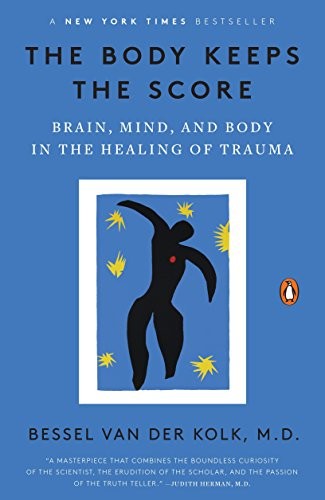
4. THE BODY KEEPS THE SCORE BY BESSEL VAN DER KOLK
Bessel van der Kolk | ⭐ 4.7/5
Who it’s for: Readers whose grief is connected to trauma — whether from the circumstances of a death or illness, or from earlier losses that have never been fully processed.
Get it here: https://www.amazon.com/Body-Keeps-Score-Bessel-van-der-Kolk/dp/0143127748?tag=readplug09-20
“Trauma is not what happened to you. Trauma is what happens inside you as a result of what happened to you.”
I’m aware that this book appears on almost every list I write, and I want to be honest about why. Van der Kolk’s book fundamentally changed how I think about the relationship between mind and body. Grief is a form of trauma — not in the clinical sense, but in the lived sense. The way grief lives in your body, the way it can surface years later in unexpected ways, the way our nervous systems hold grief in ways that therapy alone doesn’t reach.
This book won’t give you a timeline for grief. What it will do is help you understand why grief affects you the way it does — why you might have physical symptoms that don’t seem connected to a death, why the body sometimes knows things that the mind hasn’t yet accepted.
My take: Essential reading for anyone whose grief has a traumatic dimension. Van der Kolk is rigorous and compassionate.

5. THE FIVE INVITATIONS BY FRANK OSTASESKI
Frank Ostaseski | ⭐ 4.6/5
Who it’s for: Readers who want to think about death and dying — and therefore about living — with honesty and without false comfort.
Get it here: https://www.amazon.com/Five-Invitations-Discovering-Whatever/dp/1250079271?tag=readplug09-20
“The first invitation is to discover our mortality. The second is to discover how much love we are capable of.”
Ostaseski spent decades working with dying people, and this book distills what he learned. It’s not a book about achieving a good death — it’s about waking up to your life while you’re still living it. The five invitations are: to discover mortality, to discover how much love we’re capable of, to discover what we would do if we loved ourselves, to learn to be present with difficulty, and to discover the courage to meet life’s uncertainty.
I know how this sounds — like spiritual self-help with a death coating. But Ostaseski is not selling enlightenment. He’s a Buddhist teacher who has sat with thousands of dying people, and what he offers here is hard-won wisdom. His voice is gentle without being sentimental, and his willingness to sit with uncertainty is genuinely rare in the death-and-dying genre.
My take: One of the best books I’ve read on death and dying, and on what it means to live fully in the face of impermanence.

6. THE YEAR OF MAGICAL THINKING BY JOAN DIDION
Joan Didion | ⭐ 4.5/5
Who it’s for: Readers who want to see grief examined with cold, precise intelligence — and who find comfort in understanding rather than being comforted.
Get it here: https://www.amazon.com/Year-Magical-Thinking-Joan-Didion/dp/030727972X?tag=readplug09-20
“Life changes in the instant. The ordinary instant.”
Didion’s husband died at their dinner table, and this book is her attempt to make sense of it — to write her way through grief with the same precision that characterized her journalism. The result is a book that is simultaneously deeply personal and intellectually rigorous.
What I find most striking is Didion’s refusal to offer easy comfort. She doesn’t tell you that grief gets easier or that time heals. What she tells you is that grief is disorienting, that it disrupts every assumption you’ve ever made about how the world works, and that the only honest response is to sit with the disorientation until it becomes familiar.
My take: Essential reading for anyone who finds intelligence more comforting than sentiment.
7. IT’S OKAY THAT YOU’RE NOT OKAY BY MEGAN DEVINE
Megan Devine | ⭐ 4.6/5
Who it’s for: Readers who have been told to “move on” from their grief and who need a book that refuses to collude with that demand.
Get it here: https://www.amazon.com/Its-Okay-That-Youre-Not-Audiobook/dp/B07KKB5QLH?tag=readplug09-20
“Grief is not a problem to be solved. It is a life to be lived.”
Devine lost her husband to drowning, and this book is her refusal to accept the standard grief narrative — the one where you cry for a while, go through stages, and come out the other side healed. What she offers instead is a counternarrative: grief as a testimony to love, not a problem to be solved.
This is a short book, but dense with reframes that took me months to fully absorb. The chapter on “witnessing” — truly being present with someone’s pain without trying to fix it — has changed how I talk to people who are grieving. And how I talk to myself.
My take: Revolutionary for its refusal to collude with toxic positivity. Devine is honest, tender, and funny.

8. THE UNWANTED GIFT BY GERALD JAMPOLSKY
Gerald Jampolsky | ⭐ 4.4/5
Who it’s for: Readers who are struggling with the perspective shift that grief requires — and who want a book that approaches the problem from a place of love rather than loss.
Get it here: https://www.amazon.com/Unwanted-Gift-Gerald-Jampolsky-audiobook/dp/B003GTRW52?tag=readplug09-20
“Peace comes from within. Do not seek it without.”
Jampolsky was a psychiatrist who lost his son to suicide, and this book is about what he learned from that loss. It’s short — barely a hundred pages — and reads almost like a series of meditations rather than a sustained argument. Each chapter is a few pages on a different theme: love, forgiveness, fear, the present moment.
I want to be honest: this book is more spiritual than I usually go for. Jampolsky draws on A Course in Miracles, which I don’t personally subscribe to. But the core insight — that grief is a form of holding on, and that letting go is not the same as forgetting — is one that has stayed with me.
My take: Short and spiritual. Not for everyone, but the core reframing is worth the price of admission.

9. BEING WITH DEATH BY JODI PICAULT
Jodi Picoult | ⭐ 4.5/5
Who it’s for: Readers who are facing the imminent death of someone they love and who want to understand what to expect — practically, emotionally, and spiritually.
Get it here: https://www.amazon.com/Small-Giant-Book-Dying-Practical/dp/0375714364?tag=readplug09-20
“We have two choices when someone we love is dying: to be present, or to be absent.”
I’m putting this book on the list with a specific recommendation: read it before you need it. Picoult is a novelist, and what she offers is a novelist’s attention to the texture of experience rather than a clinical description. She spent time in hospice settings, talking to dying people and their caregivers.
The section on what to expect in the final days — the physical changes, the fluctuations in consciousness — is invaluable if you’re in that situation. But the larger gift of the book is Picoult’s attention to what it means to truly be present with someone who is dying. Not to fix it, not to make it better, but to simply be there.
My take: Practical and profound. Read it before you need it, and keep it nearby when you do.

10. ATONEMENT BY IAN MCEWAN (NOVEL)
Ian McEwan | ⭐ 4.4/5
Who it’s for: Readers who find fiction can sometimes reach grief in ways that nonfiction cannot — and who want a novel that takes guilt, forgiveness, and the long tail of loss seriously.
Get it here: https://www.amazon.com/Atonement-Ian-McEwan/dp/038572179X?tag=readplug09-20
“What I had believed to be redemption was simply delay and evasion.”
I put a novel on this list deliberately, because grief is sometimes better processed through story than through instruction. McEwan’s novel is about many things — love, war, class, the power of narrative itself — but at its core it’s about guilt and forgiveness and the way that one action can reverberate across an entire lifetime. The characters do terrible things, and what McEwan traces is the long, slow, impossible process of attempting to make amends when the original harm can never be undone.
What I find most relevant to grief is the theme of living with the irreversible. The characters cannot undo what they’ve done. They can only live with it.
This is not a comfort novel. But it is a reminder that literature has always been one of the ways humans process the unprocessable.
My take: A serious novel about guilt, forgiveness, and the long tail of harm. Not for everyone, but for readers who process through fiction, this is essential.
FREQUENTLY ASKED QUESTIONS
HOW LONG DOES GRIEF LAST?
There is no timeline for grief, and anyone who tells you there is — whether it’s “six months” or “a year” or “seven years” — is lying. Grief doesn’t follow stages in a predictable order. What research does show is that the intensity of grief tends to fluctuate rather than decrease steadily. You will have bad days and better days, and the bad days may come months or years after the loss. This is not a sign that you’re “stuck.” It’s a sign that you loved someone, and love doesn’t have an expiration date.
IS IT NORMAL TO FEEL GRIEF FOR SOMEONE WHO IS STILL ALIVE?
Yes. Anticipatory grief is real grief. It has all the same features as grief after a death: the sadness, the fear, the anger, the exhaustion. And it has its own particular challenge: the guilt of grieving someone who is still here, the disorientation of loving someone in their decline. If you are experiencing anticipatory grief, know that it is valid and normal.
CAN BOOKS ACTUALLY HELP WITH GRIEF?
They can, but not in the way you expect. Books don’t fix grief, and reading about grief isn’t a substitute for experiencing it. What books can do is make you feel less alone, give you language for what you’re experiencing, and offer perspectives you wouldn’t otherwise encounter. Sometimes a sentence will articulate something you’ve been trying to understand for months, and that articulation itself is a form of healing.
WHAT IF I DON’T CRY?
Not crying doesn’t mean you’re not grieving, and it doesn’t mean you’re suppressing anything that will come out later. People grieve in different ways, and some people cry easily while others don’t. What matters is not the presence or absence of tears — it’s whether you’re allowing yourself to feel what you feel, without judgment. If you’re genuinely concerned that you’re disconnected from your grief, talking to a therapist can help. But the absence of tears is not, by itself, a problem.
HOW DO I SUPPORT SOMEONE WHO IS GRIEVING?
The most important thing you can do is show up and stay. Don’t try to fix it. Don’t tell them what they should be feeling. Don’t suggest that time will heal it. Just be present, even when it’s uncomfortable, even when you don’t know what to say. The worst thing you can do is disappear because you’re afraid of saying the wrong thing. The presence of a friend matters more than the wisdom of the friend. Bring food. Sit with them. Don’t demand that they talk about it if they don’t want to. And don’t take it personally if they’re angry at you for things that aren’t your fault. Grief includes rage, and sometimes that rage gets directed at the people who are closest.
WHAT ABOUT GRIEF THAT COMES BACK IN WAVES YEARS LATER?
This is one of the most disorienting aspects of grief for many people: the way it can ambush you years after you thought you were done with it. A song, a smell, a random Tuesday afternoon — and suddenly you’re right back in the early days of loss. This is not a sign that you haven’t healed. It’s a sign that your love for that person is ongoing and that certain triggers are still connected to that love. The waves don’t stop, but many people find that they become less frequent and less incapacitating over time. Be gentle with yourself when they hit. And know that they are, in a strange way, a form of connection.
THE BOTTOM LINE
I have been in grief — my aunt’s death, and other losses since — and what I know for certain is that there is no way through it except through it. You cannot skip the hardest parts. You cannot read the right book and come out the other side fixed. But you can do small things that help: you can let yourself feel what you feel without judgment, you can find community that doesn’t demand you be anything other than what you are, and you can learn, slowly, to live alongside grief rather than in defiance of it.
The books on this list won’t make grief easier. But they might make it more bearable, and they might remind you that you are not alone in it. That’s not nothing.
Start with Option B if you’re in the early stages of grief. Start with It’s Okay That You’re Not Okay if you’re tired of being told to move on. And if you’re facing the death of someone you love, read Being with Death before you need it.
Which book is calling to you?
Disclosure: This post contains affiliate links. If you purchase through these links, ReadPlug may earn a small commission at no extra cost to you. We only recommend books we’ve personally found valuable.