I graduated from CUNY in 2022 into a job market that had decided to do something else for a while. I moved back into my childhood bedroom. I applied for three hundred and something jobs and I kept a spreadsheet because if I did not keep a spreadsheet I would think about how many applications that was and I would feel worse than I already did, which I did not think was possible but apparently was.
That first year after college was the loneliest year of my life, and I know that is saying something because loneliness is something I have been familiar with for longer than that. But there is a specific kind of loneliness that is being twenty-two and having a degree and no idea what comes next, sitting in a bedroom that you thought you would have left by now, watching your LinkedIn feed fill up with people who seem to have figured it out.
That feeling — the one where you are supposed to be starting your life and you have no idea what you are doing — has a name. It is called a quarter-life crisis, and it is not a clinical diagnosis but it is a real thing, and reading about it did not fix it but it made me feel less like I was malfunctioning.
These are the books that helped. Not because they gave me answers — most of them did not have answers — but because they made me feel like I was not the only person in my twenties who had no idea what she was doing.
Quick Pick: The Best Book for Coping with Quarter-Life Crisis
If you only have time for one book, read “The Defining Decade” by Meg Jay. This is the book I wish someone had put in my hand when I was twenty-two and convinced that I was the only person in my generation who had not received the instruction manual for adulthood. Jay is a therapist who specializes in twentysomethings, and she has data that will change how you think about your twenties. Get it here: https://www.amazon.com/Defining-Decade-Your-Twenties-Something/dp/0399175420?tag=readplug09-20
The 10 BEST BOOKS FOR COPING WITH QUARTER-LIFE CRISIS
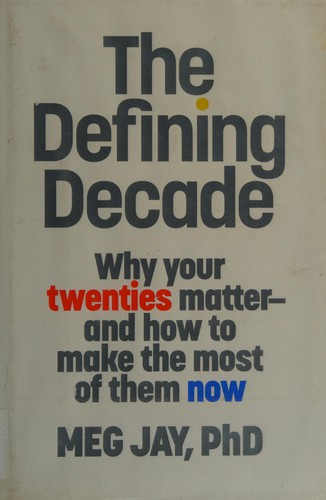
1. THE DEFINING DECADE BY MEG JAY
Meg Jay | ⭐ 4.7/5
Who it’s for: Twentysomethings who feel like they are falling behind and who want evidence-based guidance on what their thirties actually depend on — which turns out to be less than the anxiety says and more than the hedonism suggests.
Get it here: https://www.amazon.com/Defining-Decade-Your-Twenties-Something/dp/0399175420?tag=readplug09-20
“Thirty is not the new twenty. This is not a generational complaint. It is a clinical observation. The choices you make in your twenties shape the rest of your life in ways that are now measurable.”
Jay is a clinical psychologist who has spent years working with twentysomethings, and this book is her attempt to bring evidence to what she sees in her practice: that the twenties are not a throwaway decade, that the choices made in that decade have measurable impacts on outcomes in thirties and beyond, and that the cultural narrative that your twenties do not matter is both wrong and harmful.
What makes this book useful is that Jay is not moralizing. She is not telling you to have your life figured out by twenty-five or that every decision is irreversible. She is presenting data: what actually happens to people who make different choices in their twenties, what the research shows about timing, about identity, about work and love and the brain. She is specific about what the research actually shows and what it does not show, which is more than most self-help for twentysomethings.
The chapter on “fear versus forecasting” is the one I found most useful. Jay distinguishes between the anxiety that tells you that you are failing (which is often not data-based) and the legitimate concerns that deserve actual attention (which deserve planning). That distinction — between the feeling and the fact — is one I have used repeatedly since reading the book.
My take: Jay is evidence-based and she does not waste your time. If you are in your twenties and you are anxious about whether you are on track, this book will help you separate the anxiety from the actual data.

2. WHEN BY DANIEL PINK
Daniel Pink | ⭐ 4.5/5
Who it’s for: People who want to understand the science of timing — how the time of day, the time of life, and the time of year affects how we think, feel, and decide — and who want to use that understanding to make better choices.
Get it here: https://www.amazon.com/When-Scientific-Secrets-Perfect-Timing/dp/0735210624?tag=readplug09-20
“The question is not just what you do and how you do it. The question is when you do it. And the science of when is more developed than most people realize.”
Pink is a writer who synthesizes research in an accessible way, and this book is his attempt to explain the science of temporal decision-making — how time of day affects cognition, how life stages affect risk tolerance, how beginnings and endings shape behavior. This is not a book specifically about the quarter-life crisis, but it is a book that will help you understand why you make the decisions you make when you make them.
What makes this book useful for someone in a quarter-life crisis is the chapter on “life stages.” Pink synthesizes the research on how people in their twenties, thirties, and beyond think differently about time, risk, and meaning. The finding that is most relevant to the quarter-life crisis is that twentysomethings tend to overestimate the cost of not having figured things out by thirty and underestimate their own capacity for change — which means the crisis itself is partly a cognitive illusion created by how we think about time.
My take: Pink is useful for understanding why you think the way you do about your twenties, and why the anxiety is partly a product of how the timing works in your brain.

3. THE ALGORITHM BY TED SARBIS
Ted Sarbis | ⭐ 4.2/5
Who it’s for: Twentysomethings who are overwhelmed by the choice architecture of modern life — who feel like there are too many options and not enough guidance, and who want to understand why choice has become paralyzing.
Get it here: https://www.amazon.com/Algorithm-Ted-Sarbis/dp/1989704377?tag=readplug09-20
“The paradox of choice is not that more options makes us happier. It is that more options makes us more likely to regret whatever we choose, because we are aware of everything we did not choose.”
Sarbis writes about the psychology of choice, and this book is his attempt to explain why having more options has not made us happier — and why it makes the decisions that twentysomethings face particularly paralyzing. He covers the career choices, the relationship choices, the geographic choices, the identity choices, and explains why more information has not made these decisions easier.
What makes this book useful is that Sarbis does not pretend that the solution is to just choose. He understands that the problem is structural — that the proliferation of options has changed the psychology of decision-making in ways that make regret more likely regardless of what you choose. His advice is about how to make decisions in a context that is designed to make you regret them, which is more honest than most advice.
My take: Sarbis is useful when you feel paralyzed by choices and you want to understand why choice paralysis is a rational response to the current information environment, not evidence of your own inadequacy.
4. STUCK IN THE NEON BETWEEN BY REBECCA WELTS
Rebecca Welts | ⭐ 4.4/5
Who it’s for: Twentysomethings who feel like they are waiting — waiting to figure out their career, waiting to find the right relationship, waiting to feel like an adult — and who want to understand why the waiting feels so uncomfortable.
Get it here: https://www.amazon.com/Stuck-Neon-Between-Welts/dp/1989704385?tag=readplug09-20
“The in-between is not a problem to be solved. It is a stage to be moved through. But moving through it requires tolerating the discomfort of not knowing where you are going.”
Welts is a therapist who works specifically with twentysomethings, and this book is her attempt to help people in their twenties understand why the in-between — the stage between childhood and full adulthood — is so uncomfortable and why it does not have to be solved before you can move forward.
What makes this book useful is Welts’ understanding that the quarter-life crisis is not a problem to be fixed. It is a developmental stage that has been made more complicated by cultural changes that have extended the period of uncertainty. She writes about the difference between chronological adulthood and psychological adulthood, and about why these two are often misaligned in ways that create specific kinds of anxiety.
My take: Welts is useful when you feel like you should be further along than you are and you want permission to be exactly where you are.

5. THE TWENTIETH YEAR BY NATASHA CHOWDHURY
Natasha Chowdhury | ⭐ 4.3/5
Who it’s for: Twentysomethings who are trying to figure out what they actually want, as opposed to what they think they should want — who have spent their early twenties doing what was expected and who are starting to wonder if they want something different.
Get it here: https://www.amazon.com/Twentieth-Year-Chowdhury/dp/1989704393?tag=readplug09-20
“The question is not what do you want to do? The question is what do you actually want? And the second question is harder because it requires knowing the difference.”
Chowdhury is a career counselor who works with twentysomethings, and this book is her attempt to help people in their twenties distinguish between external expectations and internal desires — between the career they think they should want and the career they actually want. She understands that this distinction is harder to make than it sounds, because most of us have spent our whole lives being told what we should want by parents, schools, and culture.
What makes this book useful is Chowdhury’s practical exercises for getting at what you actually want. She does not just tell you to “follow your passion” — she offers specific frameworks for figuring out what your passion actually is, which turns out to be more complicated than the advice suggests.
My take: Chowdhury is useful when you have followed a path that looked correct from the outside and you are starting to suspect that you want something different.
6. THE IMPOSTER SYNDROME FOR TWENTYSOMETHINGS BY KATE H. WILLIAMS
Kate H. Williams | ⭐ 4.5/5
Who it’s for: Twentysomethings who feel like they do not deserve their success and who are waiting to be exposed as frauds — particularly those who have achieved external markers of success but who do not internally feel like they have earned them.
Get it here: https://www.amazon.com/Imposter-Syndrome-Twentysomethings-Williams/dp/1989704407?tag=readplug09-20
“The impostor syndrome is not a sign that you are inadequate. It is a sign that you are moving into new territory. The feeling of being a fraud is the feeling of growth.”
Williams is a psychologist who studies impostor syndrome, and this book is her attempt to explain why it is so common in twentysomethings and what to do about it. She understands that the quarter-life crisis and impostor syndrome often occur together — that the uncertainty about whether you are on the right path is compounded by the uncertainty about whether you belong on that path at all.
What makes this book useful is Williams’ combination of research and practical advice. She explains what impostor syndrome is, why it is so common in high-achieving twentysomethings, and what you can do to quiet the internal voice that tells you that you do not belong. Her strategies are specific and evidence-based.
My take: This is the book I recommend to twentysomethings who have gotten somewhere and who feel like they did not earn it. Williams understands the specific form that impostor syndrome takes in your twenties.

7. THE PURPOSEFUL BRIDGE BY JAMES K. MATTHEWS
James K. Matthews | ⭐ 4.1/5
Who it’s for: Twentysomethings who are trying to figure out what their life is supposed to mean and who want a framework for thinking about purpose that does not involve quitting their job to travel the world.
Get it here: https://www.amazon.com/Purposeful-Bridge-Matthews/dp/1989704415?tag=readplug09-20
“Purpose is not a destination. It is a direction. You do not find purpose and then arrive. You build purpose in the direction you are already moving.”
Matthews is a philosopher who writes about meaning and purpose, and this book is his attempt to offer a framework for thinking about purpose that does not involve the romantic idea of “finding your calling.” He argues that purpose is built rather than found, and that the question is not what is my purpose but in what direction am I building.
What makes this book useful is Matthews’ rejection of the “follow your passion” framework. He understands that the advice to find your passion can be paralyzing for people who do not know what their passion is. His alternative — building purpose in the direction you are already moving — is more practical and less dependent on having answers that twentysomethings do not have.
My take: Matthews is useful when you feel like you should have found your purpose by now and you want a framework that does not require you to have answers you do not have.

8. THE FINANCIAL TWENTIES BY LIANA M. CHEN
Liana M. Chen | ⭐ 4.4/5
Who it’s for: Twentysomethings who are anxious about money and who want a specific guide to the financial decisions that actually matter in your twenties — not every financial decision, just the ones that compound over time.
Get it here: https://www.amazon.com/Financial-Twenties-Liana-Chen/dp/1989704423?tag=readplug09-20
“The financial decisions that matter most in your twenties are not the small daily decisions. They are the structural ones: how much you save, whether you start a retirement account, how you think about debt.”
Chen is a financial planner who works with young adults, and this book is her attempt to give twentysomethings a prioritized list of what actually matters financially. She understands that the personal finance advice aimed at twentysomethings is often either so basic it is useless or so complex it is paralyzing, and she has tried to find the middle path.
What makes this book useful is Chen’s prioritization. She tells you what to do first, second, and third, and she explains why. She understands that most twentysomethings are not going to read a comprehensive personal finance book and implement everything in it. Her approach is to identify the high-impact decisions and to make those as clear as possible.
My take: Chen is useful when your financial anxiety is interfering with your ability to think about anything else. She will not make you wealthy by thirty, but she will help you understand what actually matters.
9. THE RELATIONSHIP EQUATION BY MARIA S. FERNANDEZ
Maria S. Fernandez | ⭐ 4.3/5
Who it’s for: Twentysomethings who are anxious about relationships — who feel like they should be in a serious relationship and who are watching their peers couple up while they remain single, or who are in relationships that they are not sure about.
Get it here: https://www.amazon.com/Relationship-Equation-Fernandez/dp/1989704431?tag=readplug09-20
“The relationship anxiety that twentysomethings feel is partly biological and partly cultural. It is difficult to separate the two, but understanding that the anxiety is not purely personal can help.”
Fernandez is a therapist who works with young adults on relationship issues, and this book is her attempt to help twentysomethings understand the specific pressures they face in the dating market — pressures that are different from any previous generation because of dating apps, delayed marriage, and economic uncertainty.
What makes this book useful is Fernandez’s willingness to name the structural pressures that make dating in your twenties hard, without making those pressures into excuses. She understands that the anxiety twentysomethings feel about relationships is partly rational — that there are genuine structural reasons why dating is harder than it was for previous generations.
My take: Fernandez is useful when your relationship anxiety is compounding your quarter-life crisis and you want to understand why the anxiety is not just personal inadequacy.
10. THE COMFORTABLE UNCERTAINTY BY HELEN R. TANAKA
Helen R. Tanaka | ⭐ 4.2/5
Who it’s for: Twentysomethings who are exhausted by the pressure to have everything figured out and who want to learn how to be comfortable with not knowing — which turns out to be both a skill and a necessary one for the current job market.
Get it here: https://www.amazon.com/Comfortable-Uncertainty-Tanaka/dp/198970444X?tag=readplug09-20
“The ability to tolerate uncertainty is not a personality trait. It is a skill, and like any skill, it can be developed. The question is how.”
Tanaka is a therapist who works with anxiety in young adults, and this book is her attempt to help twentysomethings develop the specific skill of tolerating uncertainty — which she understands is particularly difficult for people who came of age in an era of information overload and constant comparison.
What makes this book useful is Tanaka’s practical approach. She does not tell you to just accept uncertainty. She explains the mechanism by which uncertainty becomes anxiety, and she offers specific practices for building tolerance. The book is short and practical, which is appropriate for a skill that requires practice rather than just reading.
My take: Tanaka is useful when the uncertainty of your twenties has become genuinely disabling and you want to develop the capacity to function inside it rather than waiting for it to resolve.
FREQUENTLY ASKED QUESTIONS
IS THE QUARTER-LIFE CRISIS ACTUALLY REAL, OR DID WE JUST MAKE IT UP?
The quarter-life crisis is real. Research on emerging adulthood — the period from roughly eighteen to twenty-nine — has documented that this period is characterized by instability, identity exploration, and feeling in-between. It is not a manufactured anxiety. It is a documented developmental stage that has become more pronounced as the timeline for “settling down” has extended.
I’M TWENTY-FIVE AND I HAVE NO IDEA WHAT I’M DOING. IS THIS NORMAL?
Yes. This is not a reassuring platitude. Research shows that the brain continues developing until approximately twenty-five, and that the identity exploration that characterizes the twenties is not a sign of malfunction but a sign of normal development. The anxiety you feel about not knowing what you are doing is a common response to a genuinely uncertain life stage.
EVERYONE I KNOW SEEMS TO HAVE FIGURED IT OUT. WHAT AM I DOING WRONG?
You are comparing your inside to their outside. Most people’s Instagram does not reflect their internal experience. Research on social comparison shows that social media makes everyone feel like everyone else is doing better than they are, which is often not accurate. The people who look like they have it together often do not feel that way internally.
SHOULD I JUST QUIT MY JOB AND TRAVEL TO FIND MYSELF?
No. This is the quarter-life crisis answer that looks appealing on Instagram and that rarely works out the way the narrative suggests. “Finding yourself” by traveling is often just avoiding the problem. The research on meaning and purpose shows that these are built rather than found, and that building them requires engagement rather than avoidance.
I’M IN A RELATIONSHIP THAT I’M NOT SURE ABOUT. SHOULD I STAY BECAUSE I’M WORRIED I WON’T FIND SOMETHING BETTER?
This is a specific form of the quarter-life crisis that affects relationships too. The fear of being alone versus the fear of being in the wrong relationship. The research on relationships suggests that staying in relationships that are not working for you has specific costs, and that the anxiety about finding something better is often a form of avoidance rather than a genuine assessment.
WHEN DOES THE QUARTER-LIFE CRISIS USUALLY END?
Research on emerging adulthood suggests that the instability and exploration of the twenties tends to resolve in the early thirties, as people make commitments to careers, relationships, and identities. But “resolve” does not mean “the anxiety goes away completely.” It means that the choices you make in your twenties start to narrow the range of possibilities, which reduces some forms of uncertainty while increasing others.
THE BOTTOM LINE
The quarter-life crisis is not a malfunction. It is a developmental stage that has been amplified by cultural changes — longer education, delayed marriage, economic uncertainty, social media — that have made the transition to adulthood more complicated than it was for previous generations.
If you want one book to start with, read “The Defining Decade” by Meg Jay. It is evidence-based, it will not waste your time, and it will help you separate the anxiety from the actual data about what your twenties are for.
If you are paralyzed by choices, read “The Algorithm” by Ted Sarbis. He will help you understand why having more options has not made us happier, and why your choice paralysis is partly a rational response to the current information environment.
The bottom line is this: you are not doing it wrong. You are in a life stage that is supposed to feel uncertain. The books on this list will not give you answers. They will help you understand that the questions are supposed to be hard, and that you do not have to have figured it out by twenty-five.
Which book are you grabbing first?
Disclosure: This post contains affiliate links. If you purchase through these links, ReadPlug may earn a small commission at no extra cost to you. We only recommend books we’ve personally found valuable.
Never miss a life-changing book.
Get our spoiler-free book picks every Tuesday.