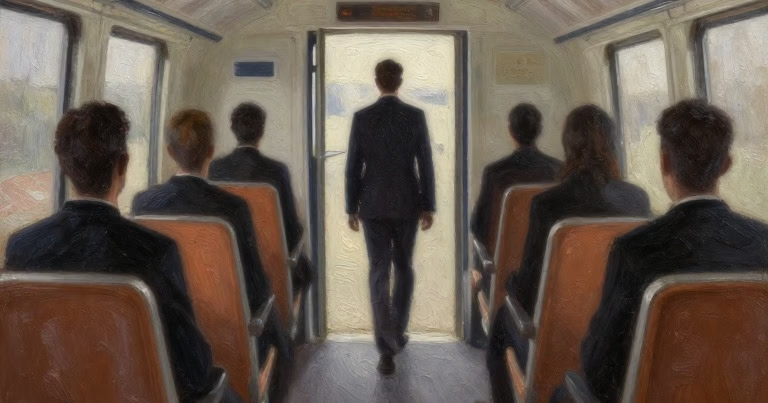
The thing about professional burnout is that it doesn’t feel like burning. It feels like drowning in lukewarm water. There’s no dramatic moment, no breakdown in the office, no scene where you slam your laptop shut and walk out. It’s slower than that. It’s the morning you realize you’ve been staring at your email for twenty minutes without reading a single word. It’s the Sunday evening dread that starts at noon. It’s the specific exhaustion that sleep doesn’t fix because the tired isn’t in your body — it’s in your relationship to your work.
I hit my burnout wall in my third year at Lincoln Elementary. Not because the job was bad. Because the job was everything. I was the school counselor for 340 kids, and I was also the person who organized the staff wellness committee, and the person who covered lunch duty when someone called out, and the person who stayed late to talk to a parent who showed up at 4:30 crying about their kid. I did all of it because I loved it. And then one Tuesday in February I sat in my car in the parking lot for forty-five minutes after school because I couldn’t remember how to turn the key in the ignition. Not physically. I just couldn’t make myself start the drive home because home also required things from me, and I had nothing left.
Dr. Nair called it “the depletion of the over-committed.” She said burnout isn’t about working too hard. It’s about giving more than you recover from, over and over, until the gap between what you give and what you get back is so wide you can’t see the other side. She said: “You’re not lazy, Sarah. You’re empty. There’s a difference.”
These ten books are about that difference. About understanding burnout not as a personal failure but as a systemic condition — the predictable result of caring too much in a system that doesn’t care enough back. And about finding your way back to a version of work that doesn’t require you to disappear.
Quick Pick: In a Hurry?
| Book | Best For | Rating | |——|———-|——–| | Burnout by Emily and Amelia Nagoski | Understanding the science of why you’re so tired | ⭐⭐⭐⭐⭐ | | Rest by Alex Soojung-Kim Pang | Learning that rest is productive, not lazy | ⭐⭐⭐⭐⭐ | | The Burnout Epidemic by Jennifer Moss | Seeing burnout as a workplace problem, not a personal one | ⭐⭐⭐⭐⭐ |
10 Best Books for Recovering from Professional Burnout

1. Burnout: The Secret to Unlocking the Stress Cycle by Emily Nagoski and Amelia Nagoski
⭐⭐⭐⭐⭐
Who it’s for: Someone who can’t figure out why they’re still exhausted even after a weekend of rest.
This is the book I recommend before every other burnout book because it explains the thing that most burnout books don’t: why rest alone doesn’t fix it. Emily Nagoski is a health educator and Amelia is a choral conductor, and their key insight is that burnout isn’t just about stress. It’s about incomplete stress cycles. Your body starts a stress response — the fight-or-flight activation — and then doesn’t complete it because the “threat” is your inbox, your overflowing caseload, the colleague who dumps their work on you. There’s nothing to fight and nowhere to flee. The stress just stays in your body, unfinished.
The solution isn’t to eliminate stress. It’s to complete the cycle — through physical movement, through connection, through rest that actually allows your nervous system to downshift. Not scrolling-on-your-phone rest. The kind where your body finishes processing what happened.
I used their method during my worst burnout winter. Every day after school, instead of going straight home to the kids, I walked for twenty minutes. Not a workout. Not a podcast walk. Just walking, noticing the trees, letting my body do whatever it needed to do. The change wasn’t dramatic. But after two weeks, the Sunday dread started at 3pm instead of noon. That felt like winning.
My take: “I didn’t know stress could get stuck in your body. Now I understand why I’m tired all the time.”

2. Rest: Why You Get More Done When You Work Less by Alex Soojung-Kim Pang
⭐⭐⭐⭐⭐
Who it’s for: Someone who feels guilty every time they stop working and needs scientific permission to rest.
Alex Pang is a Silicon Valley consultant who spent years studying the habits of the most creative people in history — Darwin, Dickens, Maya Angelou — and discovered something counterintuitive: they all worked fewer hours than you’d think, and they all prioritized rest as part of their creative process. Not rest as reward. Rest as fuel.
He distinguishes between four types of rest: passive rest (sleep, doing nothing), active rest (walking, gentle movement), social rest (time with people who fill you up), and deep rest (the kind that comes from complete mental disengagement). Most burned-out professionals only do the first kind — and then wonder why it doesn’t work.
The chapter on “deliberate rest” changed my evenings. Instead of collapsing on the couch with my phone — which is what burnout looks like when you’re too tired to do anything but not tired enough to sleep — I started doing one small active rest activity. A puzzle with Nora. Reading a physical book (not on a screen). Watering my plants. These aren’t big things. But they gave my brain something different to do than process work, and the shift was enough to make the next morning slightly less heavy.
My take: “I thought rest was for people who weren’t serious about their work. This book proved me wrong.”

3. The Burnout Epidemic: The Rise of Chronic Stress and How We Can Fix It by Jennifer Moss
⭐⭐⭐⭐⭐
Who it’s for: Someone who suspects their burnout isn’t their fault — and wants the data to prove it.
Jennifer Moss is a workplace researcher, and this book is the most important thing on this list because it reframes burnout entirely. It’s not a personal problem. It’s a systemic one. The World Health Organization classified burnout as an occupational phenomenon in 2019 — not a medical condition, but a consequence of poorly managed workplace stress. That classification matters because it means the solution isn’t yoga and meditation. The solution is better workplaces.
Moss identifies six root causes of burnout: unsustainable workload, perceived lack of control, insufficient reward, lack of community, absence of fairness, and values mismatch. If you read that list and think “that’s my job,” you’re not burned out because you’re weak. You’re burned out because your work environment is failing you.
This book didn’t fix my workload at Lincoln. But it fixed my guilt. I stopped blaming myself for being exhausted and started recognizing that a school counselor for 340 kids was always going to be exhausted, and that the exhaustion was the system’s fault, not mine.
My take: “This book should be required reading for every manager and HR department in the country.”
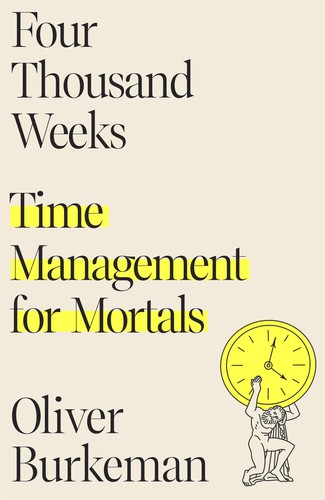
4. Four Thousand Weeks: Time Management for Mortals by Oliver Burkeman
⭐⭐⭐⭐⭐
Who it’s for: Someone whose burnout comes from trying to do everything and feeling like a failure when they can’t.
The title comes from the average human lifespan: four thousand weeks. That’s it. Not enough time to do everything. Burkeman’s argument is that burnout is the natural result of refusing to accept this limitation — of trying to optimize, systematize, and productivity-hack your way into a life that has no limits. The answer isn’t to manage your time better. It’s to accept that you can’t do everything, choose what matters, and let the rest go.
For professional burnout specifically, the most useful chapter is the one about “the efficiency trap” — the idea that doing things faster just creates space for more things, not for rest. I was living this. Every time I got more efficient at my job, my job expanded to fill the efficiency. More students, more meetings, more initiatives. Burkeman helped me see that the problem wasn’t my time management. It was my refusal to say “this is enough.”
My take: “I went in expecting productivity advice. I got a reckoning with my own mortality. Five stars.”

5. Set Boundaries, Find Peace by Nedra Glennon Tawwab
⭐⭐⭐⭐⭐
Who it’s for: Someone whose burnout was caused by saying yes to everything and now needs to learn to say no.
Most burnout recovery books tell you to rest. This one tells you to stop. Stop volunteering for every committee. Stop covering other people’s shifts. Stop being the person who handles everything because nobody else will. Tawwab gives you the words: “I want to help, and I need to protect my time.” “That doesn’t work for me.” “I’m focusing my energy on my core responsibilities.”
For professional burnout, this book is essential because burnout and boundarylessness are the same thing. You burned out because you had no limits. Recovery requires limits. Not as punishment. As protection.
I used her scripts when my principal asked me to lead another initiative. I said: “I appreciate you thinking of me. I need to focus my energy on the students this semester.” She looked surprised. Then she nodded. That was it.
My take: “I used one of her scripts with my boss the next day. It worked. I almost fell over.”

6. Essentialism: The Disciplined Pursuit of Less by Greg McKeown
⭐⭐⭐⭐
Who it’s for: Someone who needs a framework for doing fewer things better instead of more things worse.
McKeown’s core question: “What is the essential thing I can do, such that by doing it, everything else becomes easier or unnecessary?” For burned-out professionals, this is the question that changes everything. Because most of us aren’t burned out from our core work. We’re burned out from the hundred things around our core work that we’ve accumulated through guilt, habit, and the inability to say no.
The “90% rule” is the most useful tool: when evaluating any opportunity, if it’s not a clear “hell yes,” it’s a no. I started applying this to my work commitments. Committee that doesn’t directly help my students? No. Staff event I’d attend out of obligation? No. The relief was immediate.
My take: “I eliminated 40% of my commitments in one week. My colleagues thought I was having a breakdown. I was having a breakthrough.”

7. Self-Compassion: The Proven Power of Being Kind to Yourself by Kristin Neff
⭐⭐⭐⭐½
Who it’s for: Someone who beats themselves up for being burned out instead of treating themselves with kindness.
Burned-out people are often the hardest on themselves. “I should be able to handle this.” “Other people manage.” “If I were stronger, this wouldn’t happen.” Neff’s self-compassion practice is the antidote to that inner critic — not by replacing it with toxic positivity, but by offering a quieter, kinder voice that says: “This is hard. Other people find this hard too. You’re doing your best.”
Her self-compassion break — hand on chest, three breaths, “this is a moment of suffering” — is what I reach for during the 3pm crash. It doesn’t fix the exhaustion. But it stops me from spiraling into “I’m failing at everything” territory.
My take: “The self-compassion break exercise changed how I talk to myself at work. Permanently.”

8. Atlas of the Heart by Brené Brown
⭐⭐⭐⭐⭐
Who it’s for: Someone who needs to name what they’re feeling before they can recover from it.
Brown maps 87 emotions, and the precision is what makes this book essential for burnout recovery. Most burned-out people say they’re “tired” or “stressed” when they mean overwhelmed, resentful, or depleted. You can’t fix a problem you can’t name.
The distinction between “overwhelm” and “stress” changed my understanding of my own burnout. Stressed is a reaction to a specific challenge. Overwhelmed is the feeling of drowning in too many inputs. I wasn’t stressed. I was overwhelmed. The distinction sounds academic. It’s the difference between needing a break and needing a boundary.
My take: “I didn’t know there were 87 words for what I’ve been calling ‘tired.’ Now I can finally be specific.”

9. Designing Your Life by Bill Burnett and Dave Evans
⭐⭐⭐⭐
Who it’s for: Someone whose burnout has made them question their entire career and needs a framework for figuring out what’s next.
Two Stanford design professors apply design thinking to life planning. Instead of trying to figure out the one right answer, they teach you to prototype — to test different versions of your life in small, low-risk ways before committing. For burned-out professionals who are thinking “I need to quit everything and become a barista,” this book provides a middle path.
The most useful exercise: “Odyssey Plans” — mapping out three different five-year versions of your life. Not the right answer. Three possible answers. I did this exercise on a Sunday afternoon while the kids were at Daniel’s. The version I chose surprised me. It wasn’t the dramatic career change. It was staying at Lincoln but doing three days instead of five. Sometimes the answer isn’t a new life. It’s a smaller version of the one you have.
My take: “I went in wanting to quit my career. I came out wanting to redesign it.”

10. When Breath Becomes Air by Paul Kalanithi
⭐⭐⭐⭐⭐
Who it’s for: Someone who needs perspective — not advice, just perspective — on what work means in the context of a finite life.
This is the last book on the list and the one I almost didn’t include because it’s about death, and nobody wants a burnout recovery list that ends with death. But Paul Kalanithi was a neurosurgeon diagnosed with terminal cancer at thirty-six, and his memoir is the most honest thing I’ve ever read about the relationship between work and meaning. He spent his career saving lives. Then his own life ran out. And the question he was left with wasn’t “did I work hard enough?” It was “did I live?”
For burned-out professionals, this book isn’t about productivity or rest or boundaries. It’s about the question underneath all of those: what are you working for? If the answer is “because I have to” or “because people need me,” this book will gently, devastatingly, suggest that there might be a better reason. And that finding it might be the most important work you do.
I read the final chapter on a Sunday afternoon while Nora did homework and Eli built something with Legos. The specific ordinary afternoon — the homework and the Legos and the light through the window — was the thing Kalanithi helped me see. Not the prelude to living. The living itself.
My take: “I finished it and sat in silence for twenty minutes. Then I called my mom.”
Frequently Asked Questions
1. How do I know if I’m burned out or just tired?
Tired goes away with rest. Burnout doesn’t. If you’ve slept well, taken a weekend off, or gone on vacation and still feel exhausted, depleted, or detached from your work, that’s burnout. Other signs: cynicism about your job, feeling ineffective, dreading Monday on Friday afternoon, physical symptoms like headaches or insomnia.
2. Is burnout a medical condition?
The WHO classifies it as an “occupational phenomenon” — not a disease, but a consequence of chronic workplace stress. It can lead to depression and anxiety, which are medical conditions. If your burnout has progressed to clinical depression, please see a professional.
3. Can I recover from burnout without quitting my job?
Yes, if the workplace allows it. Tawwab (#5) and McKeown (#6) give you tools for reducing your load within your current role. But if the workplace is fundamentally toxic — if your boundaries are consistently violated and there’s no structural support for change — Moss (#3) helps you assess whether it’s fixable or whether you need to leave.
4. How long does burnout recovery take?
Months, not weeks. The Nagoskis (#1) explain that you need to complete the accumulated stress cycles from potentially years of overwork. Be patient with yourself. This isn’t a weekend project.
5. My partner says I’m just lazy. Am I?
No. If you were lazy, you wouldn’t feel guilty about resting. Burnout is the opposite of laziness — it’s the consequence of caring too much for too long without adequate recovery. Show your partner Jennifer Moss’s book (#3). The data is clear.
6. What’s the single most important thing I can do to recover?
Complete the stress cycle daily. Walk. Move. Breathe. The Nagoskis (#1) explain why this matters more than any other single intervention. Twenty minutes of physical movement after work — not a workout, just movement — is the foundation of recovery.
7. How do I talk to my boss about being burned out?
Read Moss (#3) first so you have the data. Then use Tawwab’s scripts (#5): “I want to do my best work, and I need to discuss my current workload to make that possible.” Frame it as a performance conversation, not a complaint. Most reasonable managers respond to structure.
A Final Thought
It’s a Tuesday. I left school at 4pm today — not 6, not 5:30, 4. The hallway was still full of kids and noise and someone else’s crisis, and I walked through it to the parking lot and got in my car and drove home. No parking lot meditation. No forty-five-minute paralysis. Just the drive, and the specific relief of a Tuesday that ended when it was supposed to.
The burnout isn’t gone. I don’t think it ever fully goes away — not for people who care about their work the way I care about mine. But it’s smaller now. It lives in the corner instead of the center. It shows up on bad weeks, not every week. And when it comes, I have tools. I walk. I breathe. I say no. I sit at this kitchen table with cold tea and remind myself that I am not my productivity. I am not my usefulness. I am the person who chose to go home at 4pm on a Tuesday, and the world did not fall apart.
Which book are you grabbing first?
Disclosure: This article contains affiliate links. If you purchase through these links, ReadPlug may earn a small commission at no additional cost to you. We only recommend books we genuinely believe in.
Never miss a life-changing book.
Get our spoiler-free book picks every Tuesday.