I have a draft document I started six years ago that is currently twenty-three pages long. It is about my father’s ramen restaurant, which closed when I was sixteen, and about decision-making under uncertainty. It has gone through approximately eleven complete restarts. Each version has a different thesis about what the book is actually about.
The books on this list are all trying to answer versions of the same question: why do smart people make bad decisions, and what can anyone actually do about it? The critical thinking literature is usually framed as self-improvement content. But the deeper argument in most of these books is more unsettling: it’s about the gap between how we think we reason and how reasoning actually works.
This is a reading list for people who are comfortable being told they are wrong about how their own mind works. It is not comfortable reading. But it is the most useful reading I have done in six years of working on a document I keep not finishing.
Quick Pick: The Best Book for Critical Thinking
If you only have time for one book, go with “Thinking, Fast and Slow” by Daniel Kahneman. This is the foundational text of behavioral economics and the book most of the others on this list are in conversation with. Kahneman spent decades studying judgment and decision-making, and his central finding is that human reasoning operates two systems — fast intuition and slow analysis — and that the fast system is systematically biased in ways the slow system cannot easily correct. The book is long and demanding. It is also the most rewarding book I have read about how minds actually work versus how we assume they work.
The 10 BEST BOOKS FOR STRENGTHENING YOUR CRITICAL THINKING AND MAKING BETTER ARGUMENTS

1. THINKING, FAST AND SLOW BY DANIEL KAHNEMAN
[DANIEL KAHNEMAN] | * 4.7/5
Who it’s for: Readers who want to understand the cognitive architecture behind how we make decisions. This is the book for people who have always assumed they were rational and want to know why that assumption might be wrong.
Get it here: https://www.amazon.com/Thinking-Fast-Slow/dp/0374533555?tag=readplug09-20
“A reliable way to make people believe in something false is to start with a belief they are already fond of and feel great about.”
Kahneman, who won the Nobel Prize in Economics for work done primarily with Amos Tversky, spent decades studying the two systems that drive how we think. System One is fast, automatic, intuitive — it recognizes patterns, makes snap judgments. System Two is slow, deliberate, analytical — it checks System One’s work, does the math. System One is how you catch a falling glass. System Two is how you do your taxes.
The problem, which Kahneman spends the rest of the book demonstrating with patient thoroughness: System One is also the source of most of our reasoning errors. It is overconfident, it creates coherence out of chaos, it substitutes easy questions for hard ones, and it cannot be switched off. System Two believes it is in charge. System Two is, much of the time, a post-hoc rationalizer for conclusions System One has already reached. This is the book that made me understand why I kept rewriting the same twenty-three pages and never finishing them. I kept finding the good arguments for conclusions I had already decided I wanted to reach.
My take: The foundational text. Everything else on this list is in conversation with this book. Read it twice. The second time makes more sense than the first.
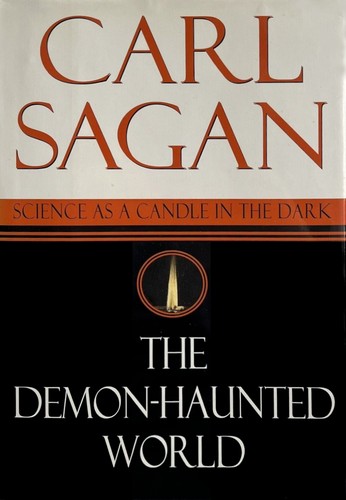
2. THE DEMON-HAUNTED WORLD: SCIENCE AS A CANDLE IN THE DARK BY CARL SAGAN
[CARL SAGAN] | * 4.6/5
Who it’s for: Readers who want to understand the difference between thinking critically and being a cynic. This is the book for people who have noticed that skepticism is often mistaken for pessimism, and who want a more nuanced framework.
Get it here: https://www.amazon.com/Demon-Haunted-World-Science-Candle-Dark/dp/0345409469?tag=readplug09-20
“I have a foreboding of an America in my children’s lifetime or my grandchildren’s when the United States is a service and information economy and hardly any manufacturing at all; when people cannot trust most of what they hear but they make up their minds based on what they want to believe.”
His “baloney detection kit” — a set of questions to ask when evaluating any claim — is the most practically useful thing in this book. Does the claim have an attributable source? Has it been peer reviewed? Does it account for alternative explanations? These sound like obvious questions. Sagan demonstrates, with examples ranging from alien abduction to water fluoridation, how rarely people actually apply them.
My take: The most humane book on this list. Sagan’s skepticism is not cold — it is driven by curiosity and a belief that understanding the world is worth the discomfort it sometimes produces. This is what intellectual humility actually looks like.
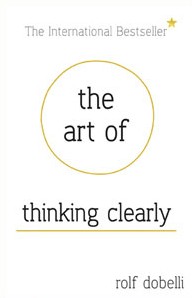
3. THE ART OF THINKING CLEARLY BY ROLF DOBELLI
[ROLF DOBELLI] | * 4.2/5
Who it’s for: Readers who found Thinking, Fast and Slow too dense and want the key insights in a more digestible format. This is the book for people who want to understand cognitive biases without spending 500 pages on the research behind them.
Get it here: https://www.amazon.com/Art-Thinking-Clearly-Improve-Decision/dp/0062225540?tag=readplug09-20
“The chief enemy of good decisions is a lack of sufficient points at which to check before making the decision.”
Dobelli compiled 99 cognitive errors — survivorship error, sunk cost fallacy, anchoring, confirmation bias — and wrote a short chapter on each. The format is deliberately accessible: each bias gets two to three pages, a clear example, and a practical takeaway. The brevity makes it useful as a reference. It also means the arguments behind each bias are severely truncated.
I found myself wanting to argue with Dobelli in several places — his treatment of loss aversion doesn’t fully capture the research. But the book is valuable as an inventory. Sometimes naming the error is the beginning of understanding it.
My take: Best used as a reference book, not a primary text. Keep it on your desk. Return to the chapters on the bias you think might be affecting your current decision.
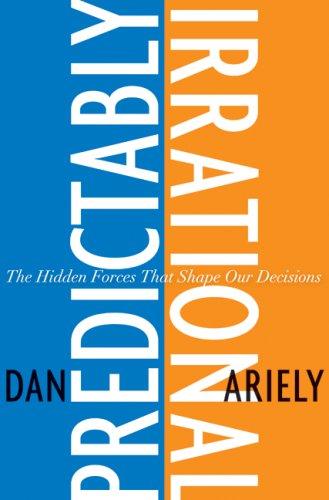
4. PREDICTABLY IRRATIONAL: THE HIDDEN FORCES THAT SHAPE OUR DECISIONS BY DAN ARIELY
[DAN ARIELY] | * 4.3/5
Who it’s for: Readers who want to understand how behavioral economics applies to everyday decisions — not just financial ones. This is the book for people who have noticed that their spending, eating, and relationship choices don’t match what they would have predicted in advance.
Get it here: https://www.amazon.com/Predictably-Irrational-Revised-Expanded/dp/0061353248?tag=readplug09-20
“We are consistently aware of our limitations, but we do not necessarily try harder to overcome them.”
Ariely ran experiments that produced consistently surprising results. His central finding: human behavior is not just irrational, it is systematically irrational in ways that can be predicted in advance. We are not random in our errors. We are biased in consistent directions.
What Ariely demonstrates is that context — the way a choice is framed, the default options available, the presence or absence of social pressure — affects behavior much more than we assume. The same person reasoning in two different contexts will produce two different conclusions.
My take: More accessible than Kahneman, less rigorous. Useful for understanding the practical implications of behavioral economics. Ariely is a better storyteller than researcher.

5. THE BLACK SWAN: THE IMPACT OF THE HIGHLY IMPROBABLE BY NASSIM NICHOLAS TALEB
[NASSIM NICHOLAS TALEB] | * 4.4/5
Who it’s for: Readers who are suspicious of prediction, forecasting, and the idea that future events can be reliably anticipated. This is the book for people who have noticed that experts are frequently wrong about the future and want a framework for thinking about why.
Get it here: https://www.amazon.com/Black-Swan-Second-Improbable/dp/0812973815?tag=readplug09-20
“The inability to predict outliers implies that any prediction is not only wrong but dangerous.”
Taleb’s central argument is about the role of the extreme, the unexpected, and the genuinely unprecedented in shaping history. He calls these events Black Swans. Most of what matters in any domain — finance, history, personal life — is shaped by events that could not have been predicted in advance.
The book is self-awarely polemical. Taleb writes like someone who has been angry about something for a very long time and has found a precise way to express it. I found his argument compelling and his tone occasionally exhausting. But the core insight — that the distribution of outcomes in any complex system is not what most statistical methods assume — is one I have not been able to stop thinking about.
My take: The book is making a much bigger argument than the title suggests. Read the first half for the accessible argument, skim the second half where Taleb’s anger becomes the dominant tone.

6. SUPERFORECASTING: THE ART AND SCIENCE OF PREDICTION BY PHILIP TETLOCK
[PHILIP TETLOCK] | * 4.3/5
Who it’s for: Readers who want to know whether prediction is possible and, if so, what separates good forecasters from bad ones. This is the book for people who found Taleb’s pessimism compelling but incomplete.
Get it here: https://www.amazon.com/Superforecasting-Prediction-Philip-Tetlock/dp/0804136696?tag=readplug09-20
“The most statistically anonymous analysts were often the most accurate forecasters.”
Tetlock ran a multi-decade forecasting tournament that involved thousands of participants making probability estimates about future geopolitical events. His findings: some people are genuinely better at forecasting than others, and the differences persist. These “superforecasters” share certain traits: actively open-minded, they update their views frequently, they are comfortable with probability rather than certainty.
This is an optimistic book in an unexpected way. Tetlock argues that some prediction is possible, and that the conditions for it can be cultivated. His superforecasters were not experts in the domains they forecast — which suggests the skill is separable from the content knowledge.
My take: Required reading after The Black Swan. Tetlock is the direct empirical counterargument to Taleb’s position, and the fact that both of them participated in the same research community gives their disagreement a productive precision.

7. RATIONALITY: WHAT IT IS, WHY IT SEEMS SCARCE, WHY IT MATTERS BY STEVEN PINKER
[STEVEN PINKER] | * 4.3/5
Who it’s for: Readers who want to understand why rationality seems to be in short supply and what can be done about it. This is the book for people who are pessimistic about human reasoning and want a more optimistic but empirically grounded argument.
Get it here: https://www.amazon.com/Rationality-What-Scarce-Matters/dp/0143136760?tag=readplug09-20
“Rationality is not the same as intelligence. Rationality is about how we use knowledge to achieve goals.”
Pinker, the cognitive psychologist and linguist, makes an argument that has become necessary: that rationality is not a fixed trait but a skill, and that it is being undermined by a combination of misinformation, tribalism, and the design of the information environments we inhabit. His central claim is that rationality — the use of knowledge to achieve goals — is more learnable than we assume, and that the obstacles to it are more addressable than the pessimists suggest.
The book’s structure is unusual: Pinker devotes significant space to the epistemology of rationality, explaining why the tools of reason — logic, probability, causal inference — are the way they are, before moving to the practical question of how to deploy them. This is relevant to critical thinking because it grounds the techniques in the reasoning behind them. Understanding why you should update your beliefs in response to evidence is more durable knowledge than just knowing that you should.
My take: More optimistic than the other books on this list, and less concerned with documenting errors than with explaining what rationality actually is. Pinker’s writing can be dense, but the argument is worth the effort.
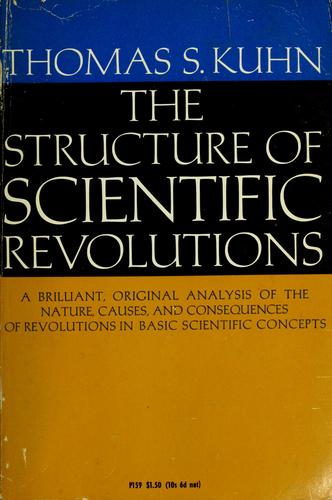
8. THE Structure OF SCIENTIFIC REVOLUTIONS BY THOMAS KUHN
[THOMAS KUHN] | * 4.5/5
Who it’s for: Readers who want to understand how scientific knowledge actually changes over time. This is the book for people who have assumed that science moves steadily toward truth and want to know why that model might be wrong.
Get it here: https://www.amazon.com/Structure-Scientific-Revolutions/dp/0226458121?tag=readplug09-20
“The normal-scientific tradition that emerges from a scientific revolution is not only incompatible with but actually actually somehow incommensurable with the tradition that has gone before.”
Kuhn’s concept of the paradigm — the set of assumptions, methods, and questions that define a scientific field — changed how historians and philosophers understand how knowledge develops. His argument that scientific progress does not look like a steady accumulation of facts but like a series of revolutions, where one paradigm is replaced by another that is incommensurable with it, is one of the most cited ideas in twentieth-century intellectual history.
Kuhn’s work demonstrates that even in domains that claim to be purely rational, the actual history of how knowledge changes involves social processes, professional incentives, and a kind of blindness to evidence that doesn’t fit. This is relevant to understanding why smart people consistently fail to see what outsiders can see clearly.
My take: Dense, important, frequently misquoted. Read it with a secondary source that explains what Kuhn actually meant, because the popular understanding of “paradigm shift” is not quite what he was arguing.

9. NUDGE: IMPROVING DECISIONS ABOUT HEALTH, WEALTH, AND HAPPINESS BY RICHARD THALER AND CASS SUNSTEIN
[RICHARD THALER] | * 4.2/5
Who it’s for: Readers who want to understand how choice architecture — the way options are presented — affects decisions. This is the book for people who have noticed that the default option in any decision matters more than they assumed.
Get it here: https://www.amazon.com/Nudge-Improving-Decisions-Happiness-Thaler/dp/0143137006?tag=readplug09-20
“A nudge is any aspect of the choice architecture that alters people’s behavior in a predictable way without forbidding any options or significantly changing their economic incentives.”
Thaler and Sunstein argue that how choices are presented matters as much as what choices are available. The way a retirement plan is framed, the order in which options appear, the default setting — all of these “nudges” affect behavior in ways people rarely notice but that can be designed deliberately.
The argument has been used to justify everything from opt-out organ donation to restrictions on predatory lending. Whether you find this persuasive depends on whether you trust the nudge designers. I found the framework useful and the politics complicated.
My take: The most practically applicable book on decision-making. Every chapter gives you a specific thing to look for in how choices are presented to you.
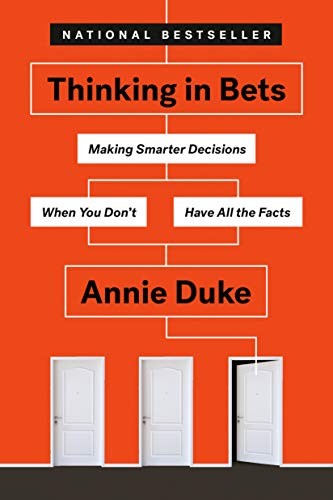
10. THINKING IN BETS: MAKING SMARTER DECISIONS WHEN YOU DON’T HAVE ALL THE FACTS BY ANNIE DUKE
[ANNIE DUKE] | * 4.4/5
Who it’s for: Readers who want to understand the relationship between decision quality and outcome quality. This is the book for people who have made the right decision and gotten the wrong result, or the wrong decision and gotten the right result, and want a framework for not confusing the two.
Get it here: https://www.amazon.com/Thinking-Bets-Smarter-Decisions-Dont/dp/0735216355?tag=readplug09-20
“Outcomes are affected by luck in addition to the quality of decisions. This simple truth is the foundation of every lesson in this book.”
Duke is a former professional poker player who spent two decades making decisions under conditions of incomplete information. Her insight: most people conflate outcome quality with decision quality. A good decision that produces a bad result feels like a bad decision. A bad decision that produces a good result feels like confirmation. Neither confusion allows you to learn from experience.
Her solution is to start thinking in bets: to acknowledge that any decision is a bet on a future you cannot fully know, and to evaluate the decision based on what was known at the time rather than what happened afterward. This sounds simple. It is not.
My take: The most personal book on this list. Duke writes about her own decision-making failures with a candor that makes the abstract argument concrete. This is the book I have given to the most people who are trying to make decisions under uncertainty.
FREQUENTLY ASKED QUESTIONS
WHY IS CRITICAL THINKING SO HARD TO DEVELOP?
Because the system you use to evaluate your own thinking is the same system that produced the thinking in the first place. Kahneman’s research demonstrates that System Two — the slow, analytical reasoning system we rely on to catch errors — is inherently lazy. It prefers to agree with System One’s fast intuitions rather than interrogate them. Critical thinking is not a skill you acquire and apply. It is a constant practice of override.
ISN’T IT ARROGANT TO QUESTION OTHER PEOPLE’S ARGUMENTS?
No. Questioning arguments is not the same as questioning people. The ability to engage with an argument on its merits — to agree with reasoning while disagreeing with the conclusion — is a sign of intellectual respect. The alternative — accepting conclusions because you like the person, or rejecting them because you dislike them — is tribalism with better branding.
CAN I IMPROVE MY CRITICAL THINKING WITHOUT TAKING A COURSE?
Yes. Practice making calibrated predictions about things you care about, track your accuracy, update based on results. Reading broadly in fields outside your own expertise provides more reference points for evaluating claims. Sagan’s baloney detection kit is useful daily practice. The habit of asking “what would change my mind about this?” is more useful than any specific technique.
WHAT IS THE MOST DANGEROUS THINKING ERROR?
The one I find most consequential is confirmation bias — the tendency to notice and credit information that supports what you already believe while ignoring information that contradicts it. Sagan’s book is an extended argument about why confirmation bias does the most damage, because it operates at the level of what questions you even think to ask. You can be perfectly logical about the evidence in front of you and still end up wrong because you never considered certain evidence.
HOW DO I EVALUATE EXPERT OPINIONS?
Carefully. Taleb and Tetlock’s research suggests expert predictions are systematically overconfident and frequently less accurate than simple statistical models. This does not mean experts are worthless — it means the appropriate response to expert opinion is probabilistic. Treat expert claims as one input. Ask what the base rate is. Ask whether the expert has skin in the game. Tetlock’s superforecasters had methodology expertise rather than domain expertise. That distinction matters.
WHAT IF I KEEP MAKING THE SAME THINKING ERRORS DESPITE KNOWING ABOUT THEM?
Kahneman’s research is discouraging: knowing about cognitive biases does not measurably reduce them. Dobelli’s response is more practical: build systems and environments that reduce the opportunity for errors rather than relying on willpower. Default to the right choice. Make the wrong choice harder. The gap between knowing and acting is bridged by changing the conditions.
THE BOTTOM LINE
The books on this list are, collectively, an argument that human reasoning is more flawed, more context-dependent, and more interesting than we assume. They do not agree on everything. Taleb and Tetlock disagree about prediction. Kahneman and Ariely occupy different positions on how systematic our irrationalities are. But they converge on something important: the assumption that you are thinking clearly is the most dangerous assumption you can make.
Take Thinking, Fast and Slow if you want the foundational text. Take Nudge or Thinking in Bets if you want something immediately practical.
Here’s what I keep thinking about, weeks after finishing these books: my father’s restaurant did not close because my father made a bad decision. It closed because a lease renewal failed and a recession happened. The decision-making was fine. The conditions were not. I have spent six years trying to understand why he didn’t make different phone calls, and the answer these books keep suggesting is that I might be asking the wrong question. Which book are you starting with?
Disclosure: This post contains affiliate links. If you purchase through these links, ReadPlug may earn a small commission at no extra cost to you. We only recommend books we’ve personally found valuable.