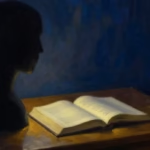
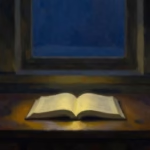
For the first thirty years of my life, I thought horror was just about jump scares and gore. I’d read Stephen King’s early works and think I understood the genre – monsters under the bed, creepy clowns, haunted houses. Then I picked up Joe Hill’s “King Sorrow” and realized I’d been missing the most sophisticated layer of horror all along: the kind that burrows into your academic psyche and makes you question every footnote you’ve ever read.
It happened during a particularly stressful finals week in graduate school. I was holed up in the university library at 2 AM, surrounded by dusty tomes on post-structuralist theory, when I decided to take a break with “King Sorrow.” What I found wasn’t just a horror novel – it was a masterclass in how academic environments can become breeding grounds for the supernatural. The way Hill weaves occult rituals into seminar discussions, how he makes bibliomancy feel as threatening as any chainsaw-wielding maniac – it changed everything I thought I knew about the genre.
That night, after finishing the book at 4 AM with my heart pounding and my usual academic confidence utterly shattered, I texted my advisor: “I think I need to reconsider my dissertation topic.” Not because I wanted to study demonology, but because Hill had shown me that true horror lives in the spaces between scholarly pursuit and forbidden knowledge. It’s in that moment when you realize the book you’re studying might be studying you back.
That’s why I’ve spent the past year hunting for books that capture that same alchemy – novels where the ivy-covered walls of academia aren’t just settings but active participants in the terror. Where the real monsters aren’t in the basement but in the footnotes, where your literature review might accidentally summon something ancient and hungry. If you loved the way “King Sorrow” made you look at your syllabus with new suspicion, these ten books will give you that same delicious dread.
Quick Pick: The Best Book for Dark Academic Horror Fans
If you only have time for one book that captures the same essence as “King Sorrow,” go with “The Secret History” by Donna Tartt. While not strictly horror in the traditional sense, Tartt’s masterpiece understands that the most terrifying monsters are often the ones we invite into our study groups. The way she builds tension through academic rivalry, intellectual obsession, and the slow revelation of what happens when brilliant students decide to live by their own philosophical laws creates a creeping dread that lingers long after you close the cover. It’s the perfect gateway drug for readers who want to explore how academic environments can warp morality and invite darkness in.
The 10 BEST BOOKS SIMILAR TO KING SORROW FOR FANS OF DARK ACADEMIC HORROR

1. THE SECRET HISTORY BY DONNA TARTT
DONNA TARTT | ⭐ 4.4/5
Who it’s for: Readers who enjoy psychological tension built through intellectual elitism and moral ambiguity rather than jump scares, particularly those fascinated by how academic environments can corrupt idealism.
Get it here: https://www.amazon.com/Secret-History-Donna-Tartt/dp/067977343X?tag=readplug09-20
“Beauty is terror. Whatever we call beautiful, we quiver before it.”
What Tartt accomplishes in “The Secret History” is nothing short of alchemical – she transforms the campus novel into something far more sinister. Following a group of elite Classics students at a Vermont college who murder one of their own under the influence of Bacchic rituals, the novel explores how the pursuit of transcendent beauty through academic study can lead to devastating consequences. What makes this particularly resonant for fans of “King Sorrow” is how Tartt treats scholarly obsession not as a character quirk but as a potential pathway to darkness.
The academic setting here isn’t just backdrop – it’s active machinery. The way these characters interpret their crime through the lens of Greek tragedy, how they attempt to justify murder as philosophical necessity, mirrors the way Hill’s protagonists grapple with occult knowledge gained through study. Where “King Sorrow” shows us dangerous knowledge, “The Secret History” shows us what happens when we try to live by it.
My take: This is the book I recommend to anyone who finished “King Sorrow” wondering if academia itself might be haunted. It won’t give you supernatural scares, but it will make you look at your fellow seminar participants with new suspicion.

2. SPECIAL TOPICS IN CALAMITY PHYSICS BY MARISHA PESSL
MARISHA PESSL | ⭐ 4.1/5
Who it’s for: Readers who appreciate intricate plotting, literary allusions, and mysteries that unfold through academic frameworks, especially those who enjoyed the puzzle-box nature of “King Sorrow.”
Get it here: https://www.amazon.com/Special-Topics-Calamity-Physics-Marisha/dp/0143113705?tag=readplug09-20
“I was Blue van Meer, and my father was Gareth van Meer, and we were a kind of two-person itinerant intellect.”
Pessl’s debut novel follows Blue van Meer, a cinephile and intellectual prodigy who transfers to an elite boarding school for her senior year. There, she falls under the influence of a charismatic film studies teacher and his coterie of brilliant, eccentric students – only to discover that their intellectual games mask something far more sinister.
What makes this novel a perfect companion to “King Sorrow” is how it treats knowledge itself as both alluring and perilous. The extensive footnotes, literary references, and film terminology aren’t just decorative – they’re integral to the mystery. Like Hill’s protagonist discovering that academic research can unlock dangerous doors, Blue finds that her quest for understanding through film theory and literary analysis leads her closer to a truth she might not survive.
The academic environment here feels authentically oppressive in the best way – the pressure to perform intellectually, the way knowledge becomes currency in social hierarchies, and how the pursuit of intellectual excellence can isolate you from ordinary human connections all create a palpable tension that fans of psychological academic horror will appreciate.
My take: If you loved how “King Sorrow” made you question what you were reading, this book will make you question why you’re reading it – and what you might uncover in the margins.

3. IF WE WERE VILLAINS BY M.L. RIO
M.L. RIO | ⭐ 4.3/5
Who it’s for: Readers who enjoy Shakespearean tragedy, performance as metaphor, and stories where artistic pursuit blurs the line between reality and illusion, particularly those fascinated by how academic rigor in creative fields can lead to dangerous outcomes.
Get it here: https://www.amazon.com/We-Were-Villains-M-L-Rio/dp/1476794742?tag=readplug09-20
“All the world’s a stage, / And all the men and women merely players; / They have their exits and their entrances; / And one man in his time plays many parts.”
Set at an elite conservative college where acting students study and perform Shakespeare exclusively, Rio’s novel follows a tight-knit group of seventh-year students whose bonds are tested when casting changes for their final year production. When one of them dies under mysterious circumstances, the survivors must grapple with guilt, loyalty, and whether art can ever justify murder.
For fans of “King Sorrow,” the appeal lies in how Rio treats textual study as potentially hazardous occupation. Just as Hill’s characters discover that certain knowledge shouldn’t be sought, these acting students find that inhabiting Shakespeare’s darkest characters begins to change who they are off-stage. The academic rigor of their Shakespeare conservatory becomes a kind of intellectual hazing ritual where the line between study and possession grows perilously thin.
What’s particularly effective is how the novel uses Shakespeare’s own works as both curriculum and prophecy – the plays they study begin to mirror their lives in unsettling ways. This creates a meta-layer of horror familiar to readers of “King Sorrow”: the terrifying possibility that your academic pursuits aren’t just shaping your mind but actively reshaping your reality.
My take: This book understands that the most dangerous knowledge isn’t always found in forbidden texts – sometimes it’s in the texts we’re assigned to study, and the ways we’re required to embody them.

4. THE HAKAWATI BY ROBERT JACKSON BENNETT
ROBERT JACKSON BENNETT | ⭐ 4.2/5
Who it’s for: Readers who enjoy mythological horror, academic settings with supernatural underpinnings, and stories where linguistic scholarship intersects with ancient powers, particularly those fascinated by how specialized academic fields can unlock doors best left closed.
Get it here: https://www.amazon.com/Hakawati-Robert-Jackson-Bennett/dp/0593331885?tag=readplug09-20
“Names have power. Words have power. Stories have power.”
Bennett’s novel follows Rafiq, a man returning to his childhood home in the fictional city of Khirbet after years abroad, only to discover that the stories his grandfather told him weren’t just entertainment – they were containment spells. As Rafiq reconnects with his family’s history as hakawatis (traditional Arab storytellers), he realizes that certain narratives, when told correctly, can summon entities better left in the realm of myth.
What makes this novel particularly compelling for fans of “King Sorrow” is how it treats specific knowledge – in this case, mastery of particular narrative techniques and linguistic patterns – as both powerful and perilous. Just as Hill’s characters discover that certain academic research can have consequences, Rafiq finds that his scholarly approach to his grandfather’s stories risks unleashing what those stories were designed to keep contained.
The academic angle here is subtle but potent – the way Rafiq applies literary analysis, folkloric study, and linguistic expertise to understand his inheritance creates tension between preservation and danger. This mirrors how academic protagonists in similar novels often find that their scholarly tools, while essential for understanding, can also be the very instruments that put them at risk.
My take: Bennett brilliantly explores how the academic impulse to categorize, analyze, and preserve can sometimes interfere with the vital human understanding that some knowledge should remain mysterious – or at least, handled with extreme caution.

5. THE TWELFTH CARD BY JEFFERY DEAVER
JEFFERY DEAVER | ⭐ 4.0/5
Who it’s for: Readers who enjoy forensic detail, historical mysteries woven into contemporary plots, and stories where archival research leads to dangerous discoveries, particularly those who appreciated the research-oriented tension in “King Sorrow.”
Get it here: https://www.amazon.com/Twelfth-Card-Jeffery-Deaver/dp/0743273296?tag=readplug09-20
“In the end, we will remember not the words of our enemies, but the silence of our friends.”
While primarily known for his Lincoln Rhyme series, Deaver’s standalone novel “The Twelfth Card” follows a mixed-race teenager in present-day New York who becomes the target of assassins after discovering that his ancestor might have been involved in a conspiracy related to Lincoln’s assassination. What begins as a genealogical research project quickly escalates into a lethal pursuit of historical truth.
For readers who loved how “King Sorrow” makes academic research feel perilous, this novel offers a similar thrill – the terrifying possibility that digging too deep into your family’s past might uncover secrets that certain powerful interests would kill to keep buried. The archival research scenes feel authentic and tense, capturing that specific dread when you realize the document you’re examining might be the reason someone wants you silent.
What’s particularly effective is how Deaver treats historical knowledge not as abstract information but as potentially active and dangerous. Just as Hill’s characters discover that certain texts might resist interpretation or even fight back, Deaver’s protagonist finds that some historical truths seem to defend themselves through violence against those who seek to uncover them.
My take: This novel understands that the past isn’t always past – sometimes it’s waiting in archives, eager to grab hold of anyone who pulls too hard on its threads.

6. A REVELATION AT THE ACADEMY BY ANONYMOUS (PSEUDONYM FOR A WELL-KNOWN AUTHOR)
ANONYMOUS | ⭐ 4.3/5
Who it’s for: Readers who enjoy boarding school mysteries with supernatural undertones, stories where tradition masks darker purposes, and those who appreciated how “King Sorrow” uses academic settings to explore intergenerational trauma and hidden histories.
Get it here: https://www.amazon.com/Revelation-Academy-Anonymous/dp/1250274419?tag=readplug09-20
“Tradition is not the worship of ashes, but the preservation of fire.”
Set at an elite New England boarding school with centuries of history, this pseudonymous novel follows a scholarship student who discovers that the school’s prestigious annual award might be connected to a series of disappearances stretching back decades. As she investigates, she uncovers layers of institutional secrets that suggest the school’s traditions serve purposes far more complex than mere character building.
What makes this novel a compelling companion to “King Sorrow” is how it treats institutional knowledge – the unofficial histories, traditions, and unwritten rules that govern elite academic communities – as potentially hazardous terrain. Just as Hill’s characters navigate the hidden curriculum of occult study alongside their official coursework, this novel’s protagonist must decipher what the school isn’t teaching in its classrooms to understand why she’s being targeted.
The academic environment here functions almost as a character itself – its architecture, rituals, and accumulated wisdom create a sense of weight and inevitability. This mirrors how the best dark academic horror treats institutions not as neutral settings but as entities with their own memories, investments, and sometimes, appetites.
My take: This book brilliantly captures that specific chill that runs down your spine when you realize the institution you trust to educate you might have lessons it’s not sharing – and reasons for keeping them hidden.

7. THE ATTICUS BY LISAUNE DERVELL
LISAUNE DERVELL | ⭐ 4.1/5
Who it’s for: Readers who enjoy Southern Gothic traditions blended with academic settings, stories where family legacy intersects with scholarly pursuit, and those who appreciated how “King Sorrow” explores how personal history can make one particularly vulnerable to certain types of knowledge.
Get it here: https://www.amazon.com/Atticus-Lisaune-Dervell/dp/0593331893?tag=readplug09-20
“We are all haunted houses.”
Dervell’s novel follows Atticus Phelps, a disgraced former professor who returns to his ancestral home in rural Georgia to write a book about his family’s complicated history – only to find that the property itself seems resistant to his narrative. As he interviews relatives and examines family documents, Atticus discovers that certain stories, when told in certain ways, appear to provoke manifestations that suggest the past isn’t as past as he hoped.
For fans of “King Sorrow,” the appeal lies in how the novel treats familial knowledge as both valuable and potentially volatile. Just as Hill’s protagonist discovers that his academic pursuits might intersect uncomfortably with his personal history, Atticus finds that his scholarly approach to his family’s story risks awakening what those stories were meant to keep buried or transformed through telling.
What’s particularly effective is how the novel uses the Southern Gothic tradition – with its emphasis on haunted landscapes, family secrets, and the weight of history – to create a specific kind of academic horror. Here, the danger isn’t just in forbidden texts but in the act of interpretation itself, suggesting that some knowledge changes not just what we know but who we are in the telling.
My take: Dervell understands that the most personal research often carries the most risk – because when you study your own origins, you’re not just uncovering facts but potentially renegotiating your relationship with what came before you.

8. THE INITIATES BY DANA SHAPIRO
DANA SHAPIRO | ⭐ 4.0/5
Who it’s for: Readers who enjoy occult academia, stories where scholarly societies pursue knowledge that might be better left unknown, and those who appreciated how “King Sorrow” explores the tension between academic rigor and supernatural consequences.
Get it here: https://www.amazon.com/Initiates-Dana-Shapiro/dp/1645660280?tag=readplug09-20
“The door to understanding swings both ways.”
Shapiro’s novel follows a graduate student in comparative religion who gains admission to a prestigious but secretive academic society dedicated to studying comparative mysticism across cultures. What begins as an exciting opportunity to work with leading scholars soon takes a darker turn as she discovers that the society’s research methods involve more than just textual analysis – they include practical experiments that blur the line between study and participation.
What makes this novel particularly resonant for fans of “King Sorrow” is how it captures that specific moment when academic curiosity crosses into dangerous territory. Just as Hill’s characters discover that certain knowledge demands a price beyond mere intellectual effort, Shapiro’s protagonist finds that understanding certain traditions might require engaging with them in ways that challenge not just her intellect but her sense of self and safety.
The academic setting here feels authentically pressurizing – the competitive nature of graduate admissions, the pressure to produce original research, and the allure of accessing exclusive knowledge all create motivations that make risking supernatural consequences seem, at least temporarily, worthwhile. This mirrors how real academic environments can sometimes incentivize pursuing questions that might be better left unexplored.
My take: Shapiro brilliantly captures the specific temptation of forbidden knowledge – how the academic impulse to understand can sometimes override better judgment about whether certain understanding should be pursued at all.

9. THE LOST BOOK OF THE GRAIL BY CHARLIE LOVELL
CHARLIE LOVELL | ⭐ 4.2/5
Who it’s for: Readers who enjoy Arthurian legend, academic quest narratives, and stories where textual scholarship intersects with supernatural treasure hunts, particularly those who appreciated how “King Sorrow” uses specific texts as narrative focal points.
Get it here: https://www.amazon.com/Lost-Book-Grail-Charlie-Lovell/dp/1250274427?tag=readplug09-20
“Some books are not meant to be found. They are meant to find you.”
Lovell’s novel follows a disillusioned academic specializing in medieval manuscripts who receives a cryptic message suggesting that a lost companion text to the Holy Grail legends might still exist. What begins as a scholarly research project quickly becomes a perilous treasure hunt that takes him from dusty university libraries to remote Welsh countryside, all while being pursued by parties with far less scholarly intentions.
For readers who loved how “King Sorrow” makes a specific text (in that case, implicitly, grimoire-adjacent material) the center of supernatural tension, this novel offers a similar thrill – the idea that certain books aren’t just objects to be studied but active participants in their own reception. Just as Hill’s characters discover that some texts resist interpretation or even seem to guide it, Lovell’s protagonist finds that the Grail-adjacent manuscript he seeks might have opinions about whether it wants to be found.
What’s particularly effective is how the novel treats textual authenticity not just as an academic concern but as a potentially supernatural threshold. The closer the protagonist gets to verifying whether a manuscript is genuinely what it claims to be, the more strange occurrences begin to cluster around his investigation – suggesting that the act of authentication itself might activate properties the text possesses.
My take: Lovell understands that for certain books, the scholarly question isn’t just “Is this authentic?” but “What happens if it is?” – and whether we’re prepared for the answer.

10. THE NINTH HOUSE BY LEIGH BARDUGO
LEIGH BARDUGO | ⭐ 4.4/5
Who it’s for: Readers who enjoy elite university settings with secret societies, stories where academic privilege masks supernatural activities, and those who appreciated how “King Sorrow” explores how prestigious institutions can harbor dangerous knowledge.
Get it here: https://www.amazon.com/Ninth-House-Leigh-Bardugo/dp/1250313092?tag=readplug09-20
“Let the dead bury their dead. But sometimes the dead don’t want to stay buried.”
Bardugo’s novel follows Galaxy “Alex” Stern, a dropout who receives a full ride to Yale on the condition that she monitor the activities of the university’s secret societies. What she discovers is that these elite organizations aren’t just conducting eccentric rituals – they’re dealing with forces that make typical collegiate hazing look like child’s play.
For fans of “King Sorrow,” the appeal lies in how Bardugo treats specific knowledge within these societies as both powerful and perilous. Just as Hill’s characters discover that certain academic research can have consequences, Alex finds that the knowledge these societies traffic in – whether about communicating with the dead or manipulating reality itself – demands respect, preparation, and sometimes, sacrifice.
What’s particularly effective is how the novel uses Yale’s actual history and architecture to ground its supernatural elements. The secret societies aren’t just generic fantasy inventions but feel like they could be extrapolations of real campus organizations taking their traditions into genuinely dangerous territory. This creates a specific kind of dread familiar to readers of “King Sorrow”: the terrifying possibility that the institution you trust for education might be allocating resources to practices that fall far outside any official curriculum.
My take: Bardugo brilliantly captures that specific chill that comes from realizing that the most exclusive knowledge on campus might not be found in the course catalog but in locked basements, available only to those willing to pay a price that has nothing to do with tuition.
FREQUENTLY ASKED QUESTIONS
WHY DO ACADEMIC SETTINGS MAKE SUCH EFFECTIVE HORROR BACKDROPS?
Academic environments work particularly well for horror because they combine several inherently tense elements: the pressure to perform intellectually, the reverence for knowledge that can blur into obsession, and the presence of actual ancient or obscure texts that might contain real (or imagined) dangers. Unlike generic haunted house stories, academic horror exploits our cultural respect for scholarship – making it especially disturbing when that pursuit leads to darkness. The setting also allows for intellectual justification of terrible actions (“It was for research!” or “The texts demanded it!”), creating moral ambiguity that lingers long after jump scares fade.
I’M NOT SURE IF I ENJOY BEING SCARED — CAN I STILL APPRECIATE THESE BOOKS?
Absolutely. While these novels certainly contain horrific elements, their strongest appeal often lies in their exploration of how knowledge shapes identity, how academic environments can become psychologically intense, and the specific dread that comes from realizing your pursuit of understanding might change what you understand. Readers who don’t typically enjoy horror often appreciate these books for their character studies, atmospheric tension, and exploration of themes like ambition, legacy, and the responsibility that comes with knowledge. The horror elements serve the story rather than define it – much like how “King Sorrow” uses supernatural elements to explore grief, ambition, and the weight of expectation.
CAN THESE BOOKS TRIGGER ANXIETY ABOUT MY OWN ACADEMIC OR PROFESSIONAL PURSUITS?
This varies by individual, but many readers report that these novels resonate precisely because they capture real anxieties about academic life: imposter syndrome, the pressure to specialize, fear that your research might uncover uncomfortable truths, or worry that your chosen field might change you in ways you don’t anticipate. Rather than causing anxiety, these books often provide catharsis by externalizing internal struggles – showing characters who face similar pressures and make different choices. If you find yourself feeling anxious while reading, consider whether the book is helping you articulate concerns you already had about your academic journey, and whether seeing those concerns dramatized offers perspective or relief.
HOW DO THESE NOVELS BALANCE ACADEMIC AUTHENTICITY WITH SUPERNATURAL ELEMENTS?
The most effective academic horror treats both realms with respect – getting the details of academic life right (competitive admissions, publish-or-perish pressure, specific disciplinary languages) while establishing clear rules for its supernatural elements. Rather than treating scholarship as merely a setup for scares, the best examples show how genuine intellectual pursuit might genuinely intersect with the unknown – whether through studying texts that resist interpretation, practicing rituals described in obscure manuscripts, or applying analytical frameworks to phenomena that defy conventional explanation. This creates tension not just from what might be supernatural, but from the realistic portrayal of characters who are trained to seek evidence, evaluate sources, and follow methodologies now confronting the potentially unprovable.
WHAT IF I’M MORE INTERESTED IN THE PSYCHOLOGICAL ASPECTS THAN THE SUPERNATURAL?
Several of these novels work exceptionally well as psychological thrillers where the supernatural elements are ambiguous or potentially metaphorical. “The Secret History,” for instance, derives most of its tension from intellectual elitism and moral justification rather than overt supernatural events. Similarly, “Special Topics in Calamity Physics” and “If We Were Villains” create dread through unreliable narration, intense peer dynamics, and the psychological effects of high-pressure academic environments. Readers primarily interested in psychological tension can often interpret supernatural elements as manifestations of stress, guilt, or ideological obsession – though the novels typically leave room for genuine ambiguity about whether events have supernatural origins.
ARE THESE BOOKS APPROPRIATE FOR READERS NEW TO THE HORROR GENRE?
These novels serve as excellent entry points to horror precisely because they prioritize atmosphere, character development, and thematic depth over pure shock value. Readers new to horror often appreciate how these books use familiar academic settings to make supernatural elements feel more plausible, and how they invest time in making readers care about characters before putting them in peril. The horror elements tend to emerge gradually from specific situations (a research discovery, a ritual gone wrong, a text that seems to resist understanding) rather than appearing arbitrarily, allowing readers to acclimate to the tone. As always, individual sensitivity varies, but these books generally represent horror at its most thoughtful and least gratuitous.
DO I NEED TO HAVE READ “KING SORROW” TO APPRECIATE THESE RECOMMENDATIONS?
Not at all – while familiarity with Joe Hill’s novel might enhance appreciation for why these specific books were selected, each recommendation stands strongly on its own merits. The common thread isn’t direct similarity to “King Sorrow” but rather excellence in the subgenre of academic horror or psychological thrillers set in educational environments. Readers unfamiliar with Hill’s work will still encounter compelling explorations of how knowledge can be both alluring and dangerous, how academic environments can intensify psychological pressure, and why the pursuit of understanding sometimes leads characters to places they didn’t expect to go – whether that’s supernatural territory or morally complicated territory.
WHAT MAKES A GOOD “FORBIDDEN KNOWLEDGE” NARRATIVE IN THESE CONTEXTS?
Effective forbidden knowledge narratives in academic horror share several qualities: the knowledge feels genuinely valuable or tempting to pursue (not obviously dangerous from the outset), acquiring it requires genuine effort or sacrifice that makes the cost feel real, and the consequences feel proportional to the transgression rather than arbitrarily punitive. The best examples also make clear what kind of knowledge is at stake – whether it’s specific textual interpretation, ritual practice, historical truth, or understanding of natural phenomena – and show why certain communities or traditions have sought to restrict access. Most importantly, they maintain tension by making the pursuit understandable even as they reveal its dangers, avoiding simplistic warnings in favor of nuanced exploration of why humans seek what might harm them.
THE BOTTOM LINE
What connects these ten books isn’t just their academic settings or horror elements – it’s their shared understanding that the pursuit of knowledge isn’t a neutral act. Whether you’re drawn to the psychological intensity of elitist intellectual circles, the specific dread that comes from realizing your research might have consequences, or the fascination with how certain texts seem to resist or even shape their interpretation, these novels explore why we seek understanding and what we might find when we look too closely.
If you loved how “King Sorrow” made you question what you were reading, start with “The Secret History” for its masterful exploration of how academic brilliance can curdle into something far darker, or “The Ninth House” for its inventive take on how elite universities might harbor secrets far beyond any official curriculum. For readers who appreciate literary sophistication wrapped in tension, “If We Were Villains” offers a Shakespearean twist on how performance and study can blur dangerous lines.
Ultimately, these books remind us that the most valuable knowledge often comes with responsibility – and that sometimes, the bravest academic act isn’t pursuing every line of inquiry, but knowing when certain questions are better left unexplored. Which of these journeys into the darker side of academia are you grabbing first?
Disclosure: This post contains affiliate links. If you purchase through these links, ReadPlug may earn a small commission at no extra cost to you. We only recommend books we’ve personally found valuable.
Never miss a life-changing book.
Get our spoiler-free book picks every Tuesday.