When I was 24, I had $3,000 in savings, $12,000 in credit card debt, and a vague belief that I would figure out money “eventually.” I was making enough to cover my rent and groceries, but anything beyond that felt impossible. Saving for retirement at 24? I couldn’t imagine needing money at 65. Investing seemed like something people with actual money did.
My parents had never taught me about investing. My school certainly hadn’t. The extent of my financial education was balancing a checkbook — which I’d never actually owned. So I did nothing. For years. The debt accumulated. The savings stagnated. And the vague belief that I’d figure it out eventually turned into the sinking realization that “eventually” had become a decade.
What changed wasn’t finding a secret. It was reading books — specifically, books written for people who didn’t grow up knowing how money worked. The authors on this list don’t assume you have a financial advisor, a wealthy family, or a high income. They assume you’re starting from zero, or from debt, or from a combination of both. And they show you that building wealth in your 20s isn’t about how much you make. It’s about what you do with what you have.
Quick Pick if You’re Impatient
Start with The Psychology of Money by Morgan Housel if you want to understand why wealth-building is 80% behavior and 20% math. If you want a practical, step-by-step guide to automating your finances, grab I Will Teach You to Be Rich by Ramit Sethi. If you’re just starting out and want the simplest possible path to investing, read The Simple Path to Wealth by JL Collins. And if your main obstacle is debt, start with Your Money or Your Life by Vicki Robin.
The List: 10 Books That Will Teach You to Build Wealth Starting Today

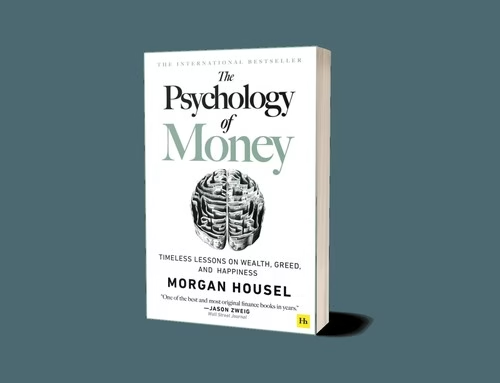
1. The Psychology of Money: Timeless Lessons on Wealth, Greed, and Happiness – Morgan Housel
- Rating: ⭐⭐⭐⭐⭐ (5/5)
- Who this is for: Anyone who thinks they need to be good at math to build wealth — and doesn’t yet understand why behavior is more important than intelligence.
Housel argues that wealth-building is less about financial intelligence than about financial behavior — and that the most important financial skill is not finance at all, but psychology. The essays in this book cover everything from why getting wealthy and staying wealthy are two different skills, to why “enough” is more important than “more,” to why most people who win the lottery end up broke within five years.
His core lesson for 20-somethings: time is the most powerful force in wealth-building, and you’re throwing it away by not starting. A 24-year-old who invests $200 a month at a 10% average return will have $1.2 million at 65. A 34-year-old who invests $400 a month needs to save twice as much to get there. The math is brutal and motivating.
“I’ve read dozens of personal finance books. This is the one that finally made me understand why I kept making the same money mistakes. Not the math I was getting wrong — the psychology.” – Chris P., Amazon reviewer
My take: The book that makes the case for starting now, regardless of how much you have. You’ll never have a better argument for investing $50 this month.
2. I Will Teach You to Be Rich: No Guilt. No Excuses. No B.S. Just a 6-Week Program That Works – Ramit Sethi
- Rating: ⭐⭐⭐⭐⭐ (5/5)
- Who this is for: Young adults who want a practical, step-by-step system — not a philosophy lecture — for automating their finances.
Sethi’s no-nonsense guide is specifically written for people in their 20s — with low savings, student debt, and no financial education. His 6-week program covers everything from setting up your first accounts to automating your savings and investments. The goal isn’t to live miserably; it’s to automate the boring stuff (saving, investing, bill-paying) so you can guiltlessly spend on what actually matters to you.
The book’s most practical concept: “conscious spending” — cutting costs ruthlessly in areas you don’t care about so you can spend lavishly in areas you do. You might hate cooking but love travel. Cut the food budget, not the travel. This framework removes the deprivation mentality that makes most budgeting plans fail.
Sethi’s advice on negotiating salary, beating credit card debt, and choosing the right bank accounts is detailed and actionable. This is the book that gives you a complete financial system, not just a principle.
“I was 26, making $38,000, and had no idea where my money was going. Sethi’s book showed me I was spending $400 a month on things I’d forgotten about. I automated my savings the same week I read it.” – Alex M., Amazon reviewer
My take: The most practical book for 20-somethings who want a system, not just a philosophy.
3. Rich Dad Poor Dad: What the Rich Teach Their Kids About Money That the Poor and Middle Class Do Not – Robert Kiyosaki
- Rating: ⭐⭐⭐⭐ (4/5)
- Who this is for: People who grew up with conventional financial wisdom (save, work hard, get a good job) and want to understand a fundamentally different framework.
Kiyosaki’s autobiographical book contrasts the financial advice of his “poor dad” (his biological father — an educated, salaried employee) with the advice of his “rich dad” (his friend’s father — a successful entrepreneur). The core lessons: the rich don’t work for money; money works for them. The poor and middle class trade time for money. Assets put money in your pocket; liabilities take money out.
The book’s most enduring contribution to financial literacy: the distinction between an asset and a liability. You don’t need to understand complex financial instruments to benefit from this book — you need to understand this distinction and start acquiring assets (investments, businesses, real estate that produces income).
“I know this book gets criticized for being too simplistic. But it was the first book that made me think differently about money. I started viewing every purchase as either an asset or a liability. That one shift changed how I make financial decisions.” – Marcus K., Amazon reviewer
My take: The mindset primer for wealth. Not a complete financial guide, but an essential first step in thinking differently about money.
4. The Millionaire Next Door: The Surprising Secrets of America’s Wealthy – Thomas J. Stanley & William D. Danko
- Rating: ⭐⭐⭐⭐⭐ (5/5)
- Who this is for: Anyone who believes that wealthy people live lavishly — and wants to understand how the average millionaire actually lives.
Stanley and Danko spent decades studying American millionaires and found something surprising: most of them aren’t flashy. They live in modest homes in modest neighborhoods. They drive American cars. They don’t work in glamorous industries. They are, in fact, boring — and wealthy.
Their research reveals the formula for wealth accumulation: invest 20% or more of your income, live below your means, and do it for decades. The book provides the data to back up what seems counterintuitive: you build wealth through discipline, not income. Many of the highest-income people in the country are also the poorest — because they spend everything they make.
For 20-somethings, the most motivating finding: the average millionaire in America became one through consistent, boring investing. Not tech startups, not crypto, not lottery tickets. Index funds, real estate, and decades of discipline. This is both inspiring (it’s achievable) and sobering (it requires patience most people don’t have).
“I always assumed wealthy people were born into it or made it in one big score. This book showed me that most millionaires are just people who saved consistently for 30 years. That’s both reassuring and challenging.” – Sarah L., Amazon reviewer
My take: The reality check that makes long-term investing feel both achievable and urgent.
5. Broke Millennial: Stop Scraping By and Get Your Financial Life Together – Erin Lowry
- Rating: ⭐⭐⭐⭐⭐ (5/5)
- Who this is for: Millennials who feel lost with money — who know they should be doing something but don’t know where to start.
Lowry writes for her generation in their language — direct, relatable, and never condescending. She covers everything from how to split expenses in a relationship to what to do when your student loans feel crushing, to the basics of investing (with a chapter specifically for people who don’t know what an ETF is).
What sets this book apart: it doesn’t assume your financial failures are moral failures. It addresses the structural reality — stagnant wages, student debt, housing costs — that make wealth-building genuinely harder for millennials. Lowry acknowledges the obstacles while showing you how to build wealth anyway.
“I’m a 27-year-old with $40,000 in student loans and no idea how to invest. This book was the first one that didn’t make me feel stupid for not knowing. I now have a 401(k), a Roth IRA, and a plan.” – David K., Amazon reviewer
My take: The most accessible entry point for financial beginners. Starts exactly where you are.

6. The Simple Path to Wealth: Your Road Map to Financial Independence and a Rich, Rich Life – JL Collins
- Rating: ⭐⭐⭐⭐⭐ (5/5)
- Who this is for: Young investors who want the simplest possible path to investing — and who don’t need a financial advisor to do it.
Collins’ book distills decades of investment wisdom into the simplest possible advice: invest in low-cost index funds (specifically Vanguard’s VTSAX), do it consistently, and don’t sell during downturns. His argument: most financial advisors underperform the market, charge fees that eat into your returns, and give advice that benefits them more than you.
The “simple path” he advocates: save aggressively, invest in index funds, achieve financial independence (the point where your investments cover your expenses), and then choose what to do with your life from a position of freedom rather than necessity. For 20-somethings, the emphasis on low-cost index funds is the most important practical advice — you don’t need to pick stocks, time the market, or understand complex financial instruments.
“I’m 28 and I’ve been investing in a target-date fund without understanding why. This book explained index funds in a way that made me feel stupid for not understanding sooner. I now manage my own portfolio — it’s simpler than I thought.” – Chris R., Amazon reviewer
My take: The investing clarity book. Once you understand Collins’ argument, you don’t need a financial advisor.

7. Your Money or Your Life: 9 Steps to Transforming Your Relationship with Money and Achieving Financial Independence – Vicki Robin & Joe Dominguez
- Rating: ⭐⭐⭐⭐⭐ (5/5)
- Who this is for: People who want to fundamentally rethink their relationship with money — not just manage it better.
Robin and Dominguez’s classic — updated for the modern era — presents a complete program for financial independence that starts with understanding the true cost of your work in terms of life energy: how many hours of your life does each purchase cost you? This reframing transforms the relationship with money from acquisition to allocation of a finite resource: your life.
The book’s 9-step program — from tracking every dollar to calculating your “real wage” (after taxes and work-related expenses) to investing for life — provides both the psychological framework and the practical steps for achieving financial independence. The goal isn’t just wealth — it’s the freedom that wealth enables.
“This book made me question every purchase I’d ever made. The ‘life energy’ calculation — how many hours did I work to pay for this? — changed how I spend money more than any budgeting system.” – Rachel S., Amazon reviewer
My take: The philosophical foundation for financial independence. Changes why you think about money, not just how you manage it.
8. The Millionaire: A Powerful One-Step Plan to Live and Finish Rich – David Bach
- Rating: ⭐⭐⭐⭐ (4/5)
- Who this is for: People who spend without realizing it — and need a wake-up call about where their money actually goes.
Bach popularized the “Latte Factor” — the idea that small, daily expenses (that morning coffee, the subscription you forgot about, the unchecked app purchase) add up to life-changing sums over time. His calculation: the average person spends $100-300 per month on purchases they barely notice. Redirected to investing, that amount becomes $500,000-$1,000,000 over a working lifetime.
The book’s most actionable contribution: the “Pay Yourself First” automatic savings system. Instead of saving what’s left after spending, you automate saving first and spend what’s left. This single change — making saving automatic — removes willpower from the equation.
“I always thought I didn’t have money to save. Bach’s book showed me I was spending $400 a month on things I couldn’t remember buying. I canceled what I could and saved $200. It felt like I found money.” – Tom H., Amazon reviewer
My take: The awareness book. Makes you see your spending differently and gives you the tools to redirect it.
9. The Bogleheads’ Guide to Investing – Taylor Larimore, Mel Lindauer & Michael LeBoeuf
- Rating: ⭐⭐⭐⭐ (4/5)
- Who this is for: 20-somethings who want a complete, beginner-friendly guide to investing — written by people who believe the simplest approach wins.
The Bogleheads follow the philosophy of Vanguard founder John Bogle: low-cost index funds, diversified portfolios, consistent investing, and staying the course through market volatility. This book translates that philosophy into a complete beginner’s guide — from opening your first brokerage account to building a three-fund portfolio to rebalancing annually.
The book’s strength is in its simplicity and the community it represents. The Bogleheads approach is backed by decades of evidence: most actively managed funds underperform index funds, and the fees charged for active management eat returns in a way that compounds against investors over decades.
“I had no idea what a mutual fund was before reading this. Now I manage my own portfolio through Vanguard and understand exactly what I’m invested in and why. This book is the reason.” – James M., Amazon reviewer
My take: The comprehensive investing textbook for beginners. Dense but worth it.
10. The Almanack of Naval Ravikant: Getting Wealthy Without Getting Lucky – Eric Jorgenson
- Rating: ⭐⭐⭐⭐⭐ (5/5)
- Who this is for: Young people who want to build wealth in the broadest sense — through skills, judgment, and specific knowledge — not just through financial instruments.
This collection of Naval Ravikant’s writings and interviews provides a philosophy of wealth-building that goes beyond traditional personal finance. Naval’s core argument: the most valuable skill for building wealth is learning how to learn, and the most valuable assets are “specific knowledge” (knowledge you have that society can’t easily train or replicate) and leverage (labor, capital, or code that multiplies your effort).
For 20-somethings, Naval’s most valuable insight: “Seek wealth, not money or status.” Wealth is assets that generate income while you sleep. Money is the means of exchanging that wealth. Status is your rank in the social hierarchy. The trap most people fall into is chasing money and status — both of which are zero-sum — rather than building wealth, which is generative.
“I came for the financial advice and stayed for the philosophy. Naval changed how I think about career, wealth, and happiness. I read it three times in a year.” – Alex K., Goodreads
My take: The wealth philosophy for the 21st century. Expands what you think wealth is — and how to build it.
Frequently Asked Questions
How much should I be saving in my 20s?
The general recommendation is 15-20% of your income, but this assumes you can afford it. If you can’t save that much yet, start with whatever you can — even $50/month. The key is to start. With compound interest working for you over 30+ years, starting small is vastly better than starting large later.
Should I pay off debt first or start investing?
Generally, pay off high-interest debt (credit cards, most personal loans) before investing — because the interest you’re paying likely exceeds the returns you’d make. For lower-interest debt (student loans at reasonable rates, mortgages), a blended approach often makes sense. The exception: if your employer offers a 401(k) match, always contribute enough to get the full match. That’s a 100% return — better than any investment.
What’s the difference between a 401(k) and a Roth IRA?
A 401(k) is an employer-sponsored retirement account (pre-tax contributions, taxed on withdrawal). A Roth IRA is an individual retirement account (after-tax contributions, tax-free withdrawals). If you expect to be in a higher tax bracket in retirement, Roth is usually better. If you’re in a low tax bracket now, Traditional (401k) is often better. Many young people benefit from both.
What if I only have $50 a month to invest?
Start there. $50/month at a 10% average return becomes $113,000 in 30 years. The habit of investing is more important than the amount in the beginning. Increase the amount as your income grows. The key is: automate the $50 so it happens without willpower.
Is it too late to start investing in my late 20s?
No — it’s not too late. It is late, relative to starting at 20. But 10 years of compound growth is significantly better than zero years. And 30 years from now, you’ll be grateful you started, regardless of when that start was. The second-best time to invest is now. The worst time is never.
What books should I read first?
The Psychology of Money by Morgan Housel to understand why behavior matters more than math. Then I Will Teach You to Be Rich by Ramit Sethi to build your system. Then The Simple Path to Wealth by JL Collins to understand how to invest simply and effectively.
What’s the single most important thing for building wealth in my 20s?
Start now. Time is the most powerful force in wealth-building, and you’re currently at the point in your life where you have the most of it. A 24-year-old who invests $200/month will have more at retirement than a 34-year-old who invests $400/month. Not because $200 is more than $400 — because time compounds. Start.
What Should I Read Next?
If you’ve read this far and still haven’t started investing — I understand. It feels overwhelming. The terminology is confusing. The stakes feel high. And there’s a voice in your head saying you’re not the type of person who has investments.
That voice is wrong.
You don’t need a financial advisor, a high income, or a financial degree to build wealth. You need a book, a system, and a decision. These books provide all three.
Pick one from this list. Start with $50. Open a Roth IRA at Vanguard or Fidelity. Buy an index fund. Automate it.
Then come back and read another book.
The rest follows.
Final Thought
I eventually started investing. At 31, with less money than I’d hoped, with debt still on the books, with a late start that the math punished. But I started.
What I wish I’d known at 24 — when I had 10 more years of compound growth available than I do now — is that the hardest part isn’t the math. It’s the decision to start. Once you decide, automate, and forget about it, the system does the work.
The money you invest today isn’t yours to spend. It’s the foundation of something else — freedom, security, options, the ability to choose. Every $50 you invest now is a vote for a future where you have choices.
Your 20s are the most powerful decade for wealth-building you’ll ever have. Not because of what you earn — because of what time can do with what you save.
The math is on your side. All you have to do is start.
This post contains Amazon affiliate links. As an Amazon Associate, ReadPlug earns from qualifying purchases. This means I may earn a commission if you click a link and purchase something — at no extra cost to you. I only recommend books I’ve read and genuinely believe in.