The thing about losing a friend is that nobody brings you a casserole. Nobody sends flowers. There’s no funeral where people stand in a line and tell you they’re sorry for your loss and mean it. There’s just… the slow realization that someone who used to know what you were thinking before you said it now feels like a stranger who happens to know your middle name.
I lost my best friend, Dana, two years after the divorce. Not to anything dramatic. Not to a fight, not to a betrayal, not to some cinematic confrontation where someone says the thing that can’t be unsaid. We just… stopped. She stopped texting first. I stopped calling. The coffee dates we used to have every Thursday became every other Thursday, then once a month, then never. The last time I saw her was at Target, of all places, in the candle aisle. She was buying a birthday gift for someone I didn’t know. We hugged. It was the kind of hug that means goodbye and both of us knew it and neither of us said anything about it.
I grieved that friendship harder than I grieved some parts of my marriage, and that’s the part nobody warns you about. We have language for divorce. We have support groups, books, therapists who specialize in it. But when you lose a friend — when a relationship that was supposed to be the constant in your life just quietly evaporates — there’s no script. No ceremony. No one asks how you’re doing because they don’t know you’re doing badly. You don’t even know, sometimes. You just know that something is missing and you can’t file a claim for it because you’re not even sure when it was lost.
These ten books are for that specific grief. The one that doesn’t have a name. The one that shows up as a small ache on a Tuesday when you see something funny and reach for your phone to text someone who isn’t there anymore.
Quick Pick: In a Hurry?
Also see our guide to 10 Best Books for Navigating Tricky Conversations at Work. Also see our guide to 10 Best Books for Building Confidence and Friendship in Tween Girls. Also see our guide to 10 Best Books for Building Trust After Betrayal in Friendship. Also see our guide to 10 Best Books for Building Confidence and Friendship in Tween Girls.| Book | Best For | Rating | |——|———-|——–| | The Friend by Sigrid Nunez | Sitting with the raw grief of losing someone | ⭐⭐⭐⭐⭐ | | Big Friendship by Aminatou Sow & Ann Friedman | Understanding that friendships take real work | ⭐⭐⭐⭐⭐ | | Set Boundaries, Find Peace by Nedra Glennon Tawwab | Learning why some friendships end when you grow | ⭐⭐⭐⭐⭐ |
10 Best Books for Navigating Friendship Breakups

1. The Friend by Sigrid Nunez
⭐⭐⭐⭐⭐
Who it’s for: Someone who needs to grieve a friendship without anyone telling them to get over it.
This novel won the National Book Award, and I understand why. It’s about a woman whose best friend and mentor dies by suicide, and she inherits his enormous dog. That’s the plot, roughly. But the plot isn’t really the point. The point is the way grief lives in the body — in the specific things you can’t do anymore, the conversations you’ll never finish, the way a room feels different when someone who used to be in it isn’t.
Nunez writes in fragments. Memories, observations, small digressions that don’t resolve. It reads the way grief actually works — not as a narrative with a beginning, middle, and end, but as a series of moments that ambush you. I read the part where she describes not being able to go to certain restaurants because they were “their places” and had to close the book for a minute because I hadn’t been to the coffee shop on Hawthorne since Dana and I stopped talking and I hadn’t even realized I was avoiding it until that sentence.
This isn’t a self-help book. It won’t give you tools or strategies. What it will give you is the feeling of being seen in a grief that most people don’t take seriously. And sometimes that’s the thing you need before you’re ready for anything else.
My take: “I didn’t know I was grieving my friendship until I read this book. Then I cried for an hour.”

2. Big Friendship: How We Keep Each Other Close by Aminatou Sow and Ann Friedman
⭐⭐⭐⭐⭐
Who it’s for: Anyone who wants to understand what makes friendships work — and what makes them break.
Aminatou Sow and Ann Friedman are best friends who built a public friendship — a podcast, a newsletter, a friendship that was their brand. And then it almost fell apart. This book is the story of how they nearly lost each other and what it took to get the friendship back. It’s honest in a way that made me uncomfortable, which is usually a sign that something is true.
What I loved about this book is that it takes friendship seriously. Not as the thing you do between romantic relationships. Not as the soft, uncomplicated backdrop to your real life. As a relationship that requires work, communication, boundaries, and the willingness to have hard conversations. They use the term “Shine Theory” — the idea that your friend’s success is your success — and they’re honest about how hard that is when jealousy, distance, or plain exhaustion get in the way.
I finished this book and thought about Dana. Not with the vague sadness I’d been carrying, but with something more specific: the understanding that our friendship didn’t just die. It was neglected. By both of us. We let the Thursday coffee dates go because we were tired and busy and assumed the other person would always be there. That’s not a comforting thought, but it’s a useful one. Useful because it means it wasn’t inevitable. Useful because it means I can do better next time.
My take: “Finally, a book that treats friendship like it matters as much as a marriage.”

3. Set Boundaries, Find Peace: A Guide to Reclaiming Yourself by Nedra Glennon Tawwab
⭐⭐⭐⭐⭐
Who it’s for: Someone whose friendship ended because they finally stopped saying yes to everything.
I didn’t realize until I read this book that some of my friendships ended because I grew. Specifically, I grew a spine. I spent years being the friend who was always available, always accommodating, always the one who drove to the other person’s neighborhood for dinner because they didn’t like driving across town. When I started setting limits — saying no, asking for reciprocity, expecting the friendship to be a two-lane road — some of those friendships didn’t survive the shift.
Nedra Tawwab is a therapist, and this book is practical without being cold. She explains what boundaries are (not walls, not punishments, not ultimatums) and what happens when you set them (some people adjust, some people leave, and both outcomes tell you something important). The chapter on boundaries in friendships specifically is the one I underlined the most. She talks about the friendships that are built on a shared dynamic — the helper and the helped, the listener and the talker — and what happens when one person stops playing their assigned role.
This book didn’t fix my friendship with Dana. But it helped me understand that not every friendship that ends is a failure. Some of them end because one person grew and the other person didn’t want to follow. That’s not betrayal. That’s just what happens sometimes. And honestly? I wasn’t okay about it for a long time. This book helped me be okay.
My take: “I lost three friends after reading this book. I also found out which ones were actually my friends.”
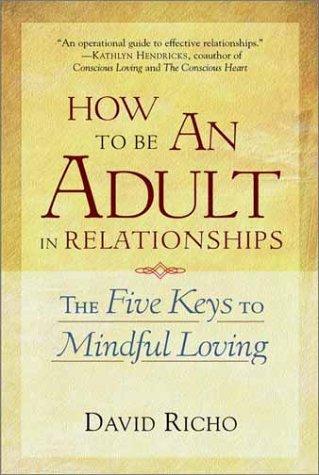
4. How to Be an Adult in Relationships: The Five Keys to Mindful Loving by David Richo
⭐⭐⭐⭐½
Who it’s for: Someone trying to understand why they keep ending up in the same patterns with friends — and romantic partners.
David Richo writes about the five things everyone needs in a relationship: attention, acceptance, appreciation, affection, and allowing. The “allowing” part is the one that got me — the idea that healthy love means letting the other person be who they actually are, not who you need them to be. That applies to friendships as much as it does to romance.
The reason this book is on a list about friendship breakups is a specific section about how we unconsciously recreate the dynamics of our earliest relationships. If you grew up in a home where love was conditional, you might build friendships where you’re constantly performing to keep the other person’s approval. And when you stop performing — when you finally show up as yourself — some of those friendships collapse. Not because you did something wrong. Because the friendship was built on a version of you that wasn’t real.
I read this one slowly, over several weeks, because it kept making me see things I wasn’t ready to see. The friendship I had with my college roommate, Sarah-with-an-H, makes so much more sense now. She needed someone who would listen without taking up space. I needed someone who would tell me I was doing a good job. We were meeting each other’s childhood wounds instead of building something new. When we both went to therapy — separately, years apart — the friendship didn’t survive our healing. That’s a strange sentence. But it’s true.
My take: “I thought this book was about romance. It ended up explaining every friendship I’ve ever lost.”

5. Platonic: How the Science of Attachment Can Help You Make — and Keep — Friends by Marisa G. Franco
⭐⭐⭐⭐⭐
Who it’s for: Anyone who wants to understand the psychology of friendship — why it’s hard to make friends as an adult and harder to keep them.
Marisa Franco is a psychologist who studies friendship, and this book is the most evidence-based thing on this list. She applies attachment theory — the framework we usually use for romantic relationships — to friendships, and the result is a book that makes you go, oh. That’s why.
She explains that friendships in adulthood are structurally disadvantaged. We don’t have the built-in proximity of school. We don’t have the cultural scripts of dating. We don’t have the biological drive of family. Friendships are entirely voluntary, and that means they require intentional effort — which most of us are too exhausted to give. She also writes about how attachment styles show up in friendships: the anxious friend who needs constant reassurance, the avoidant friend who disappears when things get real, the secure friend who is, statistically, rarer than we’d like.
This book didn’t just help me understand why I lost Dana. It helped me understand what I need to do differently. Not to fix that friendship — I think that one is gone, and I’m learning to sit with that — but to build new ones with more honesty and less assumption.
My take: “This book should be required reading for every adult. We teach kids how to make friends. Nobody teaches us.”

6. Necessary Losses: The Loves, Illusions, Dependencies, and Impossible Expectations That All of Us Have to Give Up in Order to Grow by Judith Viorst
⭐⭐⭐⭐½
Who it’s for: Someone who needs to understand that loss — including the loss of friendships — is a natural part of growing up.
Judith Viorst wrote Alexander and the Terrible, Horrible, No Good, Very Bad Day, which is a children’s book, and this is a book about loss that somehow carries the same directness — the same refusal to pretend that things are fine when they aren’t. She writes about all the losses we accumulate over a lifetime: the loss of childhood illusions, the loss of our younger selves, the loss of people we love, the loss of the friendships we thought would last forever.
The chapter on friendship loss specifically is the one I keep coming back to. She talks about how some friendships are meant for certain seasons of your life and not others, and how the pain of that ending is real even when the friendship was real too. She doesn’t pathologize it. She doesn’t tell you to move on. She says: this is what it is to be human. You love people. Some of them stay. Some of them don’t. And the ones who don’t stay are still part of who you are.
I found this book at a used bookstore on Division Street, the kind that has cats wandering between the shelves. It was $4. It’s been worth more than any therapy session I’ve paid for. Some books are like that.
My take: “She writes about loss the way it actually feels — not as a phase you get through, but as a layer that stays.”

7. When Things Fall Apart: Heart Advice for Difficult Times by Pema Chodron
⭐⭐⭐⭐
Who it’s for: Someone whose friendship loss has shaken their sense of stability and needs grounding.
Pema Chodron is a Buddhist nun, and this book is about what to do when the ground shifts under you — when the things you counted on fall apart and you’re standing in the rubble trying to figure out what’s left. Her answer isn’t to rebuild. It’s to stay. To sit in the uncertainty and the pain without trying to fix it, escape it, or put a positive spin on it.
I picked this up during the worst of the Dana situation, when I was replaying our friendship on a loop — the what-ifs, the should-haves, the specific moment I think things shifted, which was a dinner where I said something about her boyfriend that I meant as a joke and she took as a judgment. Chodron’s approach isn’t to analyze the situation. It’s to stop gripping it so hard. To let the pain be there without turning it into a story about what kind of person you are.
This book isn’t for everyone. Some people find the Buddhist framework hard to connect with. And Chodron can be frustratingly non-specific — she’ll tell you to “lean into the discomfort” without always explaining how. But on the nights when the grief felt like it had teeth, this was the book that helped me breathe through it.
My take: “I didn’t agree with everything. But the chapter on groundlessness changed something in me.”

8. Self-Compassion: The Proven Power of Being Kind to Yourself by Kristin Neff
⭐⭐⭐⭐½
Who it’s for: Someone who blames themselves for the friendship ending and can’t stop.
I have a tendency — and I think a lot of us do — to turn every friendship loss into evidence that I’m fundamentally difficult to love. That I said the wrong thing. That I was too much or not enough. That if I’d just been a better friend, they’d still be here. Kristin Neff’s book is about the specific practice of being kind to yourself when you’re in that spiral, and it’s the most practical self-compassion book I’ve read.
She defines self-compassion as three things: self-kindness (treating yourself the way you’d treat a friend), common humanity (recognizing that suffering is universal), and mindfulness (acknowledging the pain without over-identifying with it). The exercises are concrete — writing yourself a letter, using physical touch, changing the internal monologue from “I failed” to “This is hard and I’m doing my best.”
After Dana, I spent months running the same internal script: If I’d called more. If I’d been less guarded. If I’d gone to her birthday even though I was tired. Neff’s book didn’t erase that script. But it gave me a second voice — quieter, kinder — that said, You were doing what you could with what you had. That’s not a crime. Some days the second voice is louder. That’s progress, even when it doesn’t feel like it.
My take: “The chapter on self-compassion vs. self-esteem changed how I talk to myself. Permanently.”

9. Tiny Beautiful Things: Advice on Love and Life from Dear Sugar by Cheryl Strayed
⭐⭐⭐⭐⭐
Who it’s for: Someone who needs to hear real, messy, human wisdom about loss — any kind of loss.
Cheryl Strayed wrote an advice column called Dear Sugar, and this book is a collection of the best letters and responses. She writes about everything — divorce, death, addiction, pregnancy, loneliness, jealousy, friendship. And she writes with the kind of raw, unguarded honesty that makes you feel like she’s sitting across from you at a kitchen table at midnight.
The letters about friendship loss aren’t the most famous ones — everyone talks about the one about her mother’s death, and it deserves every word of praise it gets — but the quieter ones are the ones that stay with me. The woman who lost her best friend to a man. The person whose college friend group fell apart after graduation and couldn’t understand why it hurt so much. Strayed doesn’t minimize any of it. She says: you’re allowed to grieve this. You’re allowed to be this sad about a friendship. The sadness is proportional to the love, and the love was real.
I keep this book on the shelf above my desk. Not because I reread it often. Because knowing it’s there is enough.
My take: “I’ve never read advice columns that made me cry before. Every single letter felt like it was written to me.”

10. Friendship: The Evolution, Biology, and Extraordinary Power of Life’s Fundamental Bond by Lydia Denworth
⭐⭐⭐⭐
Who it’s for: Someone who wants to understand why friendship matters on a biological level — and why losing one affects you so deeply.
Lydia Denworth is a science journalist, and this book is a deep dive into the research on friendship — what it does to our brains, our bodies, our longevity. She writes about studies showing that strong social connections are as important to health as diet and exercise. That loneliness activates the same neural pathways as physical pain. That people with fewer close friends die earlier. These aren’t metaphors. These are data points.
I include this book on this list because sometimes what you need after a friendship ends isn’t emotional validation — it’s information. You need to know that the pain you’re feeling has a biological basis. That your brain is literally responding to the loss of a social bond the way it would respond to a physical injury. That the heaviness in your chest isn’t weakness. It’s neuroscience.
Denworth also writes about what makes friendships resilient — shared history, reciprocity, the willingness to show up for the boring parts — and reading that helped me see what was missing in the friendships I’ve lost. Not drama. Not betrayal. Just the slow erosion of showing up.
My take: “I finally understand why losing a friend felt like being hit by a truck. Because for my brain, it basically was.”
Frequently Asked Questions
1. Is it normal to grieve a friendship as much as a romantic relationship?
Yes. Completely. Research shows that friendship breakups can be just as painful — sometimes more so — because we don’t have the cultural scripts to process them. When a romantic relationship ends, people bring you food and ask how you’re doing. When a friendship ends, you’re supposed to just… move on. But your brain doesn’t know the difference. Loss is loss. Your grief is valid regardless of what kind of relationship triggered it.
2. Should I try to fix the friendship or let it go?
Depends on what ended it. If there was a specific incident — something said, something done — a direct conversation might help. But if the friendship ended through slow drift, like mine did with Dana, forcing it usually makes things worse. Sometimes the most loving thing you can do is let someone go. That doesn’t mean you failed. It means the friendship served its purpose and the purpose is over.
3. How do I stop blaming myself for the friendship ending?
Start with Kristin Neff’s Self-Compassion (#8). Self-blame is one of the most common responses to friendship loss, and it’s almost always disproportionate to what actually happened. Write down what happened as if it happened to a friend, not to you. What would you tell them? That’s what you should be telling yourself.
4. Can a friendship breakup cause real mental health issues?
Yes. Chronic loneliness — which often follows friendship loss — is linked to depression, anxiety, sleep problems, and even cardiovascular issues. If you’re struggling after losing a friend, that’s not weakness. It’s your brain responding to the loss of a social bond. Take it seriously. Talk to someone if you need to.
5. How do I make new friends after losing old ones?
Marisa Franco’s Platonic (#5) is the best resource for this. The short version: be intentional, be vulnerable, and be patient. Making friends as an adult requires the same effort as dating, but without the cultural framework. You have to put yourself in proximity with the same people repeatedly. You have to be the one who texts first. It’s uncomfortable. It’s also how it works.
6. Is it possible to be friends with someone again after a breakup?
Sometimes. It depends on what happened and whether both people have changed. The friendship that comes back is never the same friendship — it’s a new one, built on different terms. I’ve had two friendships that survived a break. Both required honest conversations about what went wrong and what needed to be different. It’s possible. It’s just not guaranteed. And that’s okay.
7. My friend broke up with me suddenly. I don’t even know what happened. What do I do?
This is the hardest version of a friendship breakup because you don’t have closure. You might never get it. Nedra Tawwab’s Set Boundaries, Find Peace (#3) has a section on this — the idea that you can grieve a relationship without fully understanding why it ended. Sometimes the reason isn’t about you. Sometimes people leave because of their own stuff and they can’t explain it because they don’t understand it themselves. You’re allowed to be hurt without having a neat explanation for why.
A Final Thought
I drove past Dana’s street last week. Not on purpose — I was taking a different route to the grocery store and her block happened to be on the way. I slowed down. I didn’t stop. Her porch light was on and there was a new plant by the door — something tall and green, the kind she always said she’d kill but apparently hasn’t.
I kept driving. And I thought about the Thursday coffee dates, and the Target candle aisle, and the specific way she laughed — too loud, always, in a way that made strangers look over and then smile because the joy in it was so obvious. I thought about how I’ll probably never hear that laugh again, and how that’s a small, specific loss that doesn’t have a name but sits in the same place in my chest where other losses sit.
These books won’t bring your friend back. I want to be honest about that. But they helped me understand that the grief is real, that it matters, and that I’m not the only person who has ever sat in a Target parking lot wondering how someone who used to know everything about you became someone you have nothing to say to.
Which book are you grabbing first? If you’re in the middle of this kind of loss right now, I hope one of these finds you the way they found me — at the kitchen table, in the quiet, with wet hair and no reason to be there except that you showed up anyway.
Disclosure: This article contains affiliate links. If you purchase through these links, ReadPlug may earn a small commission at no additional cost to you. We only recommend books we genuinely believe in.