Let me tell you something that took me longer than it should have to say out loud: the FIRE movement is not about deprivation. It is not about eating rice and beans for ten years while you watch your friends live the lives you think you’re supposed to be living. It is not, despite what the think pieces would have you believe, a cult for people who hate coffee and have never bought anything they didn’t need.
The FIRE movement — Financial Independence, Retire Early — is about a simple, defensible idea: if you save aggressively and invest the difference between what you earn and what you spend, you reach a point where your money is working for you harder than your job is. And at that point, you have choices. You can keep working because you want to. You can reduce your hours. You can take risks on projects you actually care about. You can walk away from a job that makes you miserable without the panic of wondering how you’ll pay next month’s rent.
That is the entire thesis. Everything else is implementation.
I came to FIRE the way most people who weren’t raised with money come to it: sideways. I didn’t grow up with anyone who owned a pension or talked about index funds or had any system for building long-term wealth beyond “work hard and don’t spend too much.” My father ran a small shop and drove for a private car service on Sundays. My mother kept cash in a tin under the kitchen sink because she didn’t fully trust banks. The information asymmetry in my family wasn’t a gap — it was a canyon.
The books on this list are the ones that helped me close that canyon. Some of them will give you the framework. Some will give you the tactics. One or two will make you angry, because they’re more honest than the lifestyle influencers who have turned FIRE into content, and honest is harder to market than hype.
Here’s what I want you to know before we start: FIRE is not one-size-fits-all. The version I work toward is not the version everyone here works toward. Some people want to retire at 40. Some at 50. Some don’t want to retire at all — they want the freedom to do work they actually care about without worrying whether it pays enough. All of those are valid. These books will help you figure out which version is yours.
Quick Pick: The Book I Recommend First
Also see our guide to 10 BEST BOOKS FOR BUILDING EMOTIONAL INTELLIGENCE AND SELF-AWARENESS AND FINALLY UNDERSTANDING HOW YOU FEEL. Also see our guide to 10 BEST BOOKS FOR BUILDING EMOTIONAL RESILIENCE AFTER SETBACKS AND DISAPPOINTMENTS. Also see our guide to 10 BEST BOOKS FOR BUILDING EMOTIONAL RESILIENCE AND OVERCOMING LIFE’S CHALLENGES. Also see our guide to 10 BEST BOOKS FOR BUILDING EMOTIONAL RESILIENCE IN TEENS AND HELPING THEM BOUNCE BACK. Also see our guide to 10 Best Books for Building Financial Confidence After Debt. Also see our guide to 10 Best Books for Building a Morning Routine for Entrepreneurs (The Early Wins That Change Everything).The Simple Path to Wealth by JL Collins. If you read one book on FIRE, read this one. Collins strips the movement down to its essential mechanics: index fund investing, the magic of compound interest, and why keeping your expenses low is more powerful than any investment strategy. His writing is direct, practical, and — unusually for personal finance — genuinely funny. He also doesn’t pretend the path is easy or that the system isn’t rigged in some ways. He just shows you how to work with what’s actually available rather than waiting for conditions that will never arrive.
The 10 BEST BOOKS FOR Early Retirement and the FIRE Movement

1. The Simple Path to Wealth: Your Road Map to Financial Independence and a Rich, Free Life by JL COLLINS
JL Collins | ⭐ 4.7/5
Who it’s for: Anyone who wants a clear, jargon-free framework for investing for financial independence without getting lost in complexity
“I read twelve personal finance books this year. This is the one I wish I’d read first.” — Goodreads reviewer
Here’s what this book actually says: the path to wealth is not complicated. Earn more than you spend. Invest the difference in low-cost index funds. Repeat until you have enough. Collins has a particular contempt for financial complexity dressed up as sophistication, and he is not shy about saying so.
The core of his argument is what he calls the “Golden Age of Personal Finance” — the period we’re living in now where ordinary investors can access the same index funds that were once only available to institutions. Before this age, you needed wealth to build wealth because transaction costs ate all your returns. Now, you don’t. That’s the unlock.
Collins is particularly good on the psychological side of FIRE — the relationship between money and identity, why keeping up with the Joneses is a wealth-destroying strategy, and how to think about your portfolio when the market is doing terrifying things. His answer, essentially: don’t watch the market. Don’t react. Just keep buying.
My take: This is the book I recommend most often, including to people who think they already know how this works. Collins has a way of making you feel like you finally understand something you maybe knew but couldn’t articulate. Buy it. Read it twice.
2. Your Money or Your Life: 9 Steps to Transforming Your Relationship with Money and Achieving Financial Independence by VICKI ROBIN
Vicki Robin | ⭐ 4.4/5
Who it’s for: Anyone who wants to fundamentally rethink their relationship with money before they start optimizing their portfolio
“This book changed how I think about every pound I spend. Not in a ‘you should feel guilty’ way. In a ‘I finally understand what I’m actually buying’ way.” — Amazon reviewer
Real talk: if you’ve been reading personal finance content for any length of time, some of the ideas in this book will feel familiar. That’s because this book, first published in 1992, helped create the vocabulary the entire field now uses. “Your money or your life” was originally about trading time for money and understanding the true cost of purchases in hours of your life. It’s been updated several times, and the 2018 edition takes into account the gig economy, student debt, and the reality of modern work.
The nine steps are: know your real income, track your money, weekly review, cross off the big three, change your relationship with money, monthly capital, invest in your savings, put your money on autopilot, and — this is the step most people skip — figure out what you’re actually retiring to.
That last step is where Robin is different from most FIRE writers. She doesn’t assume that not working is the goal. She assumes that having enough money to have choices is the goal. Those are not always the same thing.
My take: The system is solid. The tracking methodology is a bit labor-intensive for modern life — Robin is working from a 1990s mental model where you use paper spreadsheets. But the philosophy underneath is still the most honest framework I’ve found for understanding what money actually means in your life.
3. The Millionaire Next Door: The Surprising Secrets of America’s Wealthy by THOMAS J. STANLEY and WILLIAM D. DANKO
Thomas J. Stanley and William D. Danko | ⭐ 4.5/5
Who it’s for: Anyone who still thinks millionaire means designer clothes and luxury cars — and wants to understand how wealth actually works
“I grew up thinking rich people were the people on TV. This book showed me who actually has money. It’s not who you think.” — Goodreads reviewer
Here’s what this book actually says that most people refuse to believe: the person driving the modest car, living in the sensible house, and wearing the watch they bought twenty years ago is more likely to be a millionaire than the person in the leased BMW with the big house they can’t quite afford. Stanley and Danko spent decades studying actual wealthy people — not celebrities, not tech founders, but ordinary people who accumulated significant wealth through ordinary careers.
The data is genuinely surprising. The average millionaire in their study did not inherit their wealth. They owned a business, worked as a professional, or climbed a corporate ladder — and then lived below their means. The wealthy person next door is often driving a Toyota, shopping at discount stores, and has been in the same house for twenty years.
For FIRE seekers, this book is important because it breaks the link between income and wealth that most people assume is causal. High earners are not necessarily wealthy. Wealthy people are people who save aggressively and invest consistently, regardless of income level. That is both encouraging — you don’t need a six-figure salary to FIRE — and challenging — it requires a level of intentionality that isn’t comfortable.
My take: This book made me angry. Not because it’s wrong — it’s not — but because it confirmed something I’d suspected: most of what we think we know about wealth is marketing, not reality. Required reading before you make any plan.
4. I Will Teach You to Be Rich: The Money Guide to Financial Freedom by RAMIT SETHI
Ramit Sethi | ⭐ 4.4/5
Who it’s for: Someone who wants a practical, no-excuses system for automating their finances without spending hours a week managing money
“Sethi doesn’t mess around. If you want a system that works, read this. If you want validation for doing nothing, read something else.” — Amazon reviewer
I have complicated feelings about Ramit Sethi. On the one hand, his approach is exactly right: automate everything you can, cut the things you don’t care about, and put your energy into earning more rather than obsessing over the cost of coffee. His “conscious spending” framework — spend lavishly on the things you care about, cut ruthlessly on the things you don’t — is the most practical financial framework I’ve found that doesn’t require you to live like a monk.
On the other hand, Sethi is writing for a particular audience: people in their twenties and thirties with stable jobs and reasonable incomes who have enough that the problem isn’t survival. If you’re starting from zero — if your parents didn’t teach you this stuff and you’re trying to close a massive information gap while also paying off debt — some of his advice assumes a cushion that doesn’t exist yet.
The book is also showing its age in places. The 2019 edition tries to update for the gig economy and student debt, but Sethi’s core advice was built for a world where you got a job after college and stayed there. That world still exists for some people. It doesn’t exist for everyone.
My take: Best for people who are a few years into their career and ready to systematize. If you’re early in your career or still paying off debt, read it with one eyebrow raised and apply what resonates. The automation system alone is worth the price.
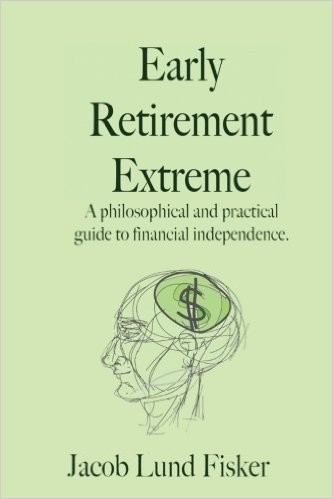
5. Early Retirement Extreme: A Philosophical and Practical Guide to Financial Independence by JACOB FISKER
Jacob Fisker | ⭐ 4.4/5
Who it’s for: Someone who wants to understand the mathematical foundations of FIRE and is willing to embrace significant lifestyle changes to achieve it faster
“This book will either change your life or make you feel like the author is completely insane. Possibly both.” — Goodreads reviewer
Here’s what most FIRE books don’t tell you: the math underneath the movement. Fisker, who retired at 33, builds his case from first principles — the relationship between savings rate and time to financial independence, the power of reducing expenses as a force multiplier on your investments, and why the “4% rule” is actually quite conservative.
Fisker’s approach is not for everyone. He advocates for a significant reduction in lifestyle spending — not as deprivation, but as a shift in priorities. He grows his own vegetables. He doesn’t own a car. He lives in a modest house in a modest neighborhood and finds the whole system of conventional success genuinely baffling. You will read some of this and think he’s right. You will read other parts and think there’s no way you’re doing that. Both reactions are correct.
The philosophical section of this book — why we conflate consumption with identity, why the standard “work until 65” retirement trajectory is a historical anomaly, not a natural law — is the most clarifying writing on the subject I’ve encountered. Read it for the philosophy even if you skip the specifics.
My take: Not the most accessible entry point, but for people who want to understand why FIRE works at a mathematical level, this is the book. Read it for the framework alone.
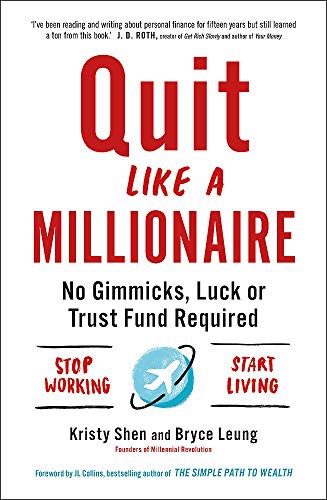
6. Quit Like a Millionaire: No Gimmicks, No Luck, No Miracles — Just Financial Independence by KRISTY SHEN and BRYCE LEUNG
Kristy Shen and Bryce Leung | ⭐ 4.5/5
Who it’s for: Anyone who wants a case study of FIRE that doesn’t come from American middle-class assumptions — and a reminder that the math works even when you don’t have a trust fund
“Two immigrants with no family money, no inheritance, and no financial help retired in their early thirties. The math works. Here’s the proof.” — Amazon reviewer
Here’s what this book actually says that I particularly appreciate: Kristy Shen and Bryce Leung are notdefault case. They are not the typical FIRE narrative — two tech workers in their twenties who figured out they could live on half their income. They are immigrants who started with significant student debt, built careers in tech, and made the math work through a combination of high savings rate and index fund investing.
What I respect about this book is that Shen and Leung don’t pretend their path is available to everyone. They acknowledge privilege — the fact that they had well-paying jobs, no dependents, and good health — while arguing, correctly, that the principles still scale down. You don’t need to earn $150,000 a year to FIRE. You need to save a high percentage of what you do earn and invest it consistently. The number changes; the principle doesn’t.
The book also does something most FIRE literature doesn’t: it addresses the question of what to do with your time after you retire. Shen and Leung both kept working after their portfolio hit their number — because they wanted to, not because they had to. That nuance matters.
My take: Best case study in FIRE literature. Not a manual, but a proof of concept that the math works outside the typical demographic. Read this alongside something more tactical.
7. The Bogleheads’ Guide to Investing by TAYLOR LARIMORE, MEL LINDBERGER, and RICHARD FERRI
Taylor Larimore, Mel Lindberger, and Richard Ferri | ⭐ 4.5/5
Who it’s for: Someone who wants a complete investing education from people who believe the individual investor can win — without paying someone to manage their money
“If Collins gave you the framework and you want to go deeper on the investing mechanics, this is the book.” — Goodreads reviewer
The Bogleheads are the community built around Jack Bogle’s investment philosophy: low-cost index funds, diversification across asset classes, and a long-term perspective that ignores the noise of market volatility. This book is essentially the community’s training manual, written by three people who have spent decades implementing and teaching Bogle’s approach.
What I appreciate about this book is its completeness. It covers asset allocation, tax-efficient investing, rebalancing, target-date funds, the mechanics of different account types (401k, IRA, Roth, HSA), and how to structure your portfolio across taxable and tax-advantaged accounts. It’s not exciting. It is, however, exactly what you need if you want to understand what you’re actually doing when you click “buy” on an index fund.
The Bogleheads approach is conservative in the best sense: it assumes you will not beat the market consistently, so it doesn’t try to. It just gives you the market’s return, minus minimal fees. Over decades, that compound interest becomes significant.
My take: The most complete investing education you’ll get without going to business school. Not a FIRE-specific book — more of a foundational text on how to invest once you’ve decided on your overall strategy.
8. Set for Life: Financial Independence for the Busy Professional by SCOTT TRENCH
Scott Trench | ⭐ 4.4/5
Who it’s for: Someone who is early in their career, not making a high income yet, and needs a realistic plan for building wealth from where they actually are
“I was making $45,000 a year and thought FIRE was for people who already had money. This book showed me a path from where I actually am.” — Amazon reviewer
Here’s what makes this book different from most FIRE literature: Trench is not writing from a high-income perspective. He’s writing from the perspective of someone who started in real estate finance making a modest salary and built his path through a combination of aggressive saving, house hacking, and building a small real estate portfolio. He is very clear that his path is not the only path — but it is a path that is genuinely available to people who don’t have six figures to invest.
The core of Trench’s message is what he calls “financial independence in 5-10 years on a modest income.” He breaks down the math of savings rate and compound interest to show that even on $50,000 a year, saving 20-30% of your income gets you to financial independence in under a decade if you invest it correctly. The assumptions are optimistic but not impossible. And he is unusually honest about what the plan costs — in discipline, in lifestyle trade-offs, in the psychological work of watching your peers make different choices.
Trench also writes about the traps that stop most people from building wealth: lifestyle inflation, debt, the belief that you’ll start tomorrow. His framework for thinking about your “enough” number is particularly useful.
My take: Best for people early in their career or anyone who looks at FIRE books and thinks “this assumes a salary I don’t have.” Trench doesn’t pretend it’s easy. He just shows it’s possible.

9. Work Optional: Retire Early the Non-Penny-Pinching Way by TANJA HESTER
Tanja Hester | ⭐ 4.3/5
Who it’s for: Someone who wants FIRE but doesn’t want to live like a college student to get there — and wants a realistic plan for early retirement that accounts for healthcare, taxes, and actual lifestyle
“Most FIRE books pretend healthcare doesn’t exist and that you’ll never get sick. This one plans for the actual complexity of early retirement.” — Amazon reviewer
Here’s what this book gets right that most FIRE literature ignores: early retirement is not the same as no income ever again. Hester retired from her marketing career at 38 and spent years thinking carefully about what that actually means — not just the math, but the psychological transition from worker to retiree, the question of identity, and the practical problems that the cheerful “save 70% and invest in index funds” narrative doesn’t address.
The healthcare chapter alone is worth the price of admission. Hester and her husband retired before 40, which in the United States means navigating the gap between employer-sponsored insurance and Medicare. She walks through their actual strategy — the plans they chose, the costs they incurred, the mistakes they made — with a specificity that almost no other FIRE author attempts.
Hester is also honest about what she calls the “non-penny-pinching” approach: you don’t have to eat rice and beans for a decade to retire early. You have to save aggressively, yes. But you also have to think carefully about what you’re actually spending your money on and whether it aligns with the life you want to retire into. That’s a different question, and she asks it well.
My take: Best practical guide to the specific problems of early retirement — healthcare, taxes, the psychological transition. The “Non-Penny-Pinching” framing is accurate. You will spend differently, but you won’t be miserable.

10. The Power of Zero: How to Get to the 0% Capital Gains Tax Rate and Beyond by DAVID McKNIGHT
David McKnight | ⭐ 4.3/5
Who it’s for: Someone who wants to understand the tax strategy side of FIRE — specifically, how to structure your savings to minimize lifetime tax burden
“I didn’t understand tax brackets or Roth conversions before this book. Now I do, and it’s already saving me thousands.” — Amazon reviewer
Here’s what this book actually says: the difference between retiring at 55 and retiring at 45 might not be how much you save. It might be how you save it — specifically, in which kinds of accounts, and when you draw from each. McKnight’s thesis is that tax diversification — having money in pre-tax, Roth, and taxable accounts — gives you the flexibility to manage your tax burden in retirement rather than paying whatever the government decides you owe.
The “power of zero” refers to the 0% capital gains rate that applies to the lowest tax brackets. McKnight’s strategy involves deliberately keeping your taxable income in the 0% or 15% capital gains bracket in retirement, which dramatically extends how long your money lasts compared to the standard withdrawal strategy.
This book is not for everyone. The tax strategy only matters if you’re saving enough that the tax implications are significant. For someone early in their FIRE journey or saving a modest amount, the tactics here are less important than the fundamentals. But for people who are serious about optimizing — who want to understand the full picture of how money moves through the tax system — this is the most accessible treatment I’ve found.
My take: Read this after you have the basics solid. The tax strategy McKnight describes is real and valuable, but only once you’re past the point where the fundamentals — savings rate, index fund investing — are already in place.
FREQUENTLY ASKED QUESTIONS
WHAT IS THE FIRE MOVEMENT AND HOW DOES IT WORK?
FIRE stands for Financial Independence, Retire Early. The core mechanic is straightforward: calculate how much money you need to live on annually in retirement — typically 25 to 30 times your annual expenses — then save and invest aggressively until your portfolio produces that income without requiring you to work. The “retire early” part is variable. Some people pursue full retirement at 40 or 45. Others pursue “financial independence” — the point at which work becomes optional because your investments cover your expenses — without retiring early. Both are valid endpoints of the same process. The key insight is that the math of FIRE depends on two variables: your savings rate and your investment returns. Earn more, save more, and invest in assets that grow over time. That’s the entire system.
HOW MUCH DO I NEED TO SAVE TO RETIRE EARLY?
The traditional FIRE number is 25 times your annual expenses — based on the “4% rule,” which holds that you can safely withdraw 4% of your portfolio annually in retirement without running out of money over a 30-year period. This means if you spend $40,000 a year, you need $1 million saved. If you spend $60,000 a year, you need $1.5 million. The higher your expenses, the more you need; the lower your expenses, the less you need. Most FIRE practitioners target a savings rate of 30-50% of their income, which, depending on your income level and investment returns, typically gets you to financial independence in 10-20 years. The number is personal — it depends on your current income, your expenses, your lifestyle expectations, and your tolerance for risk. The Simple Path to Wealth by JL Collins and Set for Life by Scott Trench both have detailed frameworks for calculating your specific number.
CAN YOU REALLY RETIRE EARLY ON AN AVERAGE SALARY?
Yes, but it requires a higher savings rate and more intentionality than the “just max out your 401k” approach. On an average salary — say, $50,000 to $75,000 — achieving financial independence in 15-20 years rather than 30-40 requires keeping your expenses low, investing consistently in low-cost index funds, and, for some people, finding ways to increase income through side businesses, promotions, or career changes. Set for Life by Scott Trench is specifically written for people on moderate incomes who want to know if FIRE is actually available to them. The answer, with sufficient discipline and time, is yes. The timeline is longer. The path is narrower. But the destination is real.
WHAT ARE THE BIGGEST MISTAKES PEOPLE MAKE WHEN PURSUING FIRE?
The three most common mistakes are: one, obsessing over investment returns while ignoring savings rate — your savings rate is actually more powerful than your return rate in the early years; two, underestimating healthcare costs, particularly in the United States, where leaving your employer means losing employer-sponsored insurance; and three, failing to plan for the psychological transition to retirement. Financial independence is a math problem. Living a good life after financial independence is a different problem, and most FIRE literature doesn’t address it. Work Optional by Tanja Hester is the best resource on the problems that actually occur after the math is solved.
IS THE FIRE MOVEMENT REALISTIC FOR PEOPLE WITH FAMILIES, DEBT, OR OTHER OBLIGATIONS?
FIRE is more complex with dependents, significant debt, or irregular income — but it is not impossible. The standard FIRE calculation assumes a specific life situation: single or dual income, no major debts beyond a mortgage, no major health issues. For people who don’t fit that profile, the path requires adjustments: a higher savings rate, a longer timeline, or a partial version of financial independence that doesn’t require complete retirement. Quit Like a Millionaire by Kristy Shen and Bryce Leung is the best resource for understanding how FIRE principles apply outside the default demographic. The authors acknowledge privilege and structural disadvantage without using either as an excuse to abandon the math.
WHAT DO I DO AFTER I REACH FINANCIAL INDEPENDENCE?
This is the question most FIRE literature ignores, and it is the most important one. Financial independence is a financial state. Retirement is a psychological and identity transition. People who reach FIRE without planning for this transition often feel adrift — they have the money but not the framework for using it well. Tanja Hester’s Work Optional addresses this directly, with a chapter on the “four pillars of a meaningful retirement”: financial, physical, mental, and social. The short answer is: you will need a strategy for how to spend your time and maintain your identity that isn’t dependent on your job. Some people keep working because they want to. Some pursue hobbies, travel, or passion projects. Almost everyone needs to think about community and relationships, which don’t automatically arrange themselves when you leave work.
THE BOTTOM LINE
FIRE is not a cult. It is not a hack. It is not something that only works for tech workers in San Francisco with equity packages and no dependents. It is a set of financial principles — save aggressively, invest in low-cost index funds, reduce expenses, and give compound interest time to work — that have been proven across multiple demographic contexts and income levels.
If you’re starting from zero — if you didn’t grow up with financial literacy and are just now closing that gap — the learning curve is real. These books will help. The order I’d suggest: start with The Simple Path to Wealth for the framework, Set for Life if you need to see how the math works on a moderate income, The Millionaire Next Door to understand how wealth actually works in the real world, and Work Optional to plan for the life you’re building after the math is done.
The most important thing I can tell you: nobody taught my family this. That’s the whole point. You are now the person in the room. Start.
Which book are you grabbing first?
Disclosure: This post contains affiliate links. If you purchase through these links, ReadPlug may earn a small commission at no extra cost to you. We only recommend books we’ve personally found valuable.