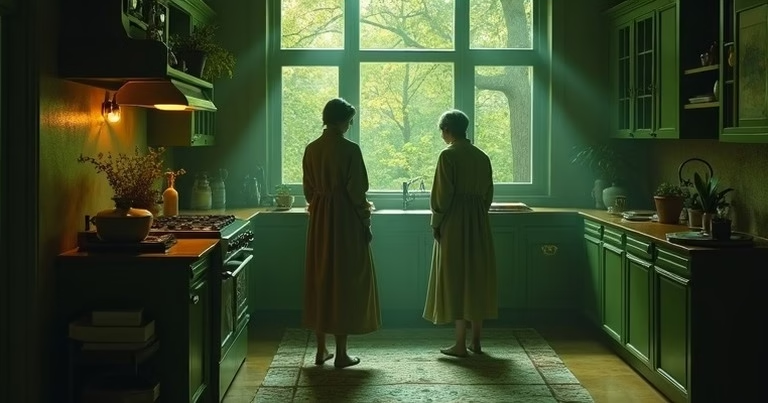
There is a particular kind of morning I know too well. You wake up, make your coffee the way you always do, and sit down at your desk or your canvas or your notebook — wherever it is you do your work — and you wait for the thing that usually comes. The idea, the feeling, the momentum. And it doesn’t come. Or it comes and it’s flat, like something already half-dead when you pull it out of a drawer.
That morning happened to me more than I want to admit during the first year after I left academia. I had left with this idea that freedom would solve everything — that without the structure of seminars and deadlines, my creativity would finally have room to breathe. What I got was a different kind of block. Quieter. Less dramatic than “writer’s block” sounds. More like a faucet that had gone from a steady stream to a drip to nothing at all.
I tried pushing through. I sat at my desk for hours, staring at the cursor blinking on an empty document. I tried waiting for inspiration. I tried punishing myself with discipline — showing up every morning, treating creativity like a factory shift. None of it worked. What finally worked was slower and less dramatic, and it started with a book.
This list is what I found when I went looking for answers. Not magic solutions — I’m suspicious of those, and you should be too. But real tools, from people who understand that the creative slump is not a personal failing but a recurring condition that comes with making things.
Quick Pick: The Best Book for Breaking Through a Creative Slump
Also see our guide to 10 BEST BOOKS FOR BREAKING THROUGH A CREATIVE SLUMP AND FINDING INSPIRATION AGAIN. Also see our guide to 10 BEST BOOKS FOR BREAKING THROUGH A CREATIVE SLUMP AND FINDING INSPIRATION AGAIN. Also see our guide to 10 BEST BOOKS FOR BREAKING THROUGH A CREATIVE SLUMP AND REIGNITING YOUR ARTISTIC PRACTICE.If you only have time for one book right now, go with “Big Magic: Creative Living Beyond Fear” by Elizabeth Gilbert. It won’t give you a five-step system or a productivity hack, and that’s exactly why it works. Gilbert approaches creativity as something that wants to live — not something you have to wrestle into submission. Reading this felt like someone had finally named the thing I was afraid of: not failure, but the bigger fear of having something inside me and never letting it out. It’s warm, it’s funny, and it gives you permission to create without needing to have it all figured out first.
The 10 BEST BOOKS FOR BREAKING THROUGH A CREATIVE SLUMP AND REIGNITING YOUR ARTISTIC PRACTICE

1. BIG MAGIC BY ELIZABETH GILBERT
Elizabeth Gilbert | ⭐ 4.7/5
Who it’s for: Anyone who has stopped creating because they convinced themselves they weren’t good enough, or who is paralyzed by perfectionism and fear of judgment.
Get it here: https://www.amazon.com/Big-Magic-Creative-Living-Beyond/dp/0553419732?tag=readplug09-20
“Your fear and your creativity are not, as most people suppose, at war with each other. They are closely allied.”
Gilbert argues that creativity is not about genius but about showing up and letting something happen. She talks about ideas as independent entities that move through the world seeking expression — if you’re not open to yours, it moves on to someone else. That’s a lot to sit with. But it also means the pressure isn’t all on you. You don’t have to be the greatest. You just have to be willing.
Her chapter on fear and creativity being allies rather than enemies is the one I return to most. She doesn’t tell you to eliminate fear. She tells you to make a deal with it: you can come along for the ride, fear, but you don’t get to drive. That framing gave me something I could actually work with.
My take: This is the permission book. Read it before anything else on this list.

2. THE ARTIST’S WAY BY JULIA CAMERON
Julia Cameron | ⭐ 4.6/5
Who it’s for: Anyone who suspects they used to be more creative and wants to find their way back. Especially useful if your block is connected to a life transition — a move, a breakup, a career change.
Get it here: https://www.amazon.com/Artists-Way-25th-Anniversary/dp/0143129252?tag=readplug09-20
“In the absence of self-nurturing, we reach for the bottle or the box or the programming that numbs us.”
Cameron’s core tool is Morning Pages: three pages of longhand writing, done first thing in the morning, no editing, no audience, no point. Just whatever is in your head poured onto the page. She calls it “brain drain” — the idea being that the noise in your head has to go somewhere, and if you don’t give it a place to drain, it blocks the quieter, more interesting things underneath.
I was skeptical. Three pages of morning writing sounded like something for people who journaled. But I was also desperate enough to try it. On day four, something shifted. A half-formed thought about my mother’s night shifts at the hospital, about exhaustion that comes from caring for people who can’t care for themselves. I followed it. It became an essay. That essay became the first thing I wrote in two years that didn’t feel like performance.
My take: The morning pages practice is simple, free, and effective. Try it for four weeks before you decide it isn’t working.

3. STEAL LIKE AN ARTIST BY AUSTIN KLEON
Austin Kleon | ⭐ 4.5/5
Who it’s for: The perfectionist frozen because they think everything has been done before. Also great for younger creatives still figuring out what kind of artist they want to be.
Get it here: https://www.amazon.com/Steal-Like-Artist-10-Things/dp/0761169253?tag=readplug09-20
“Your job is to collect ideas. The rest happens on its own.”
Kleon writes in short, punchy chapters with illustrations — more of a manifesto than a manual. His central idea, borrowed from T.S. Eliot, is that good artists don’t create from nothing; they remix what already exists into something new. The question isn’t “is this original?” The question is “what can I do with what’s already here that nobody else can do exactly the way I would?”
What I found most useful was his insistence that creativity is about showing up, not waiting for inspiration. His metaphor is side projects: the work you do outside your “real” work, the things that don’t have to be good. He argues that your side projects will eventually become your real work, and that the boundary between the two is more porous than you think.
My take: Short, funny, illustrated, and immediately applicable. Perfect for the creative person who is stuck because they feel like a fraud.
4. THE WAR OF ART BY STEVEN PRESSFIELD
Steven Pressfield | ⭐ 4.4/5
Who it’s for: Anyone who recognizes they are the obstacle to their own work — who knows exactly what they should be doing and finds a thousand reasons not to do it.
Get it here: https://www.amazon.com/War-Art-Entrepreneur-Creative-Manifesto/dp/1936891026?tag=readplug09-20
“The most talented painters, ceramicists, and writers get up at the crack of dawn and do the work. The hacks and the cowards wait until inspiration strikes.”
Pressfield calls the force that keeps you from doing your work “Resistance” — capitalized, personified, treated as an entity with its own agenda. His argument is blunt: Resistance is always against you, it never sleeps, and the only way through it is to do the work anyway. Not when you feel like it. Every day.
The section on “Turning Pro” is the one I think about most. He defines professional as someone who does the work every day, whether or not they feel like it. Amateur is someone who waits for the mood. The difference between the two isn’t talent — it’s reliability.
My take: Best for the person who already knows what they should be working on and just needs to stop making excuses. Don’t read this if you’re looking for validation.

5. THE CREATIVE HABIT BY TWYLA THARP
Twyla Tharp | ⭐ 4.5/5
Who it’s for: Anyone who suspects that creativity is a skill you can develop, not a gift you’re born with. Best for people with a specific creative practice who want to deepen it.
Get it here: https://www.amazon.com/Creative-Habit-Learn-Information/dp/0743235274?tag=readplug09-20
“I have a box of index cards. In it are routines, habits, ideas, images, questions. I fill them out constantly. That is my daily creative workout.”
Tharp is one of the most important choreographers of the twentieth century, and this book is the disciplined, specific expression of how she does what she does. Unlike most creativity books, which are written by non-practitioners, Tharp moves fluidly between dance, film, architecture, and literature, drawing connections that open up your sense of what creativity even is.
Her core argument is that creativity is not inspiration — it’s preparation. The “flash” of insight is only possible because of the long groundwork you’ve laid. She calls it the “scratch folder” — you put everything in there, everything that interests you, and then one day it starts talking to itself.
My take: Dense and rich, best read slowly. If you want a serious structural approach to building a creative practice, this is one of the best.

6. BIRD BY BIRD BY ANNE LAMOTT
Anne Lamott | ⭐ 4.7/5
Who it’s for: Writers primarily, but anyone whose creative block is tangled up in perfectionism or the belief that they have nothing worth saying. For people who respond to humor as a delivery system for truth.
Get it here: https://www.amazon.com/Bird-Some-Instructions-Writing-Life/dp/0385480016?tag=readplug09-20
“Almost all good writing begins with terrible first efforts.”
Lamott is one of the funniest writers alive, and this book is funny in the way that only writing about painful things with complete honesty can be. She tells you that your first draft will be terrible, and that this is not only acceptable but necessary.
The title comes from her father helping her brother with a school report on birds. The brother was overwhelmed by the scope — all those birds. Their father said: “Bird by bird, buddy. Just take it bird by bird.” That’s the whole book. You don’t write the book. You write the sentence. And then the next one.
What I come back to Lamott for is her treatment of perfectionism as a form of fear — a way of not trying, of protecting yourself from the vulnerability of making something real.
My take: Essential for writers, genuinely useful for anyone who creates. Read the chapter on “shitty first drafts” even if you don’t read anything else.
7. THE PRACTICE BY SETH GODIN
Seth Godin | ⭐ 4.4/5
Who it’s for: The creative person who is constantly preparing but never finishing, or who is afraid to share their work. For people who have a project they’ve been sitting on and need a push to put it into the world.
Get it here: https://www.amazon.com/Practice-Shipping-Creative-Work/dp/0593329743?tag=readplug09-20
“The practice is not about solving the problem. The practice is about showing up, again and again, in the service of solving the problem.”
Godin’s central argument is that the work is not done when you finish it — it’s done when it gets into the world. He makes the case that the practice is not about getting better in the abstract; it’s about showing up consistently so you can ship things that matter.
What I found useful was his reframe of the “quality” objection. He distinguishes between the industrial view of quality — consistency, predictability, error-free — and the artistic view, which is resonance. Does this thing you’ve made connect with the people it’s meant for?
His point about permission is also worth sitting with: most creative people are waiting for permission from themselves, from their peers, from the world. The real shift happens when you stop waiting and just decide that you’re allowed to make the thing.
My take: Smart and grounded. Read it if you’re a chronic preparer who never seems to finish anything.
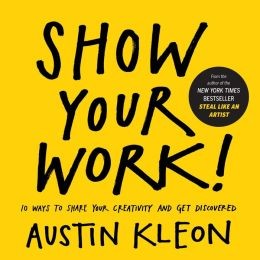
8. SHOW YOUR WORK BY AUSTIN KLEON
Austin Kleon | ⭐ 4.4/5
Who it’s for: Creatives who are good at making things but terrible at sharing them, or who feel like they don’t have anything worth showing yet. Great for people building a presence online.
Get it here: https://www.amazon.com/Show-Your-Work-Auston-Kleon/dp/0761178120?tag=readplug09-20
“You don’t have to be a genius. You just have to be genuine.”
This is Kleon’s follow-up to Steal Like an Artist, and where the first book was about finding inspiration, this one is about what to do with it once you have it. His central argument is that sharing your process — the half-finished work, the inspirations, the failures — is itself a form of creative work.
I was resistant at first. I’m not someone who likes to share things that aren’t finished. But Kleon doesn’t argue that you should share everything — he argues that sharing your process helps you find the people who are on the same path, and those connections sustain a creative life over time.
The concept of “thinking out loud” — using your work to find your people rather than using your people to validate your work — was the thing I took from this book. I started sharing more after reading it.
My take: Most relevant in the social media age. If you’re a private creator who only shares finished work, this might not resonate as much.

9. THE ELEMENT BOOK OF FINDING YOUR PURPOSE BY SIR KEN ROBINSON
Sir Ken Robinson and Lou Aronica | ⭐ 4.3/5
Who it’s for: Anyone whose creative block is not really about creativity at all, but about a deeper question of purpose — who am I supposed to be, and what am I supposed to be doing?
Get it here: https://www.amazon.com/Element-Book-Finding-Your-Purpose/dp/0143111922?tag=readplug09-20
“The Element is the point where what you are naturally good at and what you love to do come together.”
Robinson’s insight is that most people don’t have a creativity problem — they have a purpose problem. They are doing work that doesn’t fit them, and the block is not artistic but existential. You can’t solve an existential problem with technique.
This companion workbook is structured as a guided exploration, with exercises designed to help you map your own Element. I did not work through it systematically — I skipped around, found the most useful chapters, and returned to them over several months.
His point about courage is the one that stuck: the courage to admit that what you’re doing isn’t working. The self-knowledge to know what would.
My take: Most useful if your creative block is connected to a bigger life question. If you’re in the right life but struggling with the work, start elsewhere.

10. KEEP GOING BY AUSTIN KLEON
Austin Kleon | ⭐ 4.5/5
Who it’s for: The creative person in the thick of it — not the early block, but the long haul. For people who have been making things for a while and are in danger of burning out or losing their way.
Get it here: https://www.amazon.com/Keep-Going-Austen-Kleon/dp/1523506644?tag=readplug09-20
“The room is dark and quiet. The work is the light.”
This is Kleon’s third book on this list, and it’s the one I return to most when I’m in the deepest part of a creative slump — not the initial block, but the long, grinding middle where you’ve been working and nothing seems to be happening and you’re not sure if it ever will.
The advice is almost too simple: keep a routine, protect your creative time, turn inward when the world gets too loud, forget about the future and do today’s work. He illustrates each chapter with examples from artists who persisted through long periods of rejection and doubt. Van Gogh, who sold almost nothing in his lifetime. Carroll, who wrote Alice for a girl on a riverboat, not for the ages.
What I keep coming back to is his chapter on the garden. Creative work is seasonal. The key is to keep tending the garden regardless of the season.
My take: Best as a recurring read, not a one-time read. Keep it on your shelf. Pick it up when you’re in the long middle.
FREQUENTLY ASKED QUESTIONS
WHY DO CREATIVE SLUMPS HAPPEN IN THE FIRST PLACE?
Most persistent creative blocks are connected to fear — fear of failure, fear of judgment, fear of finding out you’re not as good as you hoped. Sometimes they are connected to life circumstances that consume the psychological energy you need for creative work. Understanding that your slump is not a sign that you’ve lost it, but a signal that something needs attention, is the first step through it.
CAN THESE BOOKS ACTUALLY UNBLOCK MY CREATIVITY OR ARE THEY JUST MOTIVATION?
Both, depending on which book and how you use it. Some work by shifting your mindset (Big Magic, Steal Like an Artist), some by changing your behavior (The Artist’s Way, The Practice), and some by giving you a framework for understanding what you’re going through (The War of Art, The Element). None of them will do the work for you. But they can help you understand why the work isn’t happening and what to do about it.
I’VE TRIED MORNING PAGES AND THEY DIDN’T HELP. IS THE ARTIST’S WAY WORTH THE TIME?
Morning Pages work best when you do them consistently for at least four weeks without judging the output. If you tried them for three days and decided they weren’t for you, you may not have given the practice enough time. Morning Pages are not journaling — you’re not supposed to read them back or find meaning in them. They’re psychological plumbing. If that approach doesn’t appeal to you, there are other paths in on this list.
I DON’T CONSIDER MYSELF AN ARTIST. IS THIS LIST STILL FOR ME?
The underlying principles in these books apply to any work that requires creativity, problem-solving, or original thought. A businessperson developing a new strategy is doing creative work. A teacher developing a new curriculum is doing creative work. If you’ve been stuck doing something in a way that feels stale and repetitive, these books are for you.
HOW LONG DOES IT TYPICALLY TAKE TO BREAK THROUGH A CREATIVE SLUMP?
There is no universal answer. Some blocks resolve in weeks with the right book and practice. Others take months. The slumps connected to big life questions — purpose, identity, whether you’re in the right career — take longer than blocks connected to specific creative problems. Be patient with yourself in an active way: keep working the practice even when you can’t see results.
IS THERE A RISK OF USING THESE BOOKS AS A FORM OF PROCRASTINATION?
Absolutely. Reading about creativity is not the same as being creative. I have done this. I have bought the books, highlighted the good parts, felt motivated for a day, and then done nothing. The books on this list only work if they lead you back to the desk, the canvas, the instrument, the page. If you find yourself reading them compulsively without ever applying anything, that is a signal to stop and go make something terrible. The terrible first draft is always the way in.
THE BOTTOM LINE
Creative slumps are not a sign that you’ve lost something. They are often a sign that something else needs attention first — your mental health, your life circumstances, your relationship to the work itself. These books meet you at that question honestly, without false promises.
If I had to pick three to start with: Big Magic first, because it shifts the relationship you have with creativity itself. The Artist’s Way second, because the morning pages practice is the most effective single tool I have found for breaking through psychological blocks. And Keep Going third, because it is the book I return to when I am in the long middle and need to remember that the work itself is the point.
The coffee will get cold. The cursor will blink. The blank page will stay blank until you fill it with something, even if that something is terrible. Bird by bird, you get there.
Which book are you grabbing first?
Disclosure: This post contains affiliate links. If you purchase through these links, ReadPlug may earn a small commission at no extra cost to you. We only recommend books we’ve personally found valuable.