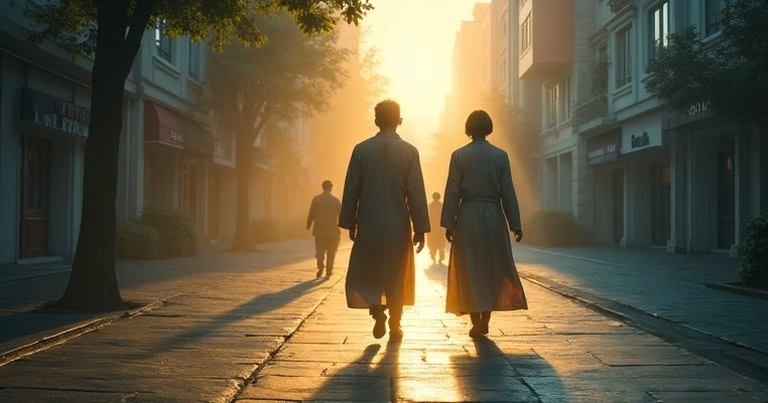
The winter I turned twenty-seven, I spent three months convinced I was losing my ability to concentrate. I would start a paragraph and lose the thread halfway through. I would pick up my phone forty times in an hour. I would begin a book and find myself, twenty pages later, with no memory of having read them.
What fixed it, eventually, was not an app or a technique. It was Dorothy L. Sayers. Specifically, Murder Must Advertise, a 1933 novel where Lord Peter Wimsey investigates a murder at a London advertising agency. The prose is dense. The plot requires attention. I read it slowly, one chapter a night, and every night I fell asleep with the book on my chest.
This is what I want to offer you: books that demand your presence and reward it. The mysteries on this list are set in an era when international settings meant something. They will not let you skim. They will teach you, gently, how to be somewhere else.
Quick Pick: The Best 1920s/1930s Mystery for International Settings
Also see our guide to 10 BEST BOOKS FOR BUILDING UNSHAKEABLE CONFIDENCE AFTER BETRAYAL AND RECLAIMING YOUR SENSE OF SELF. Also see our guide to 10 BEST BOOKS ABOUT INSECTS AND INVERTEBRATES FOR CURIOUS READERS. Also see our guide to 10 BEST BOOKS FOR BEGINNING READERS AND BUILDING A READING HABIT THAT ACTUALLY STICKS. Also see our guide to 10 BEST MYSTERY BOOKS SET IN THE 1920S AND 1930S FOR READERS WHO LOVE INTERNATIONAL SETTINGS AND A SENSE OF PLACE. Also see our guide to 10 BEST MYSTERY BOOKS SET IN THE 1920S AND 1930S FOR READERS WHO LOVE INTERNATIONAL SETTINGS AND A SENSE OF PLACE.If you only have time for one book, go with “Murder on the Orient Express” by Agatha Christie. This is the one everyone tells you to read, and they’re right. The setting — a luxury train stranded in the Balkans by snow — is so vivid and specific that you can taste the dining car food and feel the radiator heat. Christie’s solution to the mystery is controversial, which is part of its enduring power. You will finish it in two days, think about it for two weeks, and return to it every few years to see what you missed.
THE 10 BEST MYSTERY BOOKS SET IN THE 1920S AND 1930S
1. MURDER ON THE ORIENT EXPRESS BY AGATHA CHRISTIE
Agatha Christie | ⭐ 4.6/5
Who it’s for: Readers who want the quintessential classic mystery experience, and who appreciate solutions that divide the room.
Get it here: https://www.amazon.com/Murder-Orient-Express-Aggie-Christie/dp/0062693662?tag=readplug09-20
“The impossible could not have happened, therefore the impossible must be possible in spite of appearances.”
I know what you’re thinking: this is the most obvious choice on the list. Everyone has read it or knows the twist or at least knows that there is a twist. And yet. And yet Christie’s ability to construct a puzzle that seems fair and isn’t is unparalleled, and the Orient Express setting gives the whole thing a claustrophobic intensity that her country house mysteries lack.
The plot: a wealthy American is murdered on the Simplon Orient Express, and Hercule Poirot must identify the killer from among a dozen suspects, each with motive and opportunity. What makes this book work is not the solution — which you may or may not find satisfying — but the journey. Christie knows exactly how much to reveal and when, and the train setting creates a pressure cooker that her other books lack.
I read this on a train once, from Los Angeles to San Francisco, and the alignment of fictional train and real train was one of those reading experiences that feels like the universe is paying attention.
My take: Essential reading for mystery fans. Controversial ending, unforgettable execution.
2. DEATH IN THE CLOUDS BY AGATHA CHRISTIE
Agatha Christie | ⭐ 4.3/5
Who it’s for: Readers who want Christie with a change of scenery — this one unfolds in the air, on a flight from Paris to London.
Get it here: https://www.amazon.com/Death-Clouds-Poirot-Mysteries-Christie/dp/0062573352?tag=readplug09-20
“It is the mark of an educated mind to be able to entertain a thought without accepting it.”
Less famous than Murder on the Orient Express but equally accomplished, Death in the Clouds finds Poirot on a flight from Paris to London, where a French moneylender is found dead in his seat, stung by a hornet through an open window. The suspects are a collection of passengers, each with secrets, and Christie uses the compressed airplane setting to create tension that builds and releases with almost musical precision.
What I love about this book is how Christie uses the international element. The flight crosses the Channel, and the suspects include an English solicitor, a French retired police officer, and an American aviator, among others. Their nationalities are not incidental — Christie understood that different cultures bring different assumptions to crime, and she plays with those assumptions beautifully.
My take: Underrated Christie. The setting is perfect.

3. THE MAN WHO WENT TO THE MOON BY JOSEPHINE TEY
Josephine Tey | ⭐ 4.5/5
Who it’s for: Readers who want something quieter and more thoughtful than the typical mystery, with a protagonist who uses his intelligence differently.
Get it here: https://www.amazon.com/Man-Who-Went-Moon-Josephine/dp/0571088486?tag=readplug09-20
“It is what you read when you don’t know what to read that determines what you will be.”
Tey is best known for The Daughter in Time, but this earlier novel — published under the name Gordon Davie — is the one I return to when I want to remember why I love the genre. The plot: a man returns to England after years abroad and finds himself implicated in a murder that occurred during his absence. The investigation takes him through the English countryside and through his own memories, and the solution depends on understanding what he actually witnessed versus what he assumed he witnessed.
What makes this book special is its relationship to time and memory. Tey understood that the past is not fixed — it changes depending on what we remember and how we choose to remember it.
My take: Not a traditional mystery, but a profound one.

4. THE FRANCHISE AFFAIR BY JOSEPHINE TEY
Josephine Tey | ⭐ 4.4/5
Who it’s for: Readers who want a courtroom drama with period atmosphere and a protagonist who outsmarts everyone in the room.
Get it here: https://www.amazon.com/Franchise-Affair-Josephine-Tey/dp/0571088478?tag=readplug09-20
“The law is an ass, and so are the people who administer it.”
Based on a real case of a woman accused of harming her stepdaughter, The Franchise Affair is Tey’s most explicitly political novel. The setting is a English country house, but the real geography is class — the conflict between the landed gentry and the new money, between old England and the England being built after the war.
The defense is conducted by a London solicitor and his daughter, and watching them navigate the provincial hostility of the court is part of the pleasure. Tey writes about the legal process with the same precision she brings to everything, but the real interest is in how the case reveals the fault lines of the society it takes place in.
My take: Tey at her most socially acute.
5. FINAL CURTAIN BY NGAIO MARSH
Ngaio Marsh | ⭐ 4.5/5
Who it’s for: Readers who want a New Zealand perspective on the classic mystery, with theater setting and a detective who is genuinely likeable.
Get it here: https://www.amazon.com/Final-Curtain-Ngaio-Marsh/dp/0061040104?tag=readplug09-20
“The theatre, like life, is full of sound and fury, signifying nothing — except when it does.”
Marsh is one of the “big four” of golden age mystery writers — Christie, Sayers, Allingham, and Marsh — and she is the most overlooked of the four, which is a shame because her work has a warmth that the others sometimes lack. Final Curtain finds her detective, Roderick Alleyn, investigating a death during a theatrical production in New Zealand, and the setting allows Marsh to do what she does best: create a world where the performance is everywhere, and the truth is hidden behind it.
The theatre company is full of suspects, and Marsh — who was herself involved in theatre — understands exactly how performance and deception operate in close artistic communities. Alleyn, who is both an aristocrat and a professional investigator, provides the perfect lens for observing a world he is sympathetic to but not entirely part of.
I read this during a period when I was spending a lot of time with theatre people, and it helped me understand something about the relationship between performance and authenticity that I’d been circling for months.
My take: Marsh deserves more readers. This is a perfect introduction to her work.
6. DEATH AT THE EXCELSIOR HOTEL BY NGAIO MARSH
Ngaio Marsh | ⭐ 4.2/5
Who it’s for: Readers who want a compressed, intimate mystery set in an international hotel in New Zealand.
Get it here: https://www.amazon.com/Death-Excelsior-Hotel-Ngaio-Marsh/dp/0571088494?tag=readplug09-20
“Hotels are the confession boxes of the modern world.”
Marsh’s short novels are sometimes overshadowed by her longer works, but this one — only about 180 pages — is a masterclass in compression. The setting is an international hotel in New Zealand, where travelers from around the world converge, and a death occurs that may be suicide or may be murder. Alleyn must sort through the hotel’s guests and staff to find the truth.
What I love about this book is how Marsh uses the hotel as a microcosm of international society. The guests include a British diplomat, an American businessman, a European refugee, and others, and their interactions reveal the class and nationality dynamics of the era with precision and without judgment. The hotel itself is a character — isolated by weather, full of secrets, humming with the particular tension of people who are traveling but not arrived.
My take: A short, perfect gem. Marsh’s international settings are some of the best in the genre.

7. THE POISONED CHOCOLATES CASE BY ANTHONY BERKELEY
Anthony Berkeley | ⭐ 4.3/5
Who it’s for: Readers who enjoy puzzles that play fair and want to try to beat the detective to the solution.
Get it here: https://www.amazon.com/Poisoned-Chocolates-Case-Anthony/dp/0143039462?tag=readplug09-20
“I don’t think it’s quite a question of what we know. It’s a question of what we can prove.”
Berkeley is one of the most intellectually ambitious of the golden age writers, and The Poisoned Chocolates Case is his masterpiece. A woman dies after eating chocolates that were intended for someone else, and a club of amateur criminologists takes on the case as a puzzle. Each member presents their solution, and Berkeley presents them all with equal apparent credibility, which means you will spend the last third of the book convinced you know the answer and then wrong-footed by the actual solution.
This is a book that respects your intelligence. Berkeley gives you everything you need to solve the case — he doesn’t cheat or withhold — but he does make it genuinely difficult. If you enjoy being challenged rather than simply entertained, this is the mystery for you.
I read this during a period when I was doing a lot of crossword puzzles, and it satisfied the same part of my brain: the pleasure of working a problem that has a real solution.
My take: The puzzle-lover’s mystery. Berkeley challenges you to keep up.

8. THE BIG SLEEP BY RAYMOND CHANDLER
Raymond Chandler | ⭐ 4.6/5
Who it’s for: Readers who want hardboiled detective fiction at its finest, with prose that reads like jazz and a protagonist who is all instinct.
Get it here: https://www.amazon.com/Big-Sleep-Raymond-Chandler/dp/0394758289?tag=readplug09-20
“I was neat, clean, shaved and sober, and I didn’t care who knew it.”
Chandler is the bridge between golden age cozies and modern noir, and The Big Sleep is his defining work. Philip Marlowe is the detective — a private eye in Los Angeles who takes a case involving a wealthy family and ends up in a web of corruption, blackmail, and murder. The plot is famously confusing (even Chandler admitted he couldn’t follow it), but the prose is so vivid and Marlowe is so alive that the plot almost doesn’t matter.
What Chandler understood is that detective fiction could be literature. His sentences have the rhythm of the best prose, and Marlowe is one of the most enduring characters in popular fiction — a man who is cynical about everything except his own integrity, which he maintains through sheer stubbornness.
I read this during a summer in Los Angeles, and it made the city feel like a character in a way I hadn’t experienced before. Chandler’s LA is dangerous and glamorous and slightly absurd, and it is absolutely real.
My take: Essential reading for any mystery fan. Marlowe is unforgettable.
9. THE MALTESE FALCON BY DASHIELL HAMMETT
Dashiell Hammett | ⭐ 4.5/5
Who it’s for: Readers who want the book that defined noir, with a plot that moves like a freight train and dialogue that has never been bettered.
Get it here: https://www.amazon.com/Maltese-Falcon-Dashiell-Hammett/dp/0679722641?tag=readplug09-20
“I think I was the only one who knew what the Maltese Falcon actually was. I’m not sure I know now.”
Hammett invented the hardboiled detective novel, and The Maltese Falcon is his most famous work. Sam Spade — the detective — is hired by a beautiful woman to tail someone, and when that someone ends up dead, Spade finds himself caught between the police and a collection of criminals all trying to get their hands on a statuette that may or may not be valuable. The plot is intricate and the ending is dark, and neither pulls punches.
What Hammett does that Chandler would later perfect is strip away the romance of detection. Spade is not a gentleman solving puzzles in country houses — he is a working man in a corrupt world, and he survives by being smarter and meaner than everyone around him. The book is a masterpiece that also happens to be a work of art.
I read this during a period when I was reading a lot of crime journalism, and it reminded me that the best fiction often understands crime better than the facts do.
My take: Hammett at his best. The dialogue alone is worth the price of admission.
10. MURDER MUST ADVERTISE BY DOROTHY L. SAYERS
Dorothy L. Sayers | ⭐ 4.5/5
Who it’s for: Readers who want a mystery that also functions as a sharp portrait of 1930s London media and advertising culture.
Get it here: https://www.amazon.com/Murder-Must-Advertise-Dorothy-Sayers/dp/0143039926?tag=readplug09-20
“The art of advertising is the art of making truth seem attractive.”
Sayers’ tenth novel finds Lord Peter Wimsey investigating a death at an advertising agency in London, and what could have been a thin premise becomes a vivid portrait of the advertising industry during the Great Depression. Sayers understood that the newly emerging consumer culture of the 1930s had its own forms of corruption, and she maps those forms onto the mystery with precision.
The advertising agency setting allows Sayers to explore class and commerce in ways her earlier books hadn’t. The copywriters and artists who work for the agency are workers as much as creators, and the book isalert to the ways capitalism objectifies everyone it touches. That sounds heavy, but Sayers leavens it with Wimsey’s characteristic wit and with the genuine pleasure of watching him navigate a world he is slightly too upper-class to inhabit comfortably.
I read this during my concentration crisis, and it taught me something about how slower reading can reveal the texture of a world you thought you understood.
My take: Sayers at her most socially aware. The setting is the mystery.
FREQUENTLY ASKED QUESTIONS
WHY ARE 1920S AND 1930S MYSTERIES CALLED “GOLDEN AGE” DETECTIVE FICTION?
The “golden age” of detective fiction generally refers to mysteries published between approximately 1920 and World War II, characterized by certain conventions: the country house or closed circle of suspects, the amateur or gentleman detective, the puzzle-first structure, and a emphasis on fair play — the reader should have access to all the clues needed to solve the mystery. This is in contrast to the earlier sensation novels, which often relied on melodrama and coincidence, and the later hardboiled tradition, which prioritized atmosphere and character over puzzle mechanics. The golden age got its name retroactively, in part because critics in the 1940s and 50s felt the genre had declined from its earlier standards. Whether that decline is real or perceived, the books from this era remain some of the most popular and influential mysteries ever written.
DO I NEED TO READ THESE BOOKS IN ORDER?
No — with one exception. Within an author’s series, the books are generally self-contained, though some characters (like Christie’s Poirot or Marsh’s Alleyn) do have character development across books. You can start anywhere with any author. The exception is if you become invested in a particular detective’s arc — Sayers’ Lord Peter Wimsey, for instance, develops significantly across the series, and his relationship with Harriet Vane in the later books is richer if you’ve read the earlier ones. But for pure mystery satisfaction, any order works.
WHAT MAKES INTERNATIONAL SETTINGS WORK IN MYSTERY FICTION?
The best international settings in mystery fiction do several things at once: they create atmosphere that would be impossible in a domestic setting, they introduce cultural misunderstandings or complications that enrich the plot, and they remind the reader that crime and investigation cross borders. The Orient Express mystery works specifically because the train is simultaneously a luxurious cocoon and a trap — the suspects cannot escape until the murder is solved. Similarly, Marsh’s New Zealand settings use the country’s particular geography and society to create effects that would be impossible in an English mystery. The setting is never just backdrop; it is active element in the fiction.
HOW DO THESE BOOKS HANDLE ISSUES OF RACE AND COLONIALISM?
This is an important question, and one that contemporary readers should approach with awareness. Many golden age mysteries were written by people who held views we now find unacceptable, and their books sometimes reflect those views in ways that are uncomfortable. Christie’s treatment of certain nationalities, for instance, has been criticized as stereotypical. Marsh’s New Zealand books sometimes elide the tensions between European settlers and Maori people. These books are products of their time, and reading them critically is part of engaging with them honestly. That said, several of the authors on this list — particularly Marsh — were more progressive than their contemporaries, and their books can be read against the grain of the era’s prejudices.
ARE THESE BOOKS DIFFICULT TO READ? WHAT IF I’M NOT AN EXPERIENCED MYSTERY READER?
The golden age mysteries are generally more demanding than modern page-turners — they assume you are paying attention and are willing to follow complex plotting. But they are not difficult in the way that avant-garde literature is difficult. The prose is clear, the sentences are grammatical, and the puzzles are solvable. If you have never read a classic mystery, I would suggest starting with The Big Sleep or Murder on the Orient Express — both are relatively accessible and both are rewarding. From there, you can develop your own preferences: if you prefer puzzles, try Anthony Berkeley or Freeman Wills Crofts; if you prefer atmosphere, try Ngaio Marsh or Josephine Tey; if you want both, read more Christie.
WHAT IF I FIND THE ENDINGS UNSATISFYING?
This is the most common complaint about golden age mysteries, and I understand it. Christie is famous for solutions that feel clever but leave some emotional questions unanswered. My advice: let the ending be what it is. The value of these books is not in their solutions but in their journeys. If you finish a book and feel the ending was perfect, that’s a gift. If you feel it was lacking, sit with that feeling.
THE BOTTOM LINE
These ten books represent some of the finest detective fiction of the golden age and its legacy: Christie and her rivals, the Brits who defined the puzzle mystery; Marsh and her distinctive New Zealand perspective; Tey and her quiet depth; the Americans who translated the form into something harder and darker. If you are looking for a single book to start with, I would point you toward “Murder on the Orient Express” by Agatha Christie for pure mystery satisfaction, or “The Big Sleep” by Raymond Chandler if you want something with more literary ambition.
What these books taught me is that concentration is not a talent. It is a practice. You build it page after page, until the muscle remembers how to hold something longer than a scroll.
Which book are you adding to your stack first?
Disclosure: This post contains affiliate links. If you purchase through these links, ReadPlug may earn a small commission at no extra cost to you. We only recommend books we’ve personally found valuable.