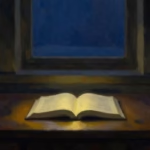
I used to think nonfiction was medicine. The kind you take because it is good for you, not because you want to. I had this image of a person at a desk with a highlighter and a stack of books, reading with the grim determination of someone who has decided to improve whether they enjoy it or not. That person was me. I had a system: read for twenty minutes, take notes, summarize in a journal, feel inadequate about how much I still did not know. It was productive, I guess. It was also joyless, and eventually I quit reading nonfiction altogether because I had convinced myself that learning and fun could not exist in the same book.
I don’t remember exactly when that changed. Probably on a Sunday afternoon when I was avoiding something I was supposed to be doing and picked up a book I had bought on impulse because the cover was orange. It was funny — the kind of funny that makes you read a paragraph aloud to no one because you need someone else to witness it. I finished it that evening. I learned more from that book than from any of my carefully scheduled self-improvement projects. I did not highlight a single sentence. I just let it wash over me, and I woke up the next morning still thinking about it, which is how you can tell a book has actually gotten under your skin.
That is what this list is. Books that feel like conversations with someone smarter than you who does not make you feel dumb about it. The ones you pick up because they sound interesting and then realize, somewhere around page fifty, that you are being quietly and permanently changed.
Quick Pick: The Best Fun Nonfiction Book to Start With
Also see our guide to 10 BEST BOOKS FOR A MIND-BENDING SCI-FI READ THAT WILL RE-AWAKEN YOUR LOVE FOR THE GENRE AND TRANSFORM YOUR LIFE. Also see our guide to 10 BEST BOOKS FOR BOUNCING BACK FROM FAILURE AND BUILDING THE KIND OF RESILIENCE THAT ACTUALLY LASTS. Also see our guide to 10 Best Books for Breaking Free from People-Pleasing and Setting Boundaries That Actually Stick. Also see our guide to 10 Books That Feel Like Endless Road Trips With No Destination (And Will Transform Your Life). Also see our guide to 10 BEST BOOKS FOR BUILDING A DAILY SELF-CARE ROUTINE THAT ACTUALLY STICKS.If you only read one book from this list, make it “Born a Crime” by Trevor Noah. It is the funniest book I have ever read about a subject that is not funny at all. Trevor Noah tells the story of growing up in apartheid South Africa as the child of a white father and a Black mother — a combination that was literally illegal. He makes you laugh on every page. You will learn more about South African history, about mothers, about resilience, and about the absurdity of systemic racism than you would from a hundred serious books, and you will not feel like you are being taught anything. That is the magic trick.
Get it here: Buy on Amazon
THE 10 BEST FUN AND EASY NONFICTION BOOKS THAT WILL TRANSFORM YOUR LIFE
1. ATOMIC HABITS BY JAMES CLEAR
James Clear | ⭐ 4.8/5
Who it’s for: Anyone who has tried to change a habit, failed, and assumed it was a character flaw rather than a systems problem.
“You do not rise to the level of your goals. You fall to the level of your systems.”
This is the book that taught me that my problem with habits was not a lack of willpower but a lack of a decent system. Clear breaks down behavior change into small, manageable pieces. The Four Laws of Behavior Change are illustrated with genuinely entertaining stories — Olympic cyclists, British cycling teams, a doctor who saved lives by changing one small procedure. What makes this book fun rather than preachy is that Clear does not moralize about habits. He tells you your environment is badly designed and your cues are wrong, and then he gives you tools to fix it.
My take: The clearest, most actionable, and most enjoyable book on behavior change I have ever read.
2. BORN A CRIME BY TREVOR NOAH
Trevor Noah | ⭐ 4.7/5
Who it’s for: Anyone who needs proof that a book can be hilarious and heartbreaking at the same time.
“Language brings with it an identity and a culture, or at least the perception of it. A shared language says ‘We’re the same.’ A language barrier says ‘We’re different.’”
I have read this book twice and bought it for five different people. Noah’s memoir about growing up in South Africa during apartheid is, on paper, a story about systemic racism and poverty. In practice, it is one of the funniest, most alive books I have ever read. His mother is the true hero — a woman so fiercely independent that she defied laws and social norms to give her son a childhood not defined by the color of his skin. Each chapter is a self-contained story, perfect for reading in short bursts. He narrates the audiobook himself and it is extraordinary.
My take: This book reminds you that the most profound lessons often come wrapped in laughter.
3. THE SUBTLE ART OF NOT GIVING A F*CK BY MARK MANSON
Mark Manson | ⭐ 4.6/5
Who it’s for: Anyone tired of positive thinking who wants permission to be honest that life is hard and sometimes ridiculous.
“The desire for more positive experience is itself a negative experience. And, paradoxically, the acceptance of one’s negative experience is itself a positive experience.”
I picked this up expecting a gimmick. A book about not caring, written by a blogger with a potty mouth — how profound could it be? I read the whole thing in one sitting. Manson is not actually telling you not to care about anything. He is telling you to care about the right things and stop wasting energy on everything else. The book draws on Stoic philosophy and Buddhist thought but wears its learning lightly. The chapter on the “feedback loop from hell” — feeling anxious about being anxious, sad about being sad — changed how I understand my own emotional patterns.
My take: The book I give to friends who say they hate self-help. Irreverent, honest, and surprisingly wise.
4. IKIGAI BY HECTOR GARCIA AND FRANCESC MIRALLES
Hector Garcia and Francesc Miralles | ⭐ 4.5/5
Who it’s for: Anyone curious about Japanese culture, looking for purpose, or wanting a book that feels like a warm cup of tea.
“Only staying active will make you want to live a hundred years.”
I read this during a week when anxiety was curled up in my chest like something waiting to spring, and it had the quality of a gentle hand on my shoulder. The authors traveled to Okinawa, one of the world’s Blue Zones, and interviewed residents about their philosophy of life. The concept of ikigai — your reason for being — is at the center. The chapters are short. The tone is gentle. It does not demand that you overhaul your life. It simply describes how another culture approaches a meaningful existence and leaves you space to take what works.
My take: Not every book needs to be a rigorous argument. Some just need to make you feel more human.
5. SAPIENS BY YUVAL NOAH HARARI
Yuval Noah Harari | ⭐ 4.7/5
Who it’s for: Anyone who wants to understand how the world got this way without reading a dense academic textbook.
“Humans think in stories rather than in facts, numbers, or equations, and the simpler the story, the better.”
I put this off for years because I assumed it would be dry. A history of the entire human species — that sounds like a textbook, right? It is not. Harari writes with the narrative propulsion of a novelist, moving from the Cognitive Revolution to the Agricultural Revolution to the Scientific Revolution with a clarity that makes complex ideas feel obvious. His central argument — that humans dominate the planet because we cooperate flexibly in large numbers through shared fictions like money and nations — is one of those ideas that seems simple once you hear it and changes how you see everything.
My take: The book that made me fall back in love with learning. It will change how you think about literally everything.
6. FACTFULNESS BY HANS ROSLING
Hans Rosling | ⭐ 4.6/5
Who it’s for: Anyone who feels overwhelmed by the news and suspects the world might not be as bad as it seems.
“The world is better than you think, but it is still bad enough.”
I read this during a period when I was avoiding the news because every headline felt like a crisis. Rosling uses data to show that most of our assumptions about the world are wrong — and that the truth is far more hopeful than we think. He names the cognitive biases that distort our view: the gap instinct, the negativity instinct, the fear instinct. Each chapter is accompanied by simple charts and stories from his career as a doctor in Mozambique and a consultant for the WHO. His voice is warm and enthusiastic. He acknowledges real problems honestly but wants you to see that progress is real and measurable.
My take: The most hopeful book about the state of the world I have ever read.
7. HYPERBOLE AND A HALF BY ALLIE BROSH
Allie Brosh | ⭐ 4.5/5
Who it’s for: Anyone who needs a book that makes them laugh until they cry, especially if they are also dealing with depression.
“I am not sure what I was expecting. But I certainly was not expecting what I got.”
This is the most unusual book on this list — an illustrated memoir that looks like a children’s book but is not remotely for children. Brosh’s stick-figure drawings and wildly exaggerated stories are hilarious on the surface. The chapter about her dog’s complete inability to understand the concept of moving is one of the funniest things I have ever read. But underneath the humor is a devastatingly honest portrayal of depression. Her chapters on the subject, originally published on her blog to an overwhelming response, are among the most accurate descriptions I have encountered. She does not romanticize it or offer solutions. She just describes it with such precision that anyone who has been through it will feel seen.
My take: Proof that the most serious subjects can be addressed through humor. It will make you laugh and then make you feel less alone.
8. THE HAPPINESS PROJECT BY GRETCHEN RUBIN
Gretchen Rubin | ⭐ 4.3/5
Who it’s for: Anyone who has wondered if happiness can be systematically cultivated.
“The days are long, but the years are short.”
Rubin spent a year systematically trying to increase her happiness, tackling one area of life each month: energy, marriage, work, parenthood. The formula could be tedious, but Rubin is such an engaging writer and so willing to share failures alongside successes that the book reads more like a novel than a self-improvement manual. Her framework of the “Four Tendencies” — how people respond to expectations — helped me understand why some resolutions stick for me and others do not. I read this in a weekend and immediately implemented two of her resolutions.
My take: Warm, practical, and surprisingly addictive. Rubin feels like a friend sharing what she has learned.
9. A WALK IN THE WOODS BY BILL BRYSON
Bill Bryson | ⭐ 4.4/5
Who it’s for: Anyone who loves travel, needs a good laugh, or wants to read about nature without going outside.
“The Appalachian Trail covers some of the most rugged and beautiful terrain in America. It also covers some of the most tedious and painful terrain in America. The two are often the same stretch of trail.”
Bryson decided to hike the Appalachian Trail despite having no experience, no fitness, and no realistic idea of what he was getting into. The result is one of the funniest travel books ever written. His voice is perfectly suited to the subject — endlessly curious, frequently exasperated, capable of turning a description of a blistered foot into comedy gold. He weaves in information about forest ecology, the history of the National Park system, and the eccentric characters along the trail. You finish knowing more about American wilderness than you expected, and you enjoyed every minute of the education.
My take: Bryson is the master of making learning effortless. Hilarious, informative, and oddly inspiring.
10. THE BOOK OF JOY BY DALAI LAMA AND DESMOND TUTU
Dalai Lama and Desmond Tutu | ⭐ 4.6/5
Who it’s for: Anyone who needs a reminder that joy is possible even in the face of enormous suffering.
“We are more alike than we are unalike.”
In 2015, Desmond Tutu traveled to Dharamshala to spend a week with his friend the Dalai Lama. Both had endured profound suffering — Tutu under apartheid, the Dalai Lama in exile from Tibet. The book from their conversations is about joy: how to find it, how to sustain it, and why it matters. The format is conversational, with Douglas Abrams facilitating. The two old friends joke with each other, tease each other, and reflect on their lives with warmth that is palpable on the page. They discuss the eight pillars of joy — perspective, humor, acceptance, forgiveness, gratitude, compassion, generosity — and each chapter feels like sitting in on a conversation between two people who have earned the right to speak.
My take: I keep this on my nightstand and return to it in small doses. Like a conversation with two very wise grandparents who have seen everything and still choose hope.
11. QUIET BY SUSAN CAIN
Susan Cain | ⭐ 4.5/5
Who it’s for: Anyone who has been told they are too quiet and wondered if something was wrong with them.
“There’s zero correlation between being the best talker and having the best ideas.”
I grew up assuming my quietness was a flaw that needed correcting. Susan Cain’s book was the first time I encountered the argument that introversion is not a deficiency but a different way of processing the world, with its own strengths. She combines research with stories: introverted lawyers thriving in an extroverted profession, quiet leaders who transformed industries without dominating the room. Her chapter on how schools and workplaces are designed for extroverts and what that costs us is one of the most insightful pieces of social criticism I have read.
My take: If you have ever felt like the world is designed for someone louder than you, this book is a permission slip to be exactly who you are.
12. WHY WE SLEEP BY MATTHEW WALKER
Matthew Walker | ⭐ 4.6/5
Who it’s for: Anyone who has ever pulled an all-nighter, struggled to fall asleep, or wants to understand one of the most essential functions of the human body.
“The shorter your sleep, the shorter your life.”
I have never read a book that made me want to go to bed earlier more than this one. Walker, a sleep scientist at UC Berkeley, makes the case that sleep is the single most effective thing we can do to reset our brain and body. The evidence is overwhelming: sleep affects learning, memory, emotional regulation, immune function, appetite, creativity, and longevity. He translates complex neuroscience into vivid explanations — describing REM sleep like he is narrating a nature documentary, explaining why caffeine works and why alcohol ruins sleep quality. This book changed my relationship with sleep. I now treat it as non-negotiable.
My take: The rare science book that actually changes your behavior. After reading it, you will not want to stay up late scrolling ever again.
FREQUENTLY ASKED QUESTIONS
WHY SHOULD I READ NONFICTION WHEN FICTION IS MORE FUN?
Nonfiction gets a reputation for being dry because we are forced to read it in school. The best nonfiction does not read like a textbook. It reads like a conversation with a fascinating person. A novel might change how you feel. A great nonfiction book can change how you think, how you make decisions, and how you spend your time. When the writing is good, it is just as immersive as fiction. The difference is that when you close a great nonfiction book, the world looks different.
I’M NOT A BIG READER. ARE THESE BOOKS ACTUALLY EASY TO GET THROUGH?
Every book on this list was chosen specifically because it is accessible. I have a friend who had not finished a book in five years, and she read “Born a Crime” in three days. The key is matching the book to your curiosity. “Sapiens” reads like a novel. “Hyperbole and a Half” is basically a comic book with deeper meaning. Start with the book that sounds most interesting, not the one you think you should read.
CAN A FUN BOOK REALLY BE TRANSFORMATIVE?
Absolutely. Some of my most profound insights came from books that made me laugh out loud. Humor disarms us. When we are laughing, we are open and not defending ourselves against being changed. That is why Trevor Noah can teach you about apartheid in a way that sticks more than any textbook. Fun is not the opposite of transformation. Sometimes it is the vehicle for it.
HOW DO I FIND TIME TO READ NONFICTION?
These books average 250-300 pages, and most are designed for short bursts. “Atomic Habits” has chapters that are four or five pages long. Start with ten minutes a day — during breakfast, your commute, before bed. Fair warning: these books are addictive. I started “Sapiens” planning to read for twenty minutes and looked up two hours later.
WHAT IF I START A BOOK AND DON’T LIKE IT?
Put it down. One of the worst things we do as readers is feel obligated to finish every book. If a book is not grabbing you by page fifty, it is not the right book for you right now. That does not mean it is bad. It means the timing is wrong. Try a different book from this list. Come back to the first one in six months. Reading should not feel like homework.
IS THIS JUST ANOTHER LIST OF SELF-HELP BOOKS?
Not exactly. Some are self-help — “Atomic Habits” and “The Happiness Project.” But others are memoirs, science writing, travel writing, and humor. What they share is that they left me thinking differently about something important. “Factfulness” changed how I understand global progress. “Sapiens” changed how I understand human history. “Why We Sleep” changed how I treat my body. Transformation does not require a book that tells you what to do. It just requires a book that shows you something you had not seen before.
WHAT IS THE BEST FORMAT TO READ THESE?
However you will actually read them. Audiobooks count. E-books count. Library books count. That said, “Born a Crime” is extraordinary as an audiobook because Noah narrates it himself. “Hyperbole and a Half” is best in physical form because the drawings matter. The others work in any format.
THE BOTTOM LINE
I spent years believing that learning had to be hard. I thought if a book was not challenging me, it was not helping me. I could not have been more wrong. The books that have actually changed my life — the ones I think about years later, the ones I buy for friends, the ones I return to in hard moments — are almost all books I enjoyed reading. They did not feel like medicine. They felt like gifts.
If you are new to nonfiction or returning after a break, start with “Born a Crime” or “Hyperbole and a Half.” Let yourself laugh. Let yourself enjoy the process. Then follow whatever thread pulls you next. Maybe you will want to understand habits, so you pick up “Atomic Habits.” Maybe you will need comfort and find it in “The Book of Joy.” The books on this list are doorways. You only need to walk through one.
Which one are you starting with?
Disclosure: This post contains affiliate links. If you purchase through these links, ReadPlug may earn a small commission at no extra cost to you. We only recommend books we’ve personally found valuable.