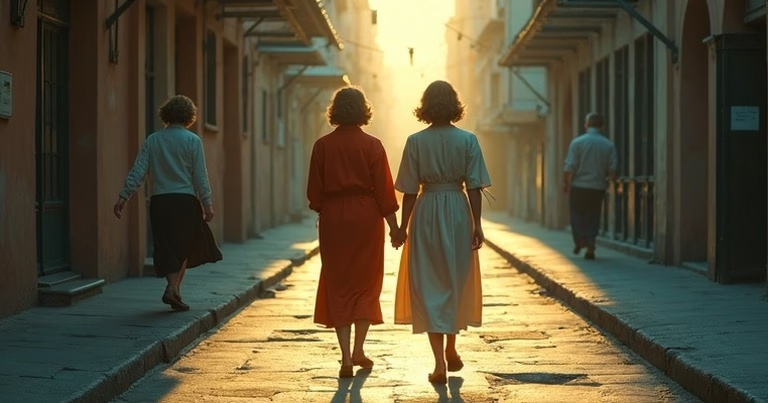
I was twenty-two years old, sitting on the floor of a bathroom stall between seminars at UC Davis, convinced I was dying. My heart was doing something I didn’t have a name for, my chest felt like it was collapsing from the inside, and the fluorescent lights were too bright and the walls were too close and I had never felt more alone in my life. I didn’t know what a panic attack was. I thought I was having a heart attack, or a stroke, or some catastrophic system failure that my body had decided to initiate without consulting me first. I sat on that floor for what felt like a very long time, and then I got up, washed my face, and walked back to my seminar like nothing had happened.
That night I was too scared to close my eyes because I was afraid it would happen again. I lay in bed in my small apartment with the gas stove that smelled faintly of something I never identified, and I did the only thing I knew how to do when I was afraid: I looked for a book. Not a textbook, not something for a class, but a real book — the kind you read because you need something to hold onto. I found a used copy of “The Power of Now” by Eckhart Tolle at a bookstore the next day, and I read it sitting on my floor with my back against the couch because for some reason that was the position where things felt most manageable. I didn’t understand all of it. Some of it I actively resisted. But something in those pages cracked open a door I didn’t know was there, and through that door came the first real evidence I had ever encountered that the noise in my head was not permanent.
That was the book that turned me into the person I am now — someone who reads not just for information or entertainment, but for transformation. Every book since then that has changed me has done it the same way: quietly, without announcement, like water finding a new path through stone. You don’t notice it happening. Then one day you look back and the landscape of your mind is different, and you realize the book did that, and you have been different ever since.
This list is for anyone who has ever sat on a bathroom floor and wished for something to hold onto. These are the books that don’t just inform you — they change you. They are the ones that, when someone asks me for a single recommendation, the kind that could actually redirect a life, these are the titles that surface first.
Quick Pick: If You Read One Book, Make It This One
Also see our guide to 10 BEST BOOKS FOR A GOOD SHORT EASY TO READ THRILLER (PG-13) AND TRANSFORMING YOUR LIFE. Also see our guide to 10 BEST BOOKS FOR BOOK CLUB AND TRANSFORMING YOUR LIFE. Also see our guide to 10 BEST BOOKS FOR A BOOK SERIES FROM THE 1950S-60S WITH A FEMALE PROTAGONIST AND NICE ARTWORK AND TRANSFORMING YOUR LIFE. Also see our guide to 10 BEST BOOKS FOR A BOOK ABOUT A U.S. PRESIDENT AND TRANSFORMING YOUR LIFE. Also see our guide to 10 BEST BOOKS FOR BOOKS THAT STAY WITH YOU FOR A LONG TIME AND TRANSFORMING YOUR LIFE.If you only have time for one book that will genuinely transform how you see yourself and your place in the world, go with “Man’s Search for Meaning” by Viktor Frankl. This is not a self-help book in the conventional sense. It is a memoir by a psychiatrist who survived Auschwitz and emerged with a psychological framework that has helped millions of people find purpose in the midst of unbearable suffering. It is 184 pages. You can read it in an afternoon. It will sit in your chest for the rest of your life.
Get it here: https://www.amazon.com/Mans-Search-Meaning-Viktor-Frankl/dp/080701429X?tag=readplug09-20
THE 10 BEST BOOKS FOR A RECOMMENDATION AND TRANSFORMING YOUR LIFE
1. “MAN’S SEARCH FOR MEANING” BY VIKTOR FRANKL
Viktor Frankl | ⭐ 4.7/5
Who it’s for: Anyone who has ever asked themselves “What is the point?” — whether in the middle of a crisis or the quiet of an ordinary Tuesday.
“When we are no longer able to change a situation, we are challenged to change ourselves.”
This is the book I give to friends going through something I don’t have words for. Frankl wrote it in nine days after his liberation from the concentration camps, and every sentence carries the weight of someone who earned it the hard way. The central idea — that meaning is not something we find but something we create through our attitude toward unavoidable suffering — is the foundation of logotherapy, a branch of existential psychology that still influences therapists today. Frankl never pretends that suffering is a gift. He simply observes that we can choose our response, and that this choice is the last human freedom. I read this book at twenty-two on the floor of my Davis apartment, and it was the first time I understood that what I was feeling was not a malfunction. It was material. It was something I could work with.
My take: The book I measure all other life-changing books against. If you read nothing else from this list, read this one.
2. “ATOMIC HABITS” BY JAMES CLEAR
James Clear | ⭐ 4.8/5
Who it’s for: Anyone who has ever set a goal, failed to follow through, and concluded the problem was them rather than their system.
“You do not rise to the level of your goals. You fall to the level of your systems.”
I resisted this book because I assumed it was another productivity manual written by someone who never had a 3am panic attack. I was wrong. Clear’s framework — that small 1% improvements compound into transformations that feel almost miraculous in retrospect — is not about becoming a machine. The chapter on identity-based habits changed how I think about change itself. Instead of “I want to read more,” you say “I am a reader.” The behavior follows the identity. I started using this with my morning routine — not “I want to meditate” but “I am someone who starts the day with stillness” — and something shifted that never had before.
My take: The most practical book on the list. If transformation feels abstract to you, start here.
3. “THE POWER OF NOW” BY ECKHART TOLLE
Eckhart Tolle | ⭐ 4.6/5
Who it’s for: Overthinkers, chronic worriers, anyone whose internal monologue has become a hostile roommate they can’t evict.
“Realize deeply that the present moment is all you ever have. Make the Now the primary focus of your life.”
This was the first book that showed me the difference between the voice in my head and the awareness that observes it. That distinction — between thinking and being aware of thinking — became the foundation of my relationship with anxiety. I read this book three times before it fully clicked. The third time, I was sitting in my car after a difficult conversation and felt the familiar dread rising. Instead of following it, I just watched it. It rose, peaked, and dissipated. That was the first time I ever experienced a feeling without becoming it. Some of Tolle’s spiritual language won’t land for everyone, but the core insight — you are not your thoughts — is genuinely liberating if you can receive it.
My take: This book requires patience. It is not a quick fix, but it can fundamentally change your relationship with your own mind.
4. “DAREING GREATLY” BY BRENÉ BROWN
Brené Brown | ⭐ 4.7/5
Who it’s for: Anyone who has ever stayed small to avoid judgment, stayed quiet to avoid criticism, or stayed safe to avoid rejection.
“Vulnerability is not winning or losing; it’s having the courage to show up and be seen when we have no control over the outcome.”
I read this book in the aftermath of the letter from my father — actual paper, actual handwriting, asking to make amends after twenty years of absence. I had been carrying it in my bag for weeks, trying to find the version of it that meant less than it did. Brown’s research gave me language for the fear keeping me from responding: the fear that if I showed up, I would be hurt again. She argues that vulnerability is not weakness but the birthplace of courage, connection, and belonging. I have recommended this book to more friends than any other on this list, because almost everyone I know is walking around with something they’re afraid to say out loud.
My take: If you avoid difficult conversations, this book will feel like being gently called out. Read it anyway.
5. “SAPIENS: A BRIEF HISTORY OF HUMANKIND” BY YUVAL NOAH HARARI
Yuval Noah Harari | ⭐ 4.6/5
Who it’s for: Readers who want to understand why the world is the way it is — how we got here, and what that means for how we think about money, religion, and happiness.
“There is no justice in history. No one can argue with a fait accompli.”
This book made me rethink everything I thought I knew about being human. Harari argues that Homo sapiens conquered the world not because of individual intelligence but because of our ability to believe in shared fictions — nations, money, corporations, laws. Understanding that changed how I read the news, how I understood politics, how I saw the structures around me. The chapter on the Agricultural Revolution was the one that stayed: he argues farming was not the progress we imagine, that it made life harder and more precarious for the average human. That chapter made me question every assumption I had about productivity and the relentless push to optimize.
My take: This book will make you feel smarter and smaller at the same time. That combination is good for the soul.
6. “EDUCATED” BY TARA WESTOVER
Tara Westover | ⭐ 4.6/5
Who it’s for: Anyone torn between the world they came from and the world they want to belong to. Especially for first-generation students and people from difficult families.
“You can love someone and still choose to say goodbye to them. You can miss a person every day and still be glad that they are no longer in your life.”
I read this memoir in two days. Westover grew up in a survivalist family in the mountains of Idaho without a birth certificate, without a formal education, without medical care. She taught herself enough math to pass the ACT, got into BYU, and eventually earned a PhD from Cambridge. But the real story is about the cost of transformation — what it costs to leave the only world you’ve known, even when that world was hurting you. The passage that broke me was when she realizes she can love her family and still choose to be separate. That tension maps onto my own situation in ways that made me put the book down several times and stare at the wall.
My take: Not a feel-good memoir. A true one. If you’ve had to choose between family and your own growth, read this.
7. “THE ALCHEMIST” BY PAULO COELHO
Paulo Coelho | ⭐ 4.5/5
Who it’s for: People at a crossroads who need permission to follow something they can’t fully explain.
“And, when you want something, all the universe conspires in helping you to achieve it.”
I know this book has become a cliché. I know it appears on Pinterest boards and graduation speeches. I know all of that, and I still think it is genuinely powerful when you read it at the right time. I first read it at eighteen, right after moving into my UCLA dorm. I didn’t get it. I read it again at twenty-five, after leaving academia, after the panic attacks, after starting to understand that following your “Personal Legend” is not a mystical fantasy but an actual decision you make every day. It hit differently the second time. Sometimes a book finds you when you are ready.
My take: If you have dismissed this book, I understand. Consider picking it up at a different point in your life.
8. “THE GIFTS OF IMPERFECTION” BY BRENÉ BROWN
Brené Brown | ⭐ 4.6/5
Who it’s for: Perfectionists, people-pleasers, and anyone whose inner critic has a louder voice than their inner advocate.
“Owning our story and loving ourselves through that process is the bravest thing that we will ever do.”
Brown identifies ten guideposts for wholehearted living — belonging, worthiness, rest, play, trust, creativity, meaningful work — and each chapter is a meditation on one of them. The chapter on rest undid me. She writes about how our culture confuses productivity with self-worth, and how the inability to rest is a form of violence we do to ourselves. I grew up believing my worth was tied to accomplishments — straight As, scholarships, fellowships, proof that I deserved to take up space. This book was the first to suggest, with research to back it up, that this approach was not just unsustainable but actively harmful. That rest was not a reward I earned but a necessity I was entitled to.
My take: If you are fundamentally tired, this book gives you permission to stop running.
9. “WHEN BREATH BECOMES AIR” BY PAUL KALANITHI
Paul Kalanithi | ⭐ 4.7/5
Who it’s for: Anyone who has confronted mortality — their own or someone they love’s — and needs language for what that does to a person.
“The future I had imagined, the one just about to be realized, the culmination of decades of striving, had evaporated.”
This is the book I read when I need to be reminded that life is short and real and not a rehearsal. Kalanithi was a neurosurgeon in his final year of residency when he was diagnosed with stage IV lung cancer at thirty-six. This memoir — unfinished, because he died before completing it — is his attempt to understand what makes life meaningful when you know exactly how much you have left. The most devastating section is when he describes returning to work after diagnosis, still operating, still holding brains in his hands, knowing his own brain was growing the cancer that would kill him. He writes without self-pity, with the precision of a surgeon and the wonder of someone seeing ordinary life as precious for the first time.
My take: This book does not give you answers. It asks the right questions and refuses to look away.
10. “MEDITATIONS” BY MARCUS AURELIUS
Marcus Aurelius | ⭐ 4.6/5
Who it’s for: Anyone who feels overwhelmed by things outside their control — leaders, caregivers, and anyone whose peace depends on things they cannot guarantee.
“You have power over your mind — not outside events. Realize this, and you will find strength.”
This is the book I read when I cannot sleep. I keep the Gregory Hays translation on my nightstand. Marcus Aurelius wrote these meditations for himself, not for publication, and that private quality is what makes them so powerful — the most powerful man in the world spending his mornings reminding himself not to be angry about traffic or frustrated with difficult people or afraid of death. The passage I return to most: “The cucumber is bitter? Then throw it out. There are brambles in the path? Then go around. That is enough. Do not ask, ‘Why did this happen?’” It does not make difficulty go away, but it returns me to myself.
My take: Stoicism is having a cultural moment, but this is the real thing. Read it slowly, one passage at a time.
11. “THE FOUR AGREEMENTS” BY DON MIGUEL RUIZ
Don Miguel Ruiz | ⭐ 4.6/5
Who it’s for: Anyone who feels trapped by patterns they know are not serving them but don’t know how to change.
“If you want to change the world, start with yourself. But don’t think for a moment that it’s about you.”
The four agreements are deceptively simple: be impeccable with your word, don’t take anything personally, don’t make assumptions, always do your best. I read them at twenty-three and thought they were too basic. I was wrong. The practice of not taking things personally — recognizing that what others say is a projection of their reality, not a reflection of mine — took years to integrate and I am still working on it. Ruiz draws on Toltec wisdom, framing our reality as a “dream” we absorbed from family and culture. Real freedom comes from consciously choosing which agreements to keep. This is a short book, maybe 140 pages. I have read it six times.
My take: Simple does not mean easy. These four agreements take a lifetime to master.
12. “THINKING, FAST AND SLOW” BY DANIEL KAHNEMAN
Daniel Kahneman | ⭐ 4.6/5
Who it’s for: Anyone who wants to understand why they make the decisions they make — especially the bad ones.
“We can be blind to the obvious, and we are also blind to our blindness.”
This is the most demanding book on the list. Kahneman, a Nobel laureate, spent decades researching the systematic errors our minds make. System 1 (fast, intuitive) and System 2 (slow, deliberate) are now part of my everyday vocabulary. The chapter on the availability heuristic — our tendency to overestimate the likelihood of events that come easily to mind — changed how I consume news. The chapter on loss aversion changed how I make decisions. This is a book that, once you read it, you see the world differently. You catch yourself making errors you never noticed before.
My take: The most demanding book here. Read in chunks. The transformation is cognitive, not emotional, and it is real.
FREQUENTLY ASKED QUESTIONS
I’M NOT A BIG READER. WHERE SHOULD I START?
Start with “Man’s Search for Meaning” — 184 pages, finish it in an afternoon. Do not pressure yourself to read all twelve. Read one. Let it sit. Transformation does not happen on a deadline.
WHAT IF I READ A BOOK FROM THIS LIST AND DON’T LIKE IT?
Not every life-changing book will change every life. I have recommended “The Alchemist” to people who found it trite. That is not a failure. Put it down without guilt and try a different one. The right book at the wrong time is still the wrong book.
CAN A SINGLE BOOK REALLY CHANGE YOUR LIFE?
Not like a light switch — like rain on the ground, slowly by accumulation. You read a sentence that lands. Days later, you notice thinking differently. Weeks later, you make a decision you would not have made before. The change is not the book itself. It is what you do with what it gave you.
I STRUGGLE WITH FOCUS. WHAT DO YOU RECOMMEND?
Start with “The Four Agreements” — short, direct. If that still feels like too much, try audiobooks. I find that listening while walking or doing dishes helps me focus better than sitting with a page. Both “Man’s Search for Meaning” and “The Alchemist” have excellent audiobook versions.
IS THIS LIST ONLY FOR PEOPLE IN CRISIS?
Not at all. “Sapiens” and “Thinking, Fast and Slow” are about understanding the world, not processing pain. Think of this list as a toolkit for becoming more awake to your own life. Crisis is one reason. Curiosity is just as valid.
WHAT IF MY FAVORITE LIFE-CHANGING BOOK ISN’T ON THIS LIST?
There is no definitive list — every reader brings their own history to every page. Your favorite book belongs on your version. If a book changed you, share it with someone. That is how transformation spreads: one person saying to another, “This one. Read this one.”
HOW LONG SHOULD I WAIT TO SEE CHANGES?
There is no universal timeline. Some feel different after a single chapter. Others need months. The mistake most people make is reading a life-changing book and doing nothing with it. Read, sit with what you learned, take one small action. That is how change happens.
THE BOTTOM LINE
I started this post on the floor of a bathroom at UC Davis, and I end it at my desk in Silver Lake with the morning light coming through the east-facing window and too many plants around me that I talk to. Books did not fix everything. The panic attacks still show up sometimes, and I still have a letter from my father that I have not answered. But the books on this list gave me language for what I was experiencing, and that language became a kind of architecture — a structure I could live inside while I figured out what to do next.
If I had to narrow it down to three: start with “Man’s Search for Meaning” to understand why you are here. Read “Atomic Habits” to build the scaffolding for change. Keep “Meditations” on your nightstand for the days when everything feels too heavy. The rest will find you when you are ready.
Which book are you grabbing first?
Disclosure: This post contains affiliate links. If you purchase through these links, ReadPlug may earn a small commission at no extra cost to you. We only recommend books we’ve personally found valuable.