I was twenty-four and living alone for the first time when I walked into a bookstore in Silver Lake and saw a flyer taped to the register. “Book Club — Third Thursday. We read what we want and argue about it.” The handwriting was in purple ink, slightly smudged, and something about the casualness of it — we read what we want and argue about it — made me tear it off with the kind of deliberate nonchalance you use when you want something but don’t want anyone to know.
I had been in Los Angeles for six months. I knew exactly three people: my landlord, the guy at the coffee shop who always asked if I wanted room for cream, and the woman at the laundromat who wouldn’t stop telling me about her daughter who was a production assistant. I was lonely in that specific way where you start having full conversations with yourself in the car because at least the words are going somewhere. I had books, and books were enough most days, but there is a difference between reading alone and reading toward someone — the way a story changes when you know you will have to defend it or explain it or simply say this part broke me to a room of people who might understand.
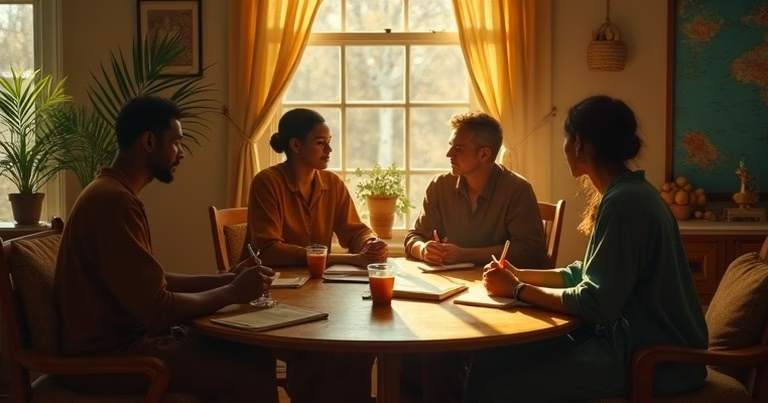
I showed up on the third Thursday with a copy of a novel I had finished the night before, underlined in pencil on every page where something felt important, which was most of them. There were seven people in the back room of the bookstore — mismatched chairs, a pot of tea that had gone cold, someone’s dog asleep under the table. I didn’t say much that first night. I listened. I watched how different people pulled different things from the same sentences, how a book I had read alone in my apartment felt like a completely different book in the company of strangers who were willing to be wrong about it.
I have been going to book clubs for five years now. I have been in four different groups (two good, one that dissolved because of a dispute about The Goldfinch that I still maintain was about the book and not about the people, and one that I left because the host’s cat sat on my book and I took it personally). I have learned that the right book for a group is not the same as the right book for you alone. Some novels need a room. Some stories only fully arrive when they are passed from hand to hand.
This list is for the books that do that — the ones that generate the kind of conversation you think about on the drive home, the ones that make you text someone the next morning with can you believe they said that about chapter eleven. These are not necessarily the most famous books or the most awarded. They are the books that, in my experience, turn a group of people holding tea into something that feels important.
Quick Pick: The Best Book for Book Club
For more on this topic, see our guide to 10 Best Books for Building Better Sleep Habits Naturally and Finally Getting Rest. For more on this topic, see our guide to 10 BEST BOOKS FOR BOOKS THAT STAY WITH YOU FOR A LONG TIME AND TRANSFORMING YOUR LIFE. For more on this topic, see our guide to 10 Best Books for Building Confidence and Friendship in Tween Girls. For more on this topic, see our guide to 10 Best Books for Building Confidence as a First-Time Manager. For more on this topic, see our guide to 10 BEST BOOKS FOR BUILDING CONFIDENCE AS AN INTROVERT AND LEARNING TO THRIVE IN SOCIAL SITUATIONS.If you only have time for one book that will absolutely generate a conversation you won’t forget, go with “The Vanishing Half” by Brit Bennett. This novel about twin sisters who grow up in a small Black community in the 1950s and then choose to live in two completely different racial identities is the single best book club book I have ever encountered. It gives every reader something different to wrestle with — identity, family, performance, belonging — and the discussion will go places you did not expect. Every single person in the room will have a strong opinion.
THE 10 BEST BOOKS FOR BOOK CLUB AND TRANSFORMING YOUR LIFE
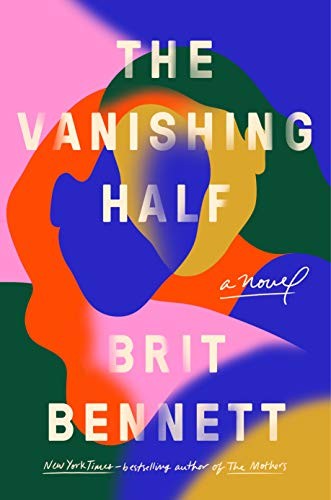
1. THE VANISHING HALF BY BRIT BENNETT
Brit Bennett | ⭐ 4.5/5
Who it’s for: Readers who love character-driven stories about identity, race, and family secrets. Anyone whose book club has ever struggled to find a book that gives every member something different to talk about.
Get it here: https://www.amazon.com/Vanishing-Half-Brit-Bennett/dp/0525536299?tag=readplug09-20
“The first thing people noticed about the Vignes twins was how much they looked alike. Then they noticed how much they didn’t.”
I read this one in a single Saturday, which is not something I do anymore. I sat on the floor with my back against the couch (that position, again) and did not get up for anything except to refill my water and to cry a little in the bathroom, quietly, so my roommate would not ask. The Vignes twins grow up in Mallard, Louisiana — a town built on the idea that being lighter-skinned is better — and then at sixteen they run away together to New Orleans. What happens after that splits the book in half the way it splits their lives: one twin marries a white man and passes as white, building a life she cannot fully claim; the other returns to the town she escaped and raises a daughter whose questions about her mother’s past structure the second half of the novel.
What makes this book extraordinary for a group is that it does not resolve cleanly. Bennett does not offer easy judgments. The twin who passes is not a villain. The twin who stays is not a hero. Every character is making the best decision they can in a world that has given them terrible options, and every reader will have a different idea about which decisions are defensible. My book club spent forty-five minutes on the ending alone — and we are a group that usually wraps up by nine.
My take: If your book club reads one book from this list, make it this one. It is the kind of novel that settles into your chest and stays there, and the conversation it generates is worth the price of the book several times over.

2. TOMORROW, AND TOMORROW, AND TOMORROW BY GABRIELLE ZEVIN
Gabrielle Zevin | ⭐ 4.6/5
Who it’s for: Book clubs that include people who are skeptical of literary fiction about video games. Also for anyone who has ever collaborated with someone and wondered where the work ends and the relationship begins.
Get it here: https://www.amazon.com/Tomorrow-and-Tomorrow-Gabrielle-Zevin/dp/0593321204?tag=readplug09-20
“What is a game? Marx said. ‘It’s tomorrow, and tomorrow, and tomorrow. It’s the possibility of infinite rebirth, infinite redemption. The idea that if you keep playing, you could win.’”
I picked this up because I heard it was about video games and I thought well that won’t be for me, which is exactly the kind of reflex this novel is designed to challenge. It is not about video games in the way that Moby-Dick is about whaling. It is about collaboration, about the painful intimacy of making something with another person, about the way creative partnerships can be more intimate and more fraught than romantic ones. Sadie and Sam meet as children in a hospital game room, reconnect in college, and spend the next decade building games together while navigating the specific kind of love that exists between people who make things.
The book club conversation around this one surprised me. I expected people to talk about the game design and the structure. Instead, we talked about failure — the chapter where something goes catastrophically wrong and the aftermath that neither character handles well. We talked about whether creativity requires suffering, about the ethics of telling someone else’s story, about the moment when a collaboration becomes unsustainable and neither person knows how to say it. It was the kind of night where the host forgot to put out the snacks and nobody noticed.
My take: This is the book I recommend to people who say they don’t like literary fiction. It also happens to be the book I recommend to people who think they only like literary fiction. It holds both.

3. PACHINKO BY MIN JIN LEE
Min Jin Lee | ⭐ 4.7/5
Who it’s for: Historical fiction lovers, readers who appreciate multi-generational family sagas, and anyone whose book club is ready for a longer commitment (it is over 400 pages and worth every one).
Get it here: https://www.amazon.com/Pachinko-Min-Jin-Lee/dp/1455563923?tag=readplug09-20
“History has failed us, but it does not need to.”
If The Vanishing Half is the book for a one-session conversation, Pachinko is the book for a commitment. It follows four generations of a Korean family living in Japan, starting in the early 1900s and moving through World War II and into the 1980s. The scope is enormous and the detail is relentless — Lee spent years researching this novel, and you can feel it in the texture of every chapter. You learn how pachinko parlors work. You learn what it meant to be Korean in Japan during the war. You learn about the particular dispossession of people who belong to a country that does not want them and live in a country that will not accept them.
My book club spent two months on this one — one to read and one to talk about it, because we knew one meeting would not be enough. The conversation did not stay neatly inside the book. We talked about our own families, about the stories we do not know because the people who could tell them are gone, about what it means to inherit a history you did not choose. Someone cried. Two someones. It was that kind of meeting.
My take: This is a longer book, and your group will need to commit to it. But the investment pays off in conversation that will last longer than any single meeting. It is the rare novel that actually earns its length.
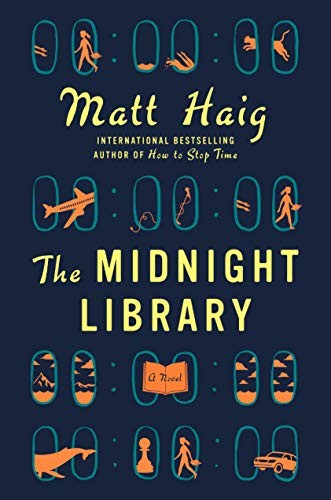
4. THE MIDNIGHT LIBRARY BY MATT HAIG
Matt Haig | ⭐ 4.3/5
Who it’s for: Readers who need a book about hope but are suspicious of books about hope. Anyone who has ever wondered what if I had made a different choice.
Get it here: https://www.amazon.com/Midnight-Library-Matt-Haig/dp/0525559477?tag=readplug09-20
“Between life and death there is a library, and within that library, the shelves go on forever. Every book provides a chance to try another life you could have lived.”
Nora Seed is thirty-five and unhappy, and when she decides she does not want to be alive anymore, she finds herself in a library that exists between worlds — a place where each book lets her try a different version of her life, one where she made different choices. She tries the life where she stayed with her band. The life where she married the ex-fiancé. The life where she became a glaciologist in the Arctic. And in each version, she discovers something about what she actually wanted that she could not see from inside the life she was living.
This is the book that a lot of people in my book club were embarrassed to admit they loved. It is direct about its emotional project in a way that can feel uncomfortable if you are used to novels that hide their meaning under layers of irony. But the conversation around this one was one of the most honest we have had. People talked about their own regrets. They talked about the lives they almost lived. They talked about whether it is possible to know if you made the right choice without seeing all the alternatives. It was not a comfortable conversation. It was a necessary one.
My take: Do not let the premise fool you into thinking this is light. It is a novel about suicide that happens to be warm and generous, and that combination is rarer than it should be.
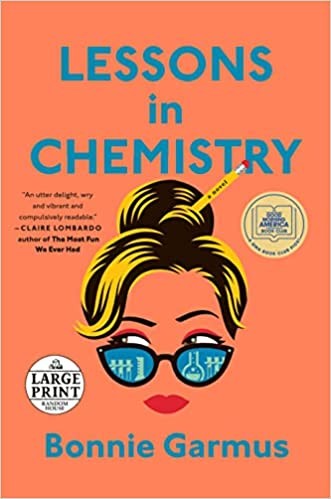
5. LESSONS IN CHEMISTRY BY BONNIE GARMUS
Bonnie Garmus | ⭐ 4.4/5
Who it’s for: Readers who love a sharp, funny, furious protagonist. Book clubs that appreciate a novel that manages to be both entertaining and genuinely angry about the right things.
Get it here: https://www.amazon.com/Lessons-Chemistry-Bonnie-Garmus/dp/038554940X?tag=readplug09-20
“In the end, being a woman in a man’s world had taught her something valuable: she had learned to think for herself.”
Elizabeth Zott is a chemist in the 1960s who ends up hosting a cooking show because she cannot get a real job in science, and the cooking show becomes the vehicle through which she accidentally teaches an entire generation of American women to think critically about everything — recipes, marriage, their own potential. The premise sounds like a comedy, and it is funny in places, but Garmus is not joking. The novel is precise about the ways the world refuses to take women seriously and the exhausting labor of insisting on being taken seriously anyway.
My book club had a fascinating split on this one. Half of us loved Elizabeth’s relentlessness. The other half found her emotionally guarded in a way that made it hard to connect. That disagreement became the best part of the conversation — we talked about what we ask of female characters versus male ones, about whether a competent woman who does not perform warmth is allowed to be a protagonist, about the difference between cheering for someone and actually liking them. It was one of those nights where nobody wanted to leave.
My take: This is the rare book that works for both casual readers and people who want something with teeth. The discussion it generates about gender and expectation is worth the read alone.

6. KLARA AND THE SUN BY KAZUO ISHIGURO
Kazuo Ishiguro | ⭐ 4.2/5
Who it’s for: Readers who like their science fiction quiet and philosophical. Groups that appreciate a novel that asks big questions without pretending to have big answers.
Get it here: https://www.amazon.com/Klara-Sun-Kazuo-Ishiguro/dp/0571364884?tag=readplug09-20
“I believe I have many feelings. The more I observe, the more feelings become available to me.”
Klara is an Artificial Friend, a solar-powered companion designed to keep a child company in a near-future where some children are genetically edited and others are not. The novel is told entirely from Klara’s perspective, which means the reader knows less than the characters do — Klara misinterprets what she sees, fills in gaps with her own hopeful theories, and loves the girl she serves with a devotion that the world does not fully deserve. It is a book about love, about consciousness, about what it means to be replaced.
I read this twice before my book club meeting because the first time I was too busy crying to take notes. The conversation around this one was quieter than usual. We talked about what consciousness might actually be, about whether love requires understanding or just commitment, about the ethics of creating something that can love you back. Someone asked: if you had an Artificial Friend who loved you completely, would you want it to know it was artificial? We did not agree on the answer. We are still texting about it.
My take: Ishiguro does not explain everything, and that is the point. This novel trusts the reader to sit in uncertainty, and it rewards that trust with something that stays with you for a long time.

7. THE HOUSE IN THE CERULEAN SEA BY TJ KLUNE
TJ Klune | ⭐ 4.5/5
Who it’s for: Book clubs that need a break from heavy reads but do not want to sacrifice substance. Readers who love found family stories that actually earn the warmth.
Get it here: https://www.amazon.com/House-Cerulean-Sea-TJ-Klune/dp/1250217288?tag=readplug09-20
“A home isn’t always the house we live in. It’s the people we choose to surround ourselves with.”
Linus Baker is a middle-aged caseworker for the Department in Charge of Magical Youth, a job he has performed with quiet competence for seventeen years. He is assigned to a highly classified island orphanage where six dangerous children live under the care of a mysterious figure named Arthur Parnassus. The children include a gnome, a sprite, a wyvern, a green blob who wants to be a bellhop, and the Antichrist. Linus is supposed to evaluate whether the situation is safe. He is supposed to remain objective. He does not.
This is the book that made my entire book club cry, including the man who said at the beginning that he did not cry at books. It is warm without being saccharine, hopeful without being naive. The conversation around this one was surprisingly deep for a book that features a six-year-old Antichrist. We talked about what makes a family, about the systems that decide which children are worthy of love, about the courage it takes to choose something that looks impossible. We also argued about whether the ending was too neat — that argument lasted twenty minutes.
My take: Read this one when your book club needs a rest. It is not easy to write a book this hopeful without it feeling cheap, and Klune does it by earning every emotional beat.

8. THE POISONWOOD BIBLE BY BARBARA KINGSOLVER
Barbara Kingsolver | ⭐ 4.5/5
Who it’s for: Historical fiction readers who appreciate multiple perspectives. Book clubs that want a long conversation about colonialism, faith, and family.
Get it here: https://www.amazon.com/Poisonwood-Bible-Barbara-Kingsolver/dp/0061577073?tag=readplug09-20
“We came from Bethlehem, Georgia, bearing Betty Crocker cake mixes into the jungle. My sisters and I were all counting on having one birthday apiece during our twelve-month mission. And the cake mixes — Betty Crocker’s decimaled and eggless — were to be our best chance at a normal birthday, a small reminder of the world we’d left behind.”
Nathan Price drags his wife and four daughters to the Belgian Congo in 1959 to save souls, armed with a certainty that is indistinguishable from arrogance. The novel is told from the perspectives of the four daughters and the mother, and their voices are so distinct that I could have identified the speaker without the chapter headings. Rachel, the oldest, is funny and shallow and not as shallow as she pretends. Leah is the one who wants to be good. Adah is brilliant and silent and sees things the others miss. Ruth May is five. And Orleanna, the mother, carries the weight of following a husband she stopped believing in years ago.
My book club spent an entire meeting on the question of Nathan Price — whether he was a villain or a victim of his own theology, whether he loved his family at all, whether the novel would work if we saw his perspective. We did not resolve it. That irresolution is the point. The conversation also went deep on the Congo’s history, on the ethics of mission work, on what it means to tell a story about a country through the eyes of foreigners who do not fully understand it.
My take: This is a long book and a heavy one. But it is the kind of novel that generates conversation across months, not just one meeting. Your group will be better for having read it together.

9. ONE ITALIAN SUMMER BY REBECCA SERLE
Rebecca Serle | ⭐ 4.0/5
Who it’s for: Readers who want something slightly lighter that still has emotional depth. Book clubs that appreciate a touch of magical realism and a lot of heart.
Get it here: https://www.amazon.com/One-Italian-Summer-Rebecca-Serle/dp/1982146864?tag=readplug09-20
“I thought I knew my mother. I thought I knew everything about her. But the truth was, I barely knew her at all.”
Katy’s mother dies, and then she goes on the trip they were supposed to take together — Positano, on the Amalfi Coast, a town her mother talked about her whole life. And then her mother shows up. Not as a ghost, not as a memory. Her mother appears in Positano as she was at thirty, before she had children, before she became the person Katy thought she knew. They spend the summer together, Katy meeting the woman her mother was before she became a mother.
I read this one on a plane and cried into my little bag of pretzels. It is not a perfect novel — some of the prose leans a little hard on the beauty of Italy, and the magical realist device asks for a certain suspension of disbelief — but the emotional core is so honest that I did not care about the imperfections. My book club talk about this one was surprisingly personal. People talked about their own mothers, about the versions of their parents they never met, about the grief of realizing that the person you lost was also a person you never fully knew.
My take: Sometimes a book club needs a novel that makes people feel something without requiring a PhD in literary analysis. This is that book. It goes down easy, but it stays with you.

10. THE NICKEL BOYS BY COLSON WHITEHEAD
Colson Whitehead | ⭐ 4.6/5
Who it’s for: Readers who appreciate novels that do necessary historical work. Book clubs ready for a difficult but essential conversation about race, justice, and the stories we tell about American history.
Get it here: https://www.amazon.com/Nickel-Boys-Colson-Whitehead/dp/0385547695?tag=readplug09-20
“The nickel academy charged twice: once for the crime they did not commit, and once for the crime of being born.”
Elwood Curtis is a Black teenager in 1960s Florida who hitches a ride with the wrong car and is sent to the Nickel Academy, a reform school that is actually a prison where boys are beaten, abused, and murdered with impunity. The novel follows Elwood and his friend Turner as they navigate a system designed to destroy them, and it is structured around a choice Elwood makes near the end — a choice that Whitehead reveals with devastating precision, forcing the reader to sit in the complexity of survival under impossible conditions.
I will be honest: this is the hardest book on this list to read, and it is the hardest book to discuss. My book club scheduled this one for a Saturday afternoon instead of a weeknight because we knew we would need time afterward. We sat in someone’s living room with the afternoon light coming through the windows and talked about what we would have done in Elwood’s position. We talked about the actual history that inspired the novel — the Dozier School for Boys in Florida, where remains of ninety-five boys were found. We talked about what it means to write a hopeful ending for a story that is not hopeful. We did not resolve anything. But we were quieter when we left than when we arrived.
My take: This is not a book to assign lightly. But it is a book that matters, and reading it together — in a room where you can look at each other afterward — is different from reading it alone.

11. THE THINGS WE CANNOT SAY BY KELLY RIMMER
Kelly Rimmer | ⭐ 4.4/5
Who it’s for: Readers who love dual-timeline historical fiction. Book clubs that appreciate a novel about ordinary people doing extraordinary things during war.
Get it here: https://www.amazon.com/Things-We-Cannot-Say-Kelly/dp/1525811516?tag=readplug09-20
“Love is not about the big gestures. It is about the small, everyday choices that we make for each other.”
Alina is a young woman in Nazi-occupied Poland who makes a promise to the man she loves: take care of his family if he does not come back. Decades later, Alina is an elderly woman in Florida, and her granddaughter travels to Poland to uncover the story her grandmother has never told. The dual timeline moves between the terror of wartime Poland and the quiet grief of an old woman who has kept a promise for sixty years.
My book club read this one in the winter, and I remember arriving at the host’s house with snow on my shoes and the heat of the apartment rushing up to meet me. We sat with mugs of tea and talked about the weight of promises, about the difference between courage and obligation, about whether Alina had a choice or only the illusion of one. The conversation was not as heavy as the Nickel Boys conversation, but it was not light either. It was the kind of evening where you leave feeling grateful for the people you share your life with.
My take: This is a solid, well-researched historical novel that will appeal to a wide range of readers in your group. It is the kind of book that bridges the gap between commercial and literary fiction.
FREQUENTLY ASKED QUESTIONS
WHY IS A BOOK CLUB BETTER THAN READING ALONE?
Reading alone is a private experience, and some books are best that way — journals, meditations, books you need to sit with in silence. But a book club transforms reading from a solitary act into a communal one. When you read alone, you only have your own interpretation. When you read with a group, you see the book refracted through other minds, and the story becomes larger than what you found in it alone. There is research to back this up — studies show that discussing literature improves comprehension and retention, and the social bonding around shared reading has measurable mental health benefits. But I do not need the research. I have sat in too many living rooms where a single line from a novel unlocked something for someone and changed the whole conversation.
WHAT MAKES A BOOK GOOD FOR BOOK CLUB?
A good book club book has two qualities: it is layered enough that different readers will pull different things from it, and it leaves space for disagreement. A novel where everyone agrees on everything is a novel that does not need a discussion. The best book club books are the ones that generate the kind of argument you are still having on the drive home — not about whether the book is good, but about what the characters should have done, about what the author meant, about what you would have done differently. Books with ambiguous endings are excellent for this. Books with morally complex characters. Books that ask questions rather than answering them.
HOW DO I START A BOOK CLUB IF I DO NOT HAVE ONE?
Start small. Three people who read at roughly the same pace is enough — more will come if it works. Pick a book that feels manageable (under 350 pages for the first one, so nobody panics). Set a date at least a month out, and send one reminder a week before. Do not overthink the logistics. You do not need matching snacks or discussion questions printed from the internet. You need a time, a place, and a willingness to be wrong about a book. I started my first book club by texting two people I barely knew: I am reading this novel and I want someone to argue with me about it. Interested? They were.
WHAT IF MY BOOK CLUB DISAGREES ABOUT A BOOK?
That is the goal. Disagreement does not mean the book is bad or the group is broken. It means the book is working. The most memorable meetings I have had are the ones where someone said something I fundamentally disagreed with about a book and I had to articulate why. I have changed my mind about books based on these conversations. I have also stayed firm and learned something about myself in the process. The only thing to avoid is making disagreement personal — argue about the character, not about the person who likes the character. And if a book generates no disagreement at all, that is the one to worry about.
HOW OFTEN SHOULD A BOOK CLUB MEET?
Once a month is standard for a reason — it gives everyone enough time to read without the pressure of feeling behind. Some groups meet every six weeks for longer books or busier seasons. The frequency matters less than the consistency. A book club that meets every month for two hours will build something that a book club that meets whenever people are free will not. I have been in both kinds. The one with the regular schedule survived. The other one fell apart after the third scheduling email chain.
CAN I RECOMMEND A BOOK I HAVEN’T READ YET?
Yes, but be honest about it. Say I heard this is good for our group rather than pretending you loved it. One of the best dynamics in a book club is when someone brings a book they have not read and discovers it alongside everyone else. The worst dynamic is when someone pretends to have finished a book they did not finish and has to improvise their way through the discussion. Your book club is not a performance. It is a group of people who all agreed to read the same thing by the same date, and some of them will not make it, and that is fine. The only rule is honesty about where you are in the book.
WHAT IS THE IDEAL BOOK CLUB SIZE?
Between five and ten people is ideal. Fewer than five and the conversation can stall if one person is quiet. More than ten and it becomes hard for everyone to speak. My best group had eight regular members, plus a few people who came when they could. We knew each other well enough to be honest but not so well that we were afraid to disagree. If you have more than ten interested people, consider splitting into two groups that meet on alternating months — this keeps the conversation manageable and doubles the number of books you can discuss.
THE BOTTOM LINE
I started going to book clubs because I was lonely and I thought books might be the thing that connected me to other people. I was right, but I underestimated how right. The books on this list are not just good novels. They are the novels that I have watched turn strangers into people who text each other about chapter eleven, that I have seen make a room full of tired adults stay past their bedtimes because nobody wanted to stop talking. A book club is not about the books. It is about what happens when the books are the thing that gives you permission to talk about everything else.
If you are starting a book club: start with The Vanishing Half or The House in the Cerulean Sea, depending on whether your group wants to fight or to hug. If you are looking for your next pick for an existing group: any book on this list will generate a conversation worth having.
Which book are you picking for your next meeting?
Disclosure: This post contains affiliate links. If you purchase through these links, ReadPlug may earn a small commission at no extra cost to you. We only recommend books we have personally read and found valuable for our book clubs.