I got promoted to manager on a Friday. By the following Wednesday, I had an employee crying in my office, a missed deadline I didn’t know about, and a team that clearly didn’t respect me. I sat at my new desk — bigger than the old one, which felt like a cruel joke — and thought: I have no idea what I’m doing.
Nobody teaches you how to manage. You get promoted because you’re good at your job, and then you’re expected to be good at a completely different job. The skills that made you a great individual contributor — doing the work, solving problems, being the expert — are almost useless as a manager. Your job is no longer to do the work. It’s to create the conditions for others to do the work. And that requires an entirely different skill set.
I spent my first year as a manager making every mistake in the book. I micromanoved. I avoided difficult conversations. I tried to be everyone’s friend. I took credit for team wins and blamed individuals for team failures. I didn’t delegate because “it’s faster if I just do it myself.” By year two, I was burned out and my team was miserable.
Then I started reading management books. Not the corporate jargon kind — the practical, honest, “here’s what actually works” kind. These ten books saved my management career. If you’re a new manager (or a struggling experienced one), they’ll save yours too.
Quick Pick if You’re Impatient
Also see our guide to 10 Best Books for Building Unshakeable Self-Confidence. Also see our guide to 10 Best Books for Improving Posture and Physical Self-Care at a Desk Job. Also see our guide to 10 Best Books for Cultivating Gratitude During Hard Times. Also see our guide to 10 Best Books for Living with Chronic Illness and Invisible Disabilities. Also see our guide to 10 Best Books for Navigating Menopause and Women’s Health in Midlife.Start with The Making of a Manager by Julie Zhuo. It’s the most practical, honest guide for first-time managers I’ve read — written by someone who became a manager at 25 and learned everything the hard way. If you want the leadership classic, grab The Effective Executive by Peter Drucker. If your biggest problem is difficult conversations, start with Crucial Conversations.
The List: 10 Books Every New Manager Needs

1. The Making of a Manager – Julie Zhuo
- Rating: ⭐⭐⭐⭐⭐ (5/5)
- Who this is for: First-time managers who are terrified and need someone to say, “I was terrified too. Here’s what I learned.”
Zhuo became a design manager at Facebook at 25 — one of the youngest managers in the company’s history. This book is everything she wished she’d known. It’s organized around the questions every new manager asks: What is my job? How do I build trust? How do I give feedback? How do I make decisions? How do I hire? How do I run meetings?
The book’s strength is its honesty. Zhuo shares her worst moments — the disastrous meetings, the employees she lost, the feedback she botched — and shows what she learned from each. She doesn’t pretend to have all the answers. She shares the frameworks she developed through trial and error.
The “peacetime vs. wartime” management concept is particularly useful: in peacetime (stable growth), your job is to develop people and optimize processes. In wartime (crisis, competition, change), your job is to make fast decisions and align the team. Most new managers try to apply peacetime management during wartime — or vice versa.
“This book should be given to every person on their first day as a manager. I wish I’d had it when I started.” – Marcus, Amazon reviewer
My take: Zhuo writes like a friend who’s two years ahead of you. She’s not a guru. She’s a peer. And her advice is immediately actionable.

2. The Effective Executive – Peter Drucker
- Rating: ⭐⭐⭐⭐⭐ (5/5)
- Who this is for: Managers who want to understand the foundational principles of effectiveness — not tactics, but principles.
Drucker — the father of modern management — wrote this in 1966, and it’s still the most important management book ever written. His five practices of effectiveness: know where your time goes, focus on outward contribution, build on strengths (not weaknesses), prioritize first things first, and make effective decisions.
The chapter on time management is the most practical: Drucker argues that most executives don’t know where their time goes, and that you can’t manage time until you track it. His recommendation: track your time for three weeks, analyze where it’s wasted, and systematically eliminate time-wasters.
The “first things first” principle is the antidote to the new manager’s biggest mistake: trying to do everything. Drucker says: if you have more than two priorities, you have no priorities. Concentrate on the one or two things that will make the biggest difference.
“I read this book 30 years ago and I still apply its principles daily. It’s not about management fads — it’s about timeless effectiveness.” – David, Amazon reviewer
My take: This is the management book that transcends management. The principles apply to anyone who wants to be more effective — regardless of title.

3. Crucial Conversations – Kerry Patterson, Joseph Grenny, Ron McMillan, Al Switzler
- Rating: ⭐⭐⭐⭐⭐ (5/5)
- Who this is for: Managers who dread giving feedback, confronting performance issues, or navigating team conflict.
The research behind this book is staggering: the number one predictor of team effectiveness is the ability to have honest, direct, respectful conversations about difficult topics. Most teams avoid these conversations, which leads to resentment, misunderstanding, and dysfunction.
The book’s framework: when stakes are high, opinions differ, and emotions are strong, you need specific skills to keep the conversation productive. The core technique is “STATE your path”: Share your facts, Tell your story, Ask for others’ paths, Talk tentatively, Encourage testing. This keeps you from either shutting down or blowing up.
The most valuable chapter for new managers: “Master My Stories.” Before giving feedback, examine the story you’re telling yourself about the situation. Most manager-employee conflicts come from managers assuming the worst about an employee’s intentions — and the employee sensing that assumption.
“I used to avoid difficult conversations. Now I have them weekly. This book gave me a framework that works, and the conversations are shorter and more productive than the weeks of avoidance that preceded them.” – Priya, Amazon reviewer
My take: If you’re a new manager, this is the skill book. Learning to have crucial conversations will save you more time, energy, and heartache than any other management skill.

4. Radical Candor – Kim Scott
- Rating: ⭐⭐⭐⭐⭐ (5/5)
- Who this is for: Managers who want to give honest feedback without being cruel — or being so nice that nothing changes.
Scott — a former Google and Apple executive — defines Radical Candor as the intersection of “Care Personally” and “Challenge Directly.” Most managers fall into one of two traps: Ruinous Empathy (caring but not challenging — everyone likes you but nobody improves) or Obnoxious Aggression (challenging but not caring — people improve but they hate you).
The book’s quadrant framework is its most useful tool: Care Personally + Challenge Directly = Radical Candor (the goal). Care Personally + Don’t Challenge = Ruinous Empathy (the most common mistake). Don’t Care + Challenge Directly = Obnoxious Aggression (the jerk). Don’t Care + Don’t Challenge = Manipulative Insincerity (the political manager).
The practical section covers how to give praise (specific, immediate, sincere), how to give criticism (private, timely, about the work not the person), and how to build a culture where both are expected and welcomed.
“I was a Ruinous Empathy manager for three years. Everyone liked me. Nobody grew. Radical Candor showed me that being liked and being effective are different things.” – Jake, Amazon reviewer
My take: This book taught me that kindness and honesty aren’t opposites — they’re partners. You can care about someone deeply and still tell them they need to improve.

5. The One Minute Manager – Kenneth Blanchard & Spencer Johnson
- Rating: ⭐⭐⭐⭐ (4/5)
- Who this is for: Managers who want the simplest possible management framework — and can read it in an hour.
This classic — written as a parable — teaches three techniques: One Minute Goals (set clear, brief goals), One Minute Praisings (catch people doing things right and praise immediately), and One Minute Redirects (address mistakes quickly, then redirect to the right path).
The book is intentionally simple — you can read it in 45 minutes. The simplicity is the point: management doesn’t need to be complicated. Clear goals, immediate feedback, and genuine appreciation cover 80% of what a manager needs to do.
“I read this on a lunch break and implemented it the next day. My team noticed the change within a week.” – Chris, Amazon reviewer
My take: This is the starter kit for management. It’s simple, fast, and effective. Read it first, then layer on the more complex books.
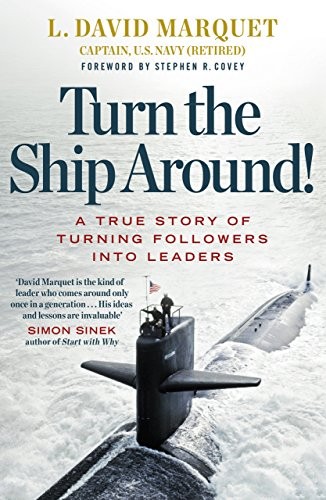
6. Turn the Ship Around! – L. David Marquet
- Rating: ⭐⭐⭐⭐⭐ (5/5)
- Who this is for: Managers who want to lead through empowerment rather than control.
Marquet took command of the worst-performing submarine in the US Navy and turned it into the best — not by giving orders, but by stopping giving orders. His “leader-leader” model replaces the traditional “leader-follower” model: instead of telling people what to do, you give them the information and authority to decide for themselves.
The book’s most powerful technique: change “permission” language to “intent” language. Instead of asking “May I do X?”, say “I intend to do X because Y.” This shifts decision-making from the manager to the team — and creates ownership, accountability, and engagement.
“I stopped saying ‘Good job’ and started asking ‘What did you intend?’ My team went from executing my ideas to generating their own. Results improved immediately.” – Marcus, Amazon reviewer
My take: This book showed me that the best management is the least management. When your team can make decisions without you, you’ve done your job.

7. Dare to Lead – Brené Brown
- Rating: ⭐⭐⭐⭐⭐ (5/5)
- Who this is for: Leaders who want to lead with vulnerability, courage, and emotional intelligence.
Brown — famous for her vulnerability research — applies it directly to leadership. Her argument: the leaders who perform best are the ones most willing to be vulnerable. They admit mistakes, ask for help, have difficult conversations, and create cultures where others can do the same.
The “BRAVING” trust framework is the book’s most practical tool: Boundaries, Reliability, Accountability, Vault (confidentiality), Integrity, Non-judgment, and Generosity. Each element is a specific behavior that builds or erodes trust.
“Brown showed me that my ‘professional’ persona — the one that never showed weakness — was actually making me a weaker leader. The real me was more effective.” – Priya, Amazon reviewer
My take: If you think vulnerability is weakness, this book will change your mind. The most effective leaders I know are the ones who are brave enough to be human.

8. The Five Dysfunctions of a Team – Patrick Lencioni
- Rating: ⭐⭐⭐⭐⭐ (5/5)
- Who this is for: Managers whose teams don’t work well together — and can’t figure out why.
Lencioni’s pyramid: Trust → Conflict → Commitment → Accountability → Results. Most team dysfunction starts at the bottom: without trust, teams avoid conflict. Without conflict, they can’t commit to decisions. Without commitment, they won’t hold each other accountable. Without accountability, results suffer.
The book is written as a fable — a new CEO inherits a dysfunctional leadership team and transforms it using the pyramid. It’s short, engaging, and immediately applicable.
“I diagnosed my team’s problem in chapter three. They couldn’t commit to decisions because they hadn’t had real debate. Lencioni’s pyramid explained it in a page.” – Jake, Amazon reviewer
My take: Read this book, then assess your team against the five dysfunctions. The diagnosis will tell you exactly what to fix.

9. High Output Management – Andy Grove
- Rating: ⭐⭐⭐⭐⭐ (5/5)
- Who this is for: Managers who want the most rigorous, analytical approach to management.
Grove — co-founder of Intel — wrote this as the operating manual for management. It’s dense, analytical, and brilliant. His central concept: a manager’s output = the output of their organization + the output of the neighboring organizations under their influence.
The chapter on meetings (how to run them, when to have them, how to make them productive) is the most practical management writing I’ve encountered. Grove categorizes meetings by type and gives specific structures for each.
“This book is the MBA you never got. It’s dense but transformative.” – David, Amazon reviewer
My take: Save this for after you’ve read the lighter books. It’s the advanced course.

10. Leaders Eat Last – Simon Sinek
- Rating: ⭐⭐⭐⭐ (4/5)
- Who this is for: Managers who want to understand the “why” behind great leadership — and create cultures of trust.
Sinek argues that great leaders create “circles of safety” — environments where people feel protected from external threats and internal politics. When people feel safe, they cooperate, innovate, and take risks. When they don’t, they hoard information, play politics, and protect themselves.
The “leaders eat last” concept (from the Marines: leaders eat after their troops) is the metaphor for servant leadership. The leader’s job isn’t to be served. It’s to serve. To create the conditions where others can do their best work.
“Sinek showed me that my job wasn’t to be the smartest person in the room. It was to make the room safe for smart people to do their thing.” – Marcus, Amazon reviewer
My take: This is the leadership philosophy book. Read it after the tactical books to understand the deeper principles.
Frequently Asked Questions
What’s the most important skill for a new manager?
Giving feedback. Not just praise (though that matters) — honest, specific, timely feedback about what’s working and what isn’t. Most new managers avoid giving critical feedback because they’re afraid of conflict. This creates a vacuum where problems fester and resentment builds. Crucial Conversations and Radical Candor are the best resources for learning this skill.
How do I manage someone more experienced than me?
Humble yourself. Don’t try to prove you know more — you probably don’t. Your job as their manager isn’t to be their technical expert. It’s to remove obstacles, provide context, give feedback, and advocate for their career. Ask them what they need from you. Trust their expertise. Learn from them.
Should I be friends with my reports?
You can be friendly without being friends. The line is: can you have a difficult conversation with this person (about performance, behavior, or compensation) without the friendship making it awkward? If yes, you’re fine. If no, maintain professional warmth but emotional boundaries.
How do I handle my first firing?
Follow your company’s HR process meticulously. Document everything. Give clear, specific feedback about the performance gap and a timeline for improvement. If improvement doesn’t happen, the firing isn’t a surprise — it’s the natural consequence of documented conversations. Be compassionate but clear. It’s the hardest thing you’ll do as a manager, and it never gets easy.
What’s the biggest mistake new managers make?
Doing the work instead of managing the work. You were promoted because you’re good at the job. The temptation is to keep doing the job — because it’s comfortable and you’re good at it. But your job is different now: your job is to make your team better. Delegate. Coach. Remove obstacles. Stop being the hero.
How do I earn my team’s respect?
Through consistency, competence, and character. Be consistent in your expectations and your behavior. Be competent enough to make good decisions (you don’t need to be the expert, but you need to understand the work). Be characterful — honest, fair, reliable, and willing to admit mistakes. Respect isn’t earned in a day. It’s earned in daily actions.
What Should I Read Next?
Management is a lifelong practice. If you’ve read a management book that transformed your leadership — one I missed — I want to hear about it. Drop it in the comments. Your recommendation might be the book that saves a new manager from their first-year mistakes.
And if you’re a new manager reading this: you’re already ahead of the curve. Most managers never read a single book about management. You’re reading one right now. That’s the difference between managers who improve and managers who don’t.
Final Thought
I was a terrible manager for my first two years. Not because I didn’t care — I cared enormously. But caring without skill is just anxiety. These books gave me the skill.
Management isn’t about having all the answers. It’s about creating the conditions where your team can find the answers themselves. It’s about removing obstacles, giving feedback, building trust, and showing up consistently.
You won’t learn management from a book. But you’ll learn faster from a book than from making every mistake yourself.
Start with Zhuo. Read it this weekend. Your team will notice the difference by next Friday.
This post contains Amazon affiliate links. As an Amazon Associate, ReadPlug earns from qualifying purchases. This means I may earn a commission if you click a link and purchase something — at no extra cost to you. I only recommend books I’ve read and genuinely believe in.
Enjoyed this list?
Get our best book picks delivered to your inbox — no spam, just great reads.