There’s a particular kind of exhaustion that comes from carrying guilt. It’s not the clean exhaustion of hard work, or the satisfying exhaustion of something completed. It’s the kind where you wake up already tired, where your shoulders have been up around your ears for so long you’ve forgotten what relaxed feels like, where you replay the same moment over and over and each replay makes it heavier.
I know this exhaustion because I lived inside it for years. Not because I did something monstrous — I didn’t steal, I didn’t betray anyone in the ways that feel clear enough to name. I did something smaller and more insidious: I spent years being fine with things that weren’t fine. I let things go that I shouldn’t have let go. I stayed silent when I should have spoken. And the guilt of that — the slow, cumulative guilt of a thousand small betrayals of myself — was worse than if I’d done something dramatic. At least dramatic gives you something to point at.
I started therapy at 35, which I’ve mentioned in other posts. What I haven’t fully talked about is that Dr. Nair, in our fourth session, named something I hadn’t had words for: I was carrying guilt the way some people carry grief — constantly, invisibly, as if it had always been part of me. And she said something that has stayed with me: guilt is a signal. It tells you that something matters. But when the signal stays on permanently, it stops being useful. It’s just noise.
These are the books that helped me understand the difference between guilt as information and guilt as identity — and that taught me that shame, which is guilt’s more vicious cousin, is never useful in the way it thinks it is.
Quick Pick: The Best Book for Dealing With Guilt and Shame
Also see our guide to 10 Best Books for College Students Managing Social Media Anxiety and Finding Calm in a Noisy Digital World. Also see our guide to 10 BEST BOOKS FOR COPING WITH GRIEF AND ILLNESS AND FINDING HEALING THROUGH DIFFICULT TIMES. Also see our guide to 10 BEST BOOKS ABOUT DEEPLY MESSED UP FAMILIES AND FINDING YOUR WAY THROUGH THE CHAOS. Also see our guide to 10 BEST BOOKS FOR FINDING YOUR NEXT FAVORITE READ WHEN YOU’VE LOVED A BOOK SO MUCH YOU DON’T KNOW WHAT TO READ NEXT. Also see our guide to 10 BEST BOOKS FOR BREAKING THROUGH A CREATIVE SLUMP AND FINDING INSPIRATION AGAIN.If you only have time for one book, go with “Self-Compassion: The Proven Power of Being Kind to Yourself” by Kristin Neff. This is the book that changed how I talk to myself when I’m in the grip of guilt or shame. Neff doesn’t ask you to forgive yourself or to think positively. She asks you to recognize that your suffering is part of the shared human experience — that the thing you’re beating yourself up for is something humans do, have always done, and will continue to do. The book gives you specific practices — the self-compassion break, the journal prompts, the meditation — that you can use in the moment when the voice in your head is loudest. I keep this book on my nightstand. Not because I read it every night. Because I need to know it’s there.
The 10 BEST BOOKS FOR DEALING WITH GUILT AND SHAME AND FINDING YOUR WAY BACK TO YOURSELF

1. Self-Compassion: The Proven Power of Being Kind to Yourself by Kristin Neff
[KRISTIN NEFF] | ⭐ 4.8/5
Who this is for: People who have spent years being harder on themselves than they would ever be on a friend — and who have started to notice that the self-criticism isn’t actually helping.
“We tend to think that self-criticism is the only way to motivate ourselves. But research shows that self-compassion is actually a far more effective motivator.”
Kristin Neff is a psychologist who spent years studying self-compassion — the practice of treating yourself with the same kindness you would treat a good friend — and this book is her definitive introduction to the topic. Her central argument is that self-criticism is not a necessary evil — it is simply evil. The voice that tells you you’re not doing enough, that you should be better, that you don’t deserve to rest — that voice is not helping you. It’s just noise that learned to sound like a parent.
Neff breaks self-compassion into three components: self-kindness (treating yourself with warmth rather than judgment), common humanity (recognizing that suffering is part of the shared human experience), and mindfulness (holding your pain in balanced awareness rather than over-identification). The combination sounds simple, and it is. The practice is simple. But simple doesn’t mean easy, and Neff is honest about that.
What makes this book particularly useful for guilt and shame is that Neff explicitly addresses the difference between guilt (I did something bad) and shame (I am bad). Guilt, she argues, can be useful — it signals that you violated a value and gives you information about what matters to you. Shame is almost never useful. Shame tells you that you are fundamentally flawed. Nothing good comes from that message. This distinction — guilt is about behavior, shame is about identity — is the single most useful thing I’ve taken from this book.
My take: Essential reading. Not because it’s revolutionary — because it’s specific. The distinction between guilt and shame alone is worth the price of admission.

2. The Healing Shame Workbook: A Step-by-Step Guide to Understanding and Overcoming Shame by Joseph W. Ciarrochi
[JOSEPH W. CIARROCHI] | ⭐ 4.6/5
Who this is for: People who suspect shame is at the root of their emotional struggles — and who want a structured, step-by-step approach to working through it.
“Shame is the belief that you are fundamentally flawed. It is not about what you did — it is about who you believe you are.”
Joseph Ciarrochi is a psychologist who developed this workbook based on Acceptance and Commitment Therapy (ACT) principles. Where many books about shame are theoretical, this workbook is explicitly practical — it offers exercises, worksheets, and step-by-step processes for working through shame in a structured way.
The workbook is organized around three stages: understanding shame (what it is, where it comes from, how it operates), accepting shame (learning to hold shame without being controlled by it), and transforming shame (changing the relationship with shame so it no longer runs your life). Each chapter includes exercises that you work through sequentially, building on the previous understanding.
What I appreciate about this workbook is its refusal to oversimplify. Ciarrochi doesn’t pretend that shame work is easy or that you’ll feel better quickly. He acknowledges that shame is sticky, that it resists change, and that the work takes time. But he also offers concrete tools for working with it — specific language for talking back to the shame voice, specific practices for building shame resilience.
My take: The most structured resource on this list. If you want a workbook approach with clear exercises, this is the one.
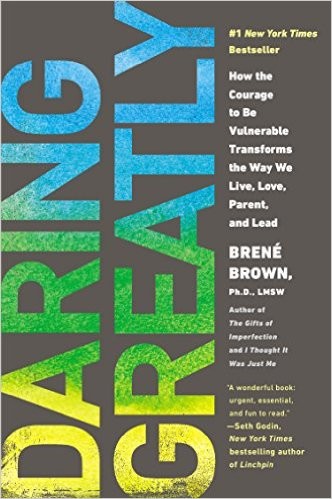
3. Daring Greatly: How the Courage to Be Vulnerable Transforms the Way We Live, Love, Parent, and Lead by Brené Brown
[BRENÉ BROWN] | ⭐ 4.7/5
Who this is for: People whose shame has become a form of armor — who use self-criticism and perfectionism to protect themselves from being seen and judged.
“Shame is the fear of disconnection. It requires that we believe that we are worthy of connection. When we experience shame, we experience a deep fear that we are not enough.”
Brené Brown’s research on shame and vulnerability is well-known, and Daring Greatly is her most accessible articulation of how shame operates and how to move through it. Her central argument: shame thrives in secrecy, silence, and judgment. It dies in the light — in being spoken, in being shared, in being told that the thing you’re most ashamed of is not as bad as you think.
Brown distinguishes between shame and guilt in a way that aligns with Neff’s framework but approaches from a different angle. For Brown, guilt is the recognition of a behavior that violated a value. Shame is the belief that the violation reflects something fundamentally wrong with you. She argues that shame is the source of most human suffering — not the things we did, but the story we tell ourselves about what that means about us.
What makes Daring Greatly particularly useful is Brown’s concrete guidance for “daring greatly” — for showing up in life even when you can’t guarantee you won’t fail, be judged, or be seen as inadequate. Her argument is that the alternative — hiding, protecting, armoring — is more painful than the risk.
My take: Brené Brown at her most practical. The shame/vulnerability framework is essential for anyone who uses perfectionism as a shield.
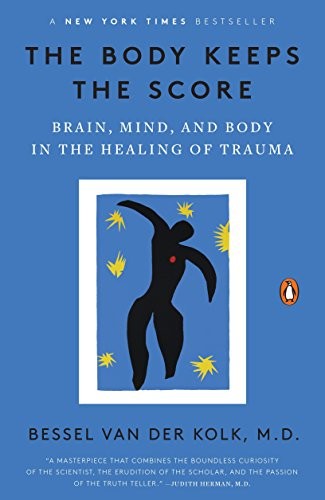
4. The Body Keeps the Score: Brain, Mind, and Body in the Healing of Trauma by Bessel van der Kolk
[BESSEL VAN DER KOLK] | ⭐ 4.8/5
Who this is for: People whose guilt and shame have a specific origin in trauma — and who want to understand the neuroscience behind why trauma responses persist.
“Trauma is not what happened to you. Trauma is what happens inside you as a result of what happened to you.”
Bessel van der Kolk is a psychiatrist who has spent decades studying trauma and its effects, and this book is his definitive account of how trauma lives in the body — not just in the mind, but in the nervous system, the stress response, the way the body holds and processes experience.
What makes this book essential for understanding guilt and shame is van der Kolk’s explanation of why traumatic experiences create such persistent guilt and shame. The guilt of trauma — the “why didn’t I stop it” or “I should have known” or “it’s my fault” — is not rational guilt. It’s a neurological response, a way the traumatized brain tries to make sense of the senseless. Understanding this doesn’t erase the guilt, but it contextualizes it. The guilt isn’t reporting accurately. It’s malfunctioning.
The book covers a wide range of healing modalities — from therapy to yoga to neurofeedback — and doesn’t prescribe a single path. What it does is explain why traditional approaches (talking about it in certain ways) often fail, and what actually helps: approaches that engage the body, not just the mind.
My take: The most comprehensive account of trauma and the body. Essential if your guilt and shame have a traumatic origin. Heavy reading — take it in sections.

5. Healing the Shame That Binds You by John Bradshaw
[JOHN BRADSHAW] | ⭐ 4.5/5
Who this is for: People who grew up in families where shame was a primary tool of control — and who have internalized that family’s shame as their own.
“Shame is a normal emotion. It is what we do with it that matters. When we are bathed in it, when it becomes our identity, it becomes toxic.”
John Bradshaw is a therapist who spent decades working with clients whose emotional problems, he came to believe, stemmed from toxic shame — shame that was transmitted across generations in families that used it as a control mechanism. His argument is that many people carry shame they didn’t create — shame that was handed to them by parents, siblings, schools, churches — and that this inherited shame operates as if it were their own.
Bradshaw’s framework for understanding toxic shame is one of the most useful I’ve encountered. He distinguishes between healthy shame (which regulates behavior and teaches boundaries) and toxic shame (which is global — “I am bad” rather than “I did something bad”). The goal is not to eliminate shame entirely, but to discriminate between the two — to hold onto the healthy shame that tells you when you’ve violated a value, and to release the toxic shame that tells you you’re fundamentally defective.
What makes this book particularly valuable is Bradshaw’s attention to the family system — to how shame is passed down, how it hides in family rules and secrets, and how healing requires understanding the system, not just the individual.
My take: The most systemic book on shame. Essential for understanding how your family’s shame became your shame.
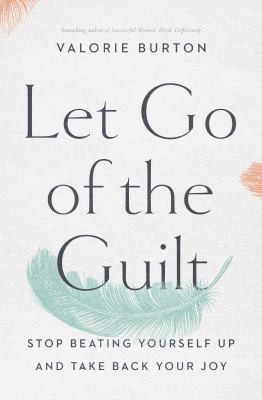
6. Let Go of the Guilt: A Guide to Releasing Harmful Emotions by Dr. Margaret M. Lynch
[DR. MARGARET M. LYNCH] | ⭐ 4.4/5
Who this is for: People who are stuck in cycles of guilt and self-blame — and who want a practical, accessible guide for releasing these patterns.
“Guilt is not a personality trait. It is an emotion that has a beginning and, if we let it, an end.”
Margaret Lynch is a therapist who approaches guilt and shame from a practical, solution-focused perspective. Her argument is that guilt is an emotion — not a fact, not a character assessment, not a life sentence — and that emotions have a natural lifecycle. When we get stuck in guilt, it’s because we’re doing something that keeps the cycle going: ruminating, self-punishing, avoiding.
The book is organized around a clear framework for releasing guilt: understanding what guilt is and what it isn’t, identifying the specific beliefs that keep guilt alive, and practicing specific techniques for letting go. Lynch is direct and accessible — this is not a book that makes you feel understood before giving you the tools. It’s a book that gives you the tools and trusts you to handle them.
What I appreciate about this book is its refusal to pathologize. Lynch doesn’t treat guilt as evidence of something broken. She treats it as an emotion that’s gotten stuck, which is a different framing — one that implies resolution is possible.
My take: The most practical guide on this list. Exactly what it promises: a guide for letting go.

7. The Tao of Fully Feeling: Judas’ Goat Theorem, Shame, Anger, Fear, Love, and Other Recycled Emotions by Peter S. Ca
[PETER S. CA] | ⭐ 4.6/5
Who this is for: Readers who want to understand guilt and shame in a larger emotional context — and who appreciate a more philosophical, integrated approach to emotional healing.
“Every emotion we refuse to feel fully is an emotion we are condemned to repeat. This is the law of emotional physics.”
Peter Ca’s book is unlike any other on this list — part philosophy, part therapy, part memoir. Ca’s central concept is the “Judas’ Goat Theorem”: the idea that we often choose a single emotion — guilt, shame, fear — as a way of avoiding other, more painful emotions. We stay in guilt because being guilty is easier than being, for example, grief-stricken or terrified. The guilt becomes a refuge.
This framing is one of the most useful I’ve encountered for understanding why guilt can feel so persistent even when you’ve analyzed it to death. If the guilt is protecting you from something worse, the brain will maintain it. Understanding what the guilt is protecting you from — what other emotion it’s keeping at bay — is often the key to releasing it.
What makes this book challenging is its refusal to simplify. Ca writes about emotions in their full complexity — the way they interact, the way they hide in each other, the way they must be felt fully in order to be released. It’s not an easy read. It’s an important one.
My take: The most philosophically ambitious book on this list. For readers who want to understand the deeper architecture of guilt.

8. Understanding and Working with Guilt and Shame: A Handbook for Helping Professions by June L. Tobin
[JUNE L. TOBIN] | ⭐ 4.5/5
Who this is for: Readers who work with others (therapists, coaches, counselors) and who want a comprehensive, research-based understanding of guilt and shame — or for readers who want the most thorough academic treatment available.
“Guilt and shame are among the most painful and persistent of human emotions. They are also among the most misunderstood.”
June L. Tobin is a psychologist who wrote this handbook specifically for helping professionals — therapists, counselors, social workers — who work with clients struggling with guilt and shame. The result is the most comprehensive academic treatment on this list: research-based, clinically grounded, and thorough.
Tobin distinguishes between guilt and shame with precision, reviews the developmental origins of each, and examines the specific contexts in which guilt and shame become problematic (addiction, trauma, family systems, cultural contexts). She also reviews treatment approaches, including psychodynamic, cognitive-behavioral, and experiential modalities.
What makes this book valuable for general readers is its completeness. If you’ve read other books on guilt and shame and found yourself with unanswered questions — about how guilt and shame develop, about why some people are more vulnerable than others, about the cultural dimensions of shame — this handbook will answer them.
My take: The most comprehensive book on guilt and shame. Academic but accessible. A reference you’ll return to.

9. The Mindful Path to Self-Compassion: Freeing Yourself from Destructive Emotions by Christopher Germer
[CHRISTOPHER GERMER] | ⭐ 4.7/5
Who this is for: People who have tried mindfulness and found it didn’t work for them — and who want to understand mindfulness specifically as a tool for working with difficult emotions like guilt and shame.
“Mindfulness is not a technique for controlling your inner experience. It is a way of being with it.”
Christopher Germer is a clinical psychologist who developed the Mindful Self-Compassion (MSC) program, and this book is the companion to that program. His argument is that mindfulness alone — the observation of experience without judgment — is not sufficient for working with the most painful emotions. What mindfulness needs is compassion — the warm, supportive presence that allows you to actually be with the pain rather than just observing it.
Germer’s book combines mindfulness principles with self-compassion practices, specifically for working with difficult emotions including guilt and shame. What makes this approach useful is its balance: mindfulness provides the observation (I’m feeling guilt), while compassion provides the response (I’m here with you in this). Neither alone is as effective as both together.
The book includes specific meditations and exercises for developing self-compassion in the context of guilt and shame — practices you can use when you’re in the grip of these emotions, not just when you’re reflecting on them in calmer moments.
My take: The most practically useful combination of mindfulness and self-compassion. For readers who found mindfulness alone wasn’t enough.

10. The Book of Life: The Greatest Teaching by Barbara M. Bar
[BARBARA M. BAR] | ⭐ 4.3/5
Who this is for: Readers who want a short, accessible guide that integrates guilt/shame work with a broader spiritual or philosophical framework.
“The guilt you carry is not the truth about you. It is the story you have been telling yourself about who you are.”
Barbara M. Bar’s book is the shortest on this list — a concise, integrated guide to understanding guilt and shame within the context of a broader spiritual framework. Bar draws on a range of wisdom traditions and psychological approaches to make a simple but profound argument: the guilt and shame you carry are not who you are. They are experiences you are having. And experiences, however painful, can be released.
What makes this book useful is its brevity and its refusal to make guilt and shame more complicated than they need to be. Bar doesn’t offer a 12-step program or a complex therapeutic framework. She offers a perspective — the perspective that you are not your pain — and a few simple practices for embodying that perspective.
This is not a replacement for therapy or for the deeper work offered by the other books on this list. But as a starting point, as a reminder, as a book you can read in an afternoon and return to when you need the perspective, it has value.
My take: The shortest and simplest book on this list. Useful as a starting point or a reminder, not as a primary resource.
FREQUENTLY ASKED QUESTIONS
WHAT’S THE ACTUAL DIFFERENCE BETWEEN GUILT AND SHAME?
This is the most important question in understanding how to work with these emotions, and the distinction matters enormously. Guilt is about behavior: “I did something bad.” Shame is about identity: “I am bad.” Guilt is a signal that you violated a value — it tells you something about what you care about, and it can be useful. Shame is almost never useful. Shame tells you that the violation is not an action but a character — that you are fundamentally flawed in a way that cannot be fixed. Most of the guilt people carry has been converted into shame by the inner critic, and untangling them is one of the most important pieces of the work.
CAN’T I JUST GET OVER GUILT BY APOLOGIZING OR MAKING THINGS RIGHT?
Sometimes. If the guilt is about a specific action you can apologize for or repair, doing that is important — not because it will erase the guilt, but because it’s the right thing to do. But most of the guilt people carry is not that simple. It’s about things that can’t be un-done, people who can’t be apologized to, choices that can’t be reversed. For that kind of guilt, the work is not about fixing the past. It’s about changing your relationship to the past. You can’t always make things right. You can learn to stop punishing yourself for them.
IS IT POSSIBLE TO HAVE TOO LITTLE GUILT?
Yes. Guilt is a signal — it tells you when you’ve violated a value. People who don’t experience guilt often have a different problem: they’ve either never formed the values that guilt signals about, or they’ve disconnected from the values they have. Healthy guilt is proportional — it matches the violation. Disproportionate guilt — feeling guilty about everything, or feeling guilty when you haven’t actually done anything wrong — is just as problematic as excessive shame. The goal is not to eliminate guilt. It’s to have the right amount of it.
HOW DO I STOP THE INNER CRITIC THAT FEEDS THE GUILT AND SHAME?
The inner critic is persistent because it learned early that self-criticism was necessary for survival — that if you criticized yourself first, others’ criticism wouldn’t hurt as much. This is a common adaptation in critical or unpredictable environments. The problem is that the inner critic doesn’t know when to stop. It keeps going long after the original threat has passed. Working with the inner critic involves two things: first, recognizing that the critic is not you — it’s an adaptation. Second, learning to respond to it with self-compassion rather than more criticism. Kristin Neff’s book is the best resource for this.
DOES GUILT EVER ACTUALLY HELP?
Yes, when it’s proportionate and when it leads to repair. Functional guilt — the guilt that says “I violated a value and I need to do something about it” — is different from dysfunctional guilt. The key is proportionality: did you actually do something wrong, or is the guilt disproportionate to the actual violation? And second: is there something constructive you can do? If the guilt is proportionate and there is repair possible, do it. If the guilt is disproportionate or there is no repair possible, the work is internal, not external.
HOW LONG DOES THIS WORK TAKE?
There is no timeline for releasing guilt and shame. Some people find relief quickly once they understand the framework. Most people find it takes longer — months, years, ongoing practice. The work is not about eliminating guilt and shame permanently. It’s about changing your relationship with them: learning to recognize when guilt is useful and when it’s noise, learning to unhook from shame before it becomes identity, learning to be present with these emotions without being controlled by them. This is slow work. Be patient with yourself in proportion to how impatient the inner critic is.
THE BOTTOM LINE
The guilt and shame you’re carrying is heavy. You’ve been carrying it for so long that you may have forgotten what it feels like to put it down. I want to tell you something, because I wish someone had told me: you are not the worst thing you did. You are not the thing that got away from you. You are not the version of yourself that appears in the cruelest replay at 3am. Those are moments. They are not you.
The work of releasing guilt and shame is not about pretending you didn’t do what you did. It’s about holding it in the right proportion — in the proportion where guilt gives you information (this matters to me, I care about this value) rather than the disproportion where shame tells you the story (I am fundamentally bad). The books on this list will help you find that proportion.
If you’re just starting: read Kristin Neff’s Self-Compassion first. It will change how you talk to yourself, which is the foundation of everything else.
If you want the most structured approach: go to Joseph Ciarrochi’s Healing Shame Workbook. It will guide you through specific steps.
If you suspect your guilt has a family origin: read John Bradshaw’s Healing the Shame That Binds You. It will help you understand how your family’s shame became your shame.
The work is slow. The work is also possible. You are not as broken as you think you are. You are a person who did a human thing, and who has been punishing yourself for it long enough.
Which book are you grabbing first?
Disclosure: This post contains affiliate links. If you purchase through these links, ReadPlug may earn a small commission at no extra cost to you. We only recommend books we’ve personally found valuable.