I still remember the moment I realized I wasn’t as rational as I thought I was. It was during a heated debate with my best friend about whether to invest in cryptocurrency. I had all my facts ready—articles I’d read, experts I’d followed, charts I’d analyzed. I was convinced I was making a logical, evidence-based decision. When she calmly pointed out that I was only seeking information that confirmed what I already wanted to believe, I felt my face flush with embarrassment. She was right—I had fallen victim to confirmation bias without even realizing it.
That night, I couldn’t sleep. I kept thinking about all the other decisions I’d made based on gut feelings rather than evidence: taking a job because the interviewer reminded me of my favorite professor (halo effect), avoiding flying after watching a plane crash documentary (availability heuristic), sticking with a failing relationship because I’d already invested so much time (sunk cost fallacy). The realization was humbling and slightly terrifying. If I—someone who prided myself on being thoughtful and analytical—was making these systematic thinking errors, how many others were doing the same without even knowing it?
This personal awakening led me down a rabbit hole of cognitive psychology and behavioral economics. I devoured books on how our brains work, why we make predictable thinking errors, and most importantly, how we can train ourselves to think more clearly. What I discovered was both comforting and challenging: these biases aren’t character flaws—they’re features of how our brains evolved to make quick decisions with limited information. But in our complex modern world, those same mental shortcuts often lead us astray. The good news? Simply becoming aware of these patterns is the first step toward overcoming them. These ten books have been instrumental in my journey to understand the hidden forces shaping our thoughts and decisions—and they might just change how you see your own mind, too.
Quick Pick: Top 3 Books for Understanding Cognitive Biases and Logical Fallacies
Also see our guide to 10 BEST BOOKS FOR BUILDING EMOTIONAL INTELLIGENCE AND SELF-AWARENESS AND FINALLY UNDERSTANDING HOW YOU FEEL. Also see our guide to 10 BEST BOOKS FOR AUTISM UNDERSTANDING AND MENTAL HEALTH SUPPORT. Also see our guide to 10 BEST BOOKS FOR BROADENING YOUR UNDERSTANDING OF THE WORLD AND SEEING WHAT YOU’VE BEEN MISSING.If you’re short on time but want to build a solid foundation in recognizing and overcoming cognitive biases, start with these three:
1. Thinking, Fast and Slow by Daniel Kahneman – The definitive work on the two systems of thinking that govern our decisions 2. The Art of Thinking Clearly by Rolf Dobelli – 99 bite-sized chapters on common cognitive errors with practical examples 3. You Are Not So Smart by David McRaney – An engaging, humorous exploration of how we delude ourselves every day

1. Thinking, Fast and Slow by Daniel Kahneman
Rating: ⭐⭐⭐⭐⭐ (5/5)
Who it’s for: Anyone wanting a deep, research-backed understanding of how our minds work—from students and professionals to lifelong learners interested in psychology and decision-making.
“This book fundamentally changed how I think about thinking. Kahneman doesn’t just explain cognitive biases—he reveals the architecture of our minds.” – Verified purchaser
My take: If you only read one book on cognitive biases, make it this one. Daniel Kahneman, a Nobel laureate in Economics, presents decades of research with Amos Tversky on the two systems that drive our thoughts: System 1 (fast, intuitive, emotional) and System 2 (slow, deliberate, logical). What makes this book extraordinary is how Kahneman shows that even experts fall prey to cognitive biases—not because they’re stupid, but because these are inherent features of human cognition. I was particularly struck by his explanation of how we substitute difficult questions with easier ones without realizing it (like answering “How happy are you with your life?” by answering “What’s my mood right now?”). The book is dense but incredibly rewarding, offering insights that will make you question your assumptions about every decision you’ve ever made.
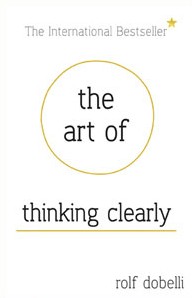
2. The Art of Thinking Clearly by Rolf Dobelli
Rating: ⭐⭐⭐⭐⭐ (5/5)
Who it’s for: Readers who prefer short, digestible chapters that they can read in small doses—perfect for busy people who want to learn about cognitive biases without committing to a dense academic text.
“Each chapter is like a mirror held up to your thinking patterns. I found myself recognizing my own biases in nearly every section.” – Verified purchaser
My take: Rolf Dobelli’s approach is brilliant in its simplicity. Rather than presenting one long argument, he breaks down 99 common cognitive biases into short, standalone chapters—each about 2-3 pages long. This makes it incredibly easy to digest and apply. I love how each chapter includes real-world examples that make the biases immediately recognizable. Whether it’s the sunk cost fallacy (why we continue investing in failing projects), the confirmation bias (why we seek information that confirms our beliefs), or the survivorship bias (why we overestimate our chances of success), Dobelli explains each bias with clarity and wit. What sets this book apart is its practical focus—each chapter ends with actionable advice on how to avoid or mitigate that particular bias. I’ve found myself referring back to specific chapters whenever I notice myself falling into a particular thinking trap.
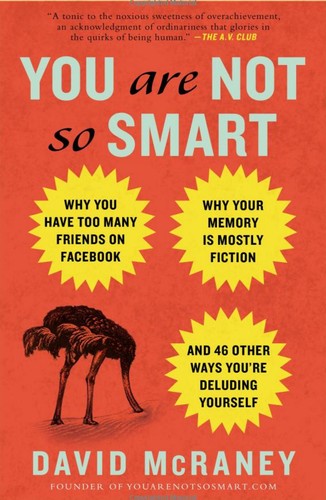
3. You Are Not So Smart by David McRaney
Rating: ⭐⭐⭐⭐☆ (4.5/5)
Who it’s for: People who enjoy learning through humor and relatable examples—perfect for anyone who thinks they’re rational but wants to see the funny ways their brain tricks them.
“McRaney has a gift for making psychology feel like chatting with a witty friend who happens to know a lot about how our brains work.” – Verified purchaser
My take: What I love most about this book is how David McRaney makes cognitive biases and logical fallacies feel personal and immediate. Based on his popular blog of the same name, each chapter reads like a short, entertaining story about a specific way we fool ourselves—from the Dunning-Kruger effect (why incompetent people don’t realize they’re incompetent) to the Texas sharpshooter fallacy (how we find patterns in randomness). McRaney’s background as a journalist shines through in his ability to explain complex psychological concepts in plain language with plenty of wit. I particularly appreciated his chapters on motivated reasoning (why we believe what we want to believe) and the illusion of transparency (why we think others can easily read our emotions). This book doesn’t just teach you about biases—it helps you develop a healthy skepticism about your own thoughts while maintaining a sense of humor about our shared human imperfections.
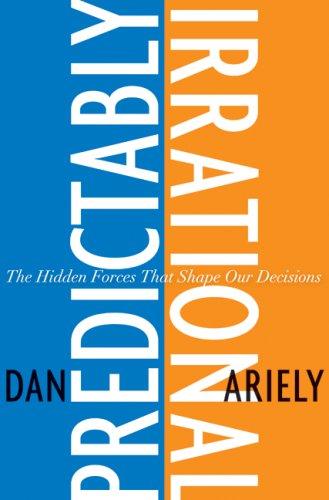
4. Predictably Irrational by Dan Ariely
Rating: ⭐⭐⭐⭐☆ (4.5/5)
Who it’s for: Anyone interested in the quirky, predictable ways our emotions and social norms influence our decisions—especially useful for people in business, marketing, or personal finance.
“Ariely’s experiments are both ingenious and entertaining—you’ll laugh while having your assumptions about rationality challenged.” – Verified purchaser
My take: Dan Ariely’s approach to studying irrationality is what makes this book so engaging: he designs clever experiments that reveal the hidden forces shaping our choices. From why we’ll pay more for a aspirin when it costs 50 cents versus 1 cent (the placebo effect) to how the Ten Commandments reduce lying (moral priming), Ariely shows that our deviations from rationality aren’t random—they’re predictable and systematic. I was particularly fascinated by his research on the “cost of zero cost” (why we irrationally overvalue free items) and the impact of arousal on decision-making. What sets this book apart is Ariely’s willingness to be the subject of his own experiments, making the science feel personal and relatable. After reading this, you’ll start noticing the “predictably irrational” patterns everywhere—in your shopping habits, relationships, and even your most important life decisions.

5. Nudge by Richard H. Thaler and Cass R. Sunstein
Rating: ⭐⭐⭐⭐☆ (4.5/5)
Who it’s for: People interested in how small changes in environment can significantly influence behavior—great for policymakers, managers, parents, or anyone who designs choices for others.
“Thaler and Sunstein show how subtle tweaks to choice architecture can lead to better outcomes without restricting freedom—practical psychology at its best.” – Verified purchaser
My take: This book introduced me to the concept of “choice architecture”—the idea that how options are presented significantly influences what we choose. Thaler and Sunstein, with Thaler later winning the Nobel Prize in Economics, demonstrate how we can design environments that help people make better decisions without forcing them. From automatically enrolling employees in retirement plans (increasing participation from 40% to over 80%) to placing healthy foods at eye level in cafeterias, the authors show how small “nudges” can have massive impacts. What I found particularly enlightening was their distinction between “nudges” (which preserve freedom of choice) and “sludge” (which creates unnecessary friction). The book taught me to look for the hidden design elements in everyday decisions—why certain options are presented first, how defaults shape our choices, and how social norms influence our behavior. It’s made me more conscious of both how I’m influenced by my environment and how I can design better choices for others.
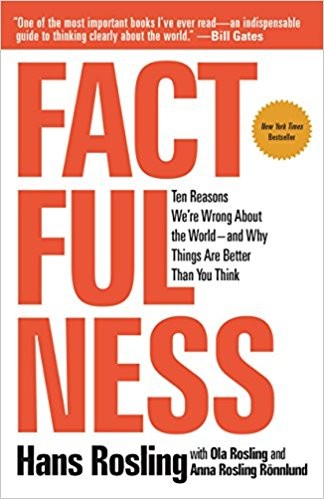
6. Factfulness by Hans Rosling
Rating: ⭐⭐⭐⭐☆ (4.5/5)
Who it’s for: Anyone who consumes news or forms opinions about global trends—essential for overcoming dramatic worldviews and developing a fact-based perspective.
“Rosling doesn’t just present data—he teaches you how to think about the world more clearly and less dramatically.” – Verified purchaser
My take: Hans Rosling’s posthumous work (completed by his son and daughter-in-law) is a masterclass in overcoming our dramatic instincts when viewing global trends. The book identifies ten specific instincts that distort our perspective—from the gap instinct (obsessing over differences between groups) to the negativity instinct (believing the world is getting worse) to the urgency instinct (feeling that immediate action is always necessary). What makes this book particularly valuable for understanding cognitive biases is how Rosling shows that even highly educated people—journalists, Nobel laureates, investment bankers—consistently perform worse than chimpanzees choosing answers at random when asked simple questions about global facts. This isn’t about lacking intelligence; it’s about how our brains are wired to pay attention to dramatic, memorable information rather than dull, steady trends. After reading Factfulness, I found myself pausing before reacting to shocking headlines and asking: “What would the data actually show?” It’s transformed how I consume news and form opinions about the world.

7. The Invisible Gorilla by Christopher Chabris and Daniel Simons
Rating: ⭐⭐⭐⭐☆ (4.5/5)
Who it’s for: Anyone interested in how our intuitions and perceptions can systematically deceive us—particularly valuable for drivers, healthcare professionals, and anyone whose work depends on accurate observation.
“This book will make you question everything you thought you ‘saw’—in the best possible way.” – Verified purchaser
My take: Written by the creators of the famous “invisible gorilla” experiment (where participants counting basketball passes fail to notice a person in a gorilla suit walking through the scene), this book explores how our intuitions about attention, perception, memory, and reasoning often lead us astray. Chabris and Simons reveal that we don’t see the world as it actually is—we see what our brains expect to see based on limited information and cognitive shortcuts. I was particularly struck by their chapters on why we’re overconfident in our memories (even vivid, emotional memories can be completely false) and why we notice sudden changes but miss gradual ones (explaining why we often fail to notice deteriorating situations until it’s too late). This book taught me to distrust my own perceptions in situations where accuracy matters and to seek objective verification instead of relying on what I “think I saw.”
7. The Invisible Gorilla by Christopher Chabris and Daniel Simons
Rating: ⭐⭐⭐⭐☆ (4.5/5)
Who it’s for: Anyone interested in how our intuitions and perceptions can systematically deceive us—particularly valuable for drivers, healthcare professionals, and anyone whose work depends on accurate observation.
“This book will make you question everything you thought you ‘saw’—in the best possible way.” – Verified purchaser
My take: Written by the creators of the famous “invisible gorilla” experiment (where participants counting basketball passes fail to notice a person in a gorilla suit walking through the scene), this book explores how our intuitions about attention, perception, memory, and reasoning often lead us astray. Chabris and Simons reveal that we don’t see the world as it actually is—we see what our brains expect to see based on limited information and cognitive shortcuts. I was particularly struck by their chapters on why we’re overconfident in our memories (even vivid, emotional memories can be completely false) and why we notice sudden changes but miss gradual ones (explaining why we often fail to notice deteriorating situations until it’s too late). This book taught me to distrust my own perceptions in situations where accuracy matters and to seek objective verification instead of relying on what I “think I saw.”

8. Superforecasting by Philip E. Tetlock and Dan Gardner
Rating: ⭐⭐⭐⭐☆ (4.5/5)
Who it’s for: Anyone interested in improving their prediction skills and understanding why expert forecasts often fail—particularly valuable for professionals in business, finance, policy, and intelligence analysis.
“Tetlock and Gardner show that forecasting is a skill that can be learned—not just a talent you’re born with.” – Verified purchaser
My take: This book changed how I think about making predictions about the future. Based on the Good Judgment Project—a massive, government-funded forecasting tournament—Tetlock and Gardner show that ordinary people can become extraordinary forecasters with the right training and habits. What makes “superforecasters” special isn’t intelligence or access to secret information, but specific cognitive habits: they think probabilistically (expressing beliefs as percentages rather than certainties), they update their beliefs frequently in response to new evidence, and they’re comfortable admitting when they were wrong. The book taught me to approach predictions with humility and to focus on the process of forecasting rather than trying to be “right.” I’ve found the techniques incredibly useful—not just for big predictions like election outcomes or market trends, but for everyday decisions like estimating how long a project will take or whether a relationship will work out.
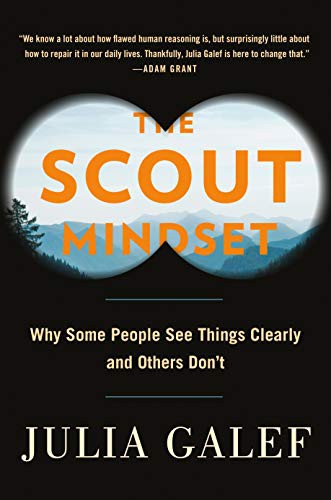
9. The Scout Mindset by Julia Galef
Rating: ⭐⭐⭐⭐☆ (4.5/5)
Who it’s for: Anyone struggling with motivated reasoning or defensive thinking—particularly valuable for people who want to see the world more clearly rather than just defend their existing beliefs.
“Galef doesn’t just teach you how to think better—she shows you how to want to see the truth, even when it’s uncomfortable.” – Verified purchaser
My take: Julia Galef’s concept of the “scout mindset” versus the “soldier mindset” revolutionized how I approach my own beliefs and biases. Soldiers are motivated to defend their existing beliefs at all costs, while scouts are motivated to get an accurate picture of reality, even if it means changing their minds. What I found most valuable about this book is that Galef doesn’t just tell us to be less biased—she shows us how to develop the emotional skills that make wanting to see the truth feel rewarding rather threatening. She emphasizes that improving our reasoning isn’t just about learning logical fallacies—it’s about cultivating traits like curiosity, intellectual humility, and the ability to enjoy being proven wrong. After reading this, I started catching myself in “soldier mode” moments (like when I find myself dismissing evidence that contradicts my views) and consciously shifting into scout mode by asking, “What would convince me I’m wrong about this?” This shift has made me far more open to changing my mind when presented with strong evidence.
9. The Scout Mindset by Julia Galef
Rating: ⭐⭐⭐⭐☆ (4.5/5)
Who it’s for: Anyone struggling with motivated reasoning or defensive thinking—particularly valuable for people who want to see the world more clearly rather than just defend their existing beliefs.
“Galef doesn’t just teach you how to think better—she shows you how to want to see the truth, even when it’s uncomfortable.” – Verified purchaser
My take: Julia Galef’s concept of the “scout mindset” versus the “soldier mindset” revolutionized how I approach my own beliefs and biases. Soldiers are motivated to defend their existing beliefs at all costs, while scouts are motivated to get an accurate picture of reality, even if it means changing their minds. What I found most valuable about this book is that Galef doesn’t just tell us to be less biased—she shows us how to develop the emotional skills that make wanting to see the truth feel rewarding rather threatening. She emphasizes that improving our reasoning isn’t just about learning logical fallacies—it’s about cultivating traits like curiosity, intellectual humility, and the ability to enjoy being proven wrong. After reading this, I started catching myself in “soldier mode” moments (like when I find myself dismissing evidence that contradicts my views) and consciously shifting into scout mode by asking, “What would convince me I’m wrong about this?” This shift has made me far more open to changing my mind when presented with strong evidence.

10. How Minds Change: The Surprising Science of Belief, Opinion, and Persuasion by David McRaney
Rating: ⭐⭐⭐⭐☆ (4.5/5)
Who it’s for: Anyone interested in how beliefs actually form and change—particularly valuable for communicators, educators, activists, and anyone who wants to understand why facts alone rarely change minds.
“McRaney combines compassion with science to show us how to actually change minds—not just win arguments.” – Verified purchaser
My take: This book brilliantly complements McRaney’s earlier work by focusing not just on how we fool ourselves, but how we can actually change our minds and help others do the same. Through extensive research and conversations with former cult members, conspiracy theorists, and people who’ve radically changed their political views, McRaney reveals that beliefs rarely change through facts and logic alone. Instead, mind change happens through deep listening, emotional connection, and creating safe spaces for people to explore their doubts. What transformed my understanding was learning about “deep canvassing”—a technique where activists have successfully changed people’s views on controversial issues through compassionate, non-confrontational conversations. This book taught me that overcoming cognitive biases isn’t just about individual mental hygiene—it’s about creating communities where truth-seeking is valued and where people feel safe enough to question their own beliefs.
Frequently Asked Questions
Q1: Do I need to read all ten books to benefit from understanding cognitive biases? A: Absolutely not! Each book offers valuable insights on its own. If you’re new to the topic, start with “Thinking, Fast and Slow” for a comprehensive foundation or “The Art of Thinking Clearly” for bite-sized, practical lessons. The books complement each other but can be read independently based on your interests and time availability.
Q2: Are cognitive biases the same as logical fallacies? A: They’re related but distinct concepts. Cognitive biases are systematic patterns of deviation from norm or rationality in judgment that occur unconsciously. Logical fallacies are errors in reasoning that make arguments invalid. Many cognitive biases lead to logical fallacies—for example, confirmation bias can lead to the fallacy of cherry-picking evidence—but you can have biases without committing formal fallacies in arguments.
Q3: Can simply reading about cognitive biases actually reduce my susceptibility to them? A: Awareness is the first and crucial step, but it’s not a complete solution. Knowing about biases helps you recognize when you might be falling prey to them, but overcoming them requires active practice—like slowing down your thinking, seeking disconfirming evidence, and using specific debiasing techniques. Think of it like learning about optical illusions: knowing they exist doesn’t prevent you from seeing them, but it helps you question what you’re seeing.
Q4: Which book is best for someone who hates dense academic texts? A: “You Are Not So Smart” by David McRaney is perfect for you. It’s based on a popular blog and written in a humorous, conversational style with plenty of relatable examples. “The Art of Thinking Clearly” by Rolf Dobelli is also excellent with its short, standalone chapters that you can read in small doses.
Q5: How do cognitive biases affect my everyday life? A: They influence nearly every decision you make—from what you buy and who you trust to how you interpret news and make important life choices. For example, the anchoring effect might cause you to overpay for something because of an initial price suggestion, confirmation bias might lead you to only follow news sources that match your existing beliefs, and the sunk cost fallacy might keep you in a unsatisfying job or relationship because you’ve already invested time in it.
Q6: Are there any benefits to having cognitive biases? A: Yes! Cognitive biases evolved as mental shortcuts that help us make quick decisions with limited information and energy. They allow us to navigate a complex world efficiently. For instance, the availability heuristic helps us quickly judge danger based on vivid examples (useful when avoiding actual threats), and social conformity biases help us maintain group harmony. The key is recognizing when these helpful shortcuts lead us astray in modern contexts.
Q7: How can I teach others about cognitive biases without sounding condescending? A: Start by sharing your own biases and mistakes—this creates psychological safety and shows you’re not positioning yourself as superior. Use relatable examples from everyday life rather than abstract theory. Books like “You Are Not So Smart” and “The Scout Mindset” model this approach beautifully by emphasizing that we’re all susceptible to biases and that improving our reasoning is a shared human journey.
Q8: Is there a specific order I should read these books in? A: While there’s no required order, a logical progression might be: 1) Start with “Thinking, Fast and Slow” for foundational knowledge, 2) Move to “The Art of Thinking Clearly” or “You Are Not So Smart” for practical applications, 3) Explore specialized topics with “Factfulness” (global perspectives), “The Invisible Gorilla” (perception), “Superforecasting” (prediction), “The Scout Mindset” (motivated reasoning), and 4) Finish with “How Minds Change” for understanding belief transformation. But feel free to follow your curiosity!
Q9: How long will it take to read all ten books? A: Depending on your reading speed and how deeply you engage with the material, expect anywhere from 3-6 months if you’re reading a book per month. Many readers find it valuable to revisit certain books or sections as they encounter situations where the concepts apply.
Q10: Can understanding cognitive biases make me more manipulative? A: Any knowledge can be used ethically or unethically. Understanding biases gives you power to influence others—but with that power comes responsibility. The books in this list (particularly “Nudge” and “How Minds Change”) emphasize using this knowledge to help people make better choices that align with their own goals and values, not to exploit them. Ethical application focuses on transparency and preserving freedom of choice.
Closing Thought
Understanding cognitive biases isn’t about achieving perfect rationality—we’re human, and our brains will always take shortcuts. Instead, it’s about developing what psychologist Keith Stanovich calls a “mindware upgrade”: installing cognitive tools that help us recognize when our intuition might be leading us astray and giving us the courage to question our own thoughts.
The most valuable insight I’ve gained from exploring these books is that intellectual humility—the willingness to say “I might be wrong”—is perhaps the most important cognitive skill we can develop. In a world of increasing polarization and misinformation, the ability to hold our beliefs lightly enough to examine them critically is not just personally beneficial; it’s essential for healthy discourse and decision-making.
So which book are you grabbing first? Whether you start with the comprehensive depth of “Thinking, Fast and Slow” or the accessible wit of “You Are Not So Smart,” you’re taking an important step toward seeing your own mind more clearly—and that’s a journey well worth beginning.
Note: As an Amazon Associate, I earn from qualifying purchases. All book links use our affiliate tag readplug09-20.