Here’s what nobody explains about getting hit by the economy: it doesn’t feel like a chapter in a story. In the actual moment, it feels like someone moved the floor. Everything you planned, everything you built your routine around, everything you assumed was stable — gone.
I know this feeling. In 2021, budget cuts eliminated my position at Decatur High. Fourteen years of coaching. Two state titles. A meeting that lasted nine minutes. I was 38. I had a mortgage. I spent four months applying for jobs I didn’t get.
Then I had what I call the library period. Six months at the DeKalb County Public Library, reading everything I could find about reinvention, failure, second acts, psychology. Self-help books I would have been too proud to read before. Memoirs of people who had started over. I took notes with the same discipline I’d applied to game film.
That library period saved me. Not because any single book fixed my situation — none of them did — but because they gave me something to do in the hallway. The hallway is the space between the thing that ended and the thing that hasn’t started yet. These ten books made the hallway bearable.
Quick Pick: The Best Book for Building Resilience
Also see our guide to 10 BEST BOOKS FOR BOUNCING BACK FROM FAILURE AND BUILDING THE KIND OF RESILIENCE THAT ACTUALLY LASTS. Also see our guide to Best Books for Building Emotional Resilience in Difficult Times. Also see our guide to 10 Best Books for Building Mental Resilience in Tough Times. Also see our guide to 10 Best Books for Building Resilience in Tough Economic Times.If you only have time for one book, go with “Man’s Search for Meaning” by Viktor Frankl. It’s the shortest book on this list and the most powerful. Frankl survived Auschwitz and wrote about the one thing that can’t be taken from you: your ability to choose your response. I read it three times in my library period. I’m giving it to you now so maybe you don’t have to wait as long as I did.
THE 10 BEST BOOKS FOR BUILDING RESILIENCE IN TOUGH ECONOMIC TIMES

1. MAN’S SEARCH FOR MEANING BY VIKTOR FRANKL
Viktor Frankl | ⭐ 4.8/5
Who it’s for: Anyone going through something that feels impossible. If you’re in the hallway right now — between the thing that ended and the thing that hasn’t started — this book is the flashlight.
“Everything can be taken from a man but one thing: the last of the human freedoms — to choose one’s attitude in any given set of circumstances.”
Frankl was a psychiatrist who survived the Nazi concentration camps. This book is half memoir, half psychological framework. His central argument: you cannot always control what happens to you, but you can always control how you respond. Meaning is not found in comfort. It’s found in the attitude you bring to suffering.
Real talk: comparing a layoff to a concentration camp sounds extreme. Frankl would say the scale is different but the principle is the same. When everything external is stripped away, what’s left is your internal response. That’s the floor you build on when the other floor is gone.
I read this at the DeKalb library on a Tuesday afternoon. I read it in one sitting. I sat there for another twenty minutes after I finished. That’s the only endorsement that matters.
My take: The most important book on this list. Not the most practical. The most important.
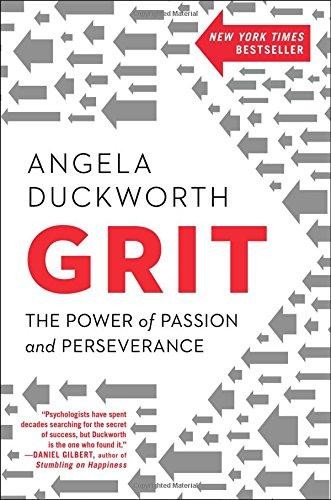
2. GRIT BY ANGELA DUCKWORTH
Angela Duckworth | ⭐ 4.5/5
Who it’s for: Anyone who has been told they just need to “work harder” and suspects that’s not the whole answer. If effort alone hasn’t gotten you where you want to be, Duckworth explains why — and what to add.
“Enthusiasm is common. Endurance is rare.”
Duckworth is a psychologist who studied what makes people succeed — not talent, not IQ, but a combination of passion and perseverance she calls “grit.” Her research shows that gritty people don’t just work harder. They work harder on the same thing for longer. They don’t bounce between goals. They commit.
Here’s the part nobody talks about: grit requires a foundation. You can’t persevere if you can’t eat. If your situation is precarious, the first step isn’t grit — it’s stabilization. Get the floor under you. Then be gritty.
That said, once you have stability, Duckworth’s framework is the best I’ve found for “how do I keep going when I don’t see results?” Fall in love with the process, not the outcome. I stopped measuring success by page views and started measuring it by whether I showed up at the library every day. The page views came later. The showing up was the grit.
My take: Essential for the long game. Read it after you’ve stabilized. Don’t read it when you’re still looking for the floor.
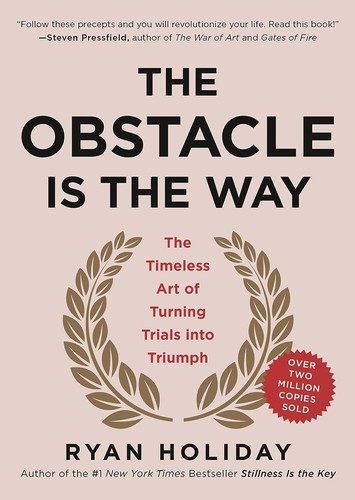
3. THE OBSTACLE IS THE WAY BY RYAN HOLIDAY
Ryan Holiday | ⭐ 4.4/5
Who it’s for: Anyone who’s been knocked down and can’t figure out how to turn the setback into something useful. If you’re tired of being told to “look on the bright side” and want a framework for actually doing it, this is your book.
“The impediment to action advances action. What stands in the way becomes the way.”
Holiday draws on Stoic philosophy — Marcus Aurelius, Seneca, Epictetus — and applies it to modern challenges. His framework has three parts: perception (how you see the obstacle), action (what you do about it), and will (the inner strength to endure). The Stoics believed that obstacles aren’t interruptions to your path. They are the path.
I read this during my library period and it rewired something. When I got laid off, I saw it as the end of my coaching career. Holiday’s framework asked me to see it differently: what if this wasn’t the end but a redirect? The obstacle — budget cuts, job loss, financial instability — became the thing that pushed me toward writing, which became the thing I was actually supposed to be doing. The obstacle was the way.
Not every obstacle is secretly a gift. Some things are just bad. But the Stoic practice of asking “what can I control here?” and focusing your energy there — that’s useful regardless of whether the obstacle turns out to be a redirect.
My take: The best framework for reframing setbacks. Not everything is a gift in disguise, but the Stoic toolkit for responding to what you can’t control is invaluable.

4. ATOMIC HABITS BY JAMES CLEAR
James Clear | ⭐ 4.6/5
Who it’s for: Anyone whose resilience has run out and needs to rebuild from zero. If you can’t make yourself do anything — can’t apply for jobs, can’t exercise, can’t get out of bed on time — this book gives you the smallest possible starting point.
“You do not rise to the level of your goals. You fall to the level of your systems.”
Clear’s argument: motivation is unreliable. What works is systems — small, repeatable habits that don’t require willpower. His “two-minute rule” says that any new habit should take less than two minutes to start. Don’t try to run a marathon. Put on your running shoes. Don’t try to write a book. Write one sentence. The habit is the starting point, not the whole thing.
I read Atomic Habits three times in my library period. I’m not recommending that. But I am recommending the core idea, because when you’re in the hallway — when everything has fallen apart and you can barely function — you don’t need a transformation. You need a single, tiny action that proves to yourself that you can still do something. For me, it was showing up at the library every morning at 9am. That was it. That was the habit. Everything else grew from there.
My take: The best book for rebuilding after collapse. Start impossibly small. The system compounds.
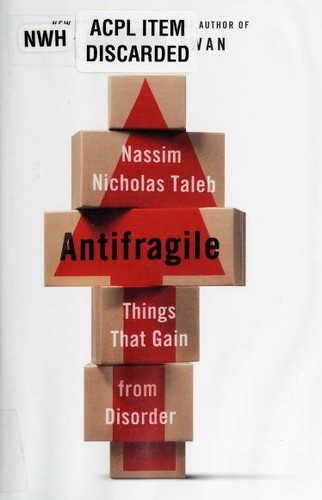
5. ANTIFRAGILE BY NASSIM NICHOLAS TALEB
Nassim Nicholas Taleb | ⭐ 4.3/5
Who it’s for: People who want to do more than survive tough times — they want to come out stronger. If you’re tired of just getting through and want to actually benefit from chaos, Taleb’s framework is the most radical on this list.
“Wind extinguishes a candle and energizes fire. Likewise with randomness, uncertainty, chaos: you want to use them, not hide from them.”
Taleb argues that some things don’t just survive disorder — they need it. They get stronger under stress. He calls this property “antifragile,” and it’s different from resilience. Resilience means you bounce back. Antifragile means you bounce forward. Muscles are antifragile — they grow when stressed. Bones are antifragile — they strengthen under load. The question is: how do you build a life that’s antifragile?
The practical application: create optionality. Don’t rely on one income stream, one employer, one skill set. Build multiple capabilities so that when one thing fails — and it will — you have others to fall back on. This is what I did with writing. Coaching was my one thing. When it disappeared, I had nothing. Now I write, I speak, I coach youth league. No single failure can take everything.
The book is dense and Taleb is arrogant. I read this in two hours on a Monday morning and I had thoughts. Skip the parts about economics and focus on the core concept.
My take: The most intellectually ambitious book on this list. Not for everyone. But the concept of antifragility changed how I think about risk.

6. MINDSET BY CAROL DWECK
Carol Dweck | ⭐ 4.4/5
Who it’s for: Anyone who has been defeated by their own internal narrative. If you’ve told yourself “I’m not the kind of person who…” or “I can’t because…” this book will show you how that story is holding you back.
“Becoming is better than being.”
Dweck’s research identifies two mindsets: fixed (believing your abilities are set) and growth (believing your abilities can develop). People with fixed mindsets avoid challenges, give up easily, and see effort as pointless. People with growth minds embrace challenges, persist through setbacks, and see effort as the path to mastery.
Real talk: I had a fixed mindset about coaching. I was a basketball coach. That was my identity. When the position was eliminated, my fixed mindset said: you are no longer a coach, therefore you are nothing. Dweck’s book helped me see that my identity didn’t have to be fixed. I could be someone who coaches and also writes. I could learn new skills. I could start over without it meaning I had failed.
The research is solid. The book can be repetitive. But the core concept — that your abilities are not fixed, that you can grow into things you can’t currently do — is the foundation of every comeback story.
My take: The most foundational mindset book. Read it early. It changes the lens through which you read everything else.

7. OPTION B BY SHERYL SANDBERG AND ADAM GRANT
Sheryl Sandberg & Adam Grant | ⭐ 4.3/5
Who it’s for: Anyone who has experienced a devastating loss and is trying to find a way forward. If Option A — the life you planned — is no longer available, this book is about building Option B.
“Option A is not available. So let’s just kick the hell out of Option B.”
Sandberg wrote this after her husband died suddenly at 48. Grant is a psychologist who studies resilience. Together they explore how people recover from loss — not just death, but any loss that reshapes your life: job loss, divorce, health crises, financial ruin. Their framework includes the “three P’s” that hinder recovery: personalization (it’s my fault), pervasiveness (it affects everything), and permanence (it will never get better).
The chapter on post-traumatic growth was the one that mattered most to me. Sandberg and Grant present research showing that while trauma doesn’t always lead to growth, it can. People who survive difficult experiences sometimes develop deeper relationships, a stronger sense of purpose, greater appreciation for life, and new possibilities they wouldn’t have seen otherwise. That’s not toxic positivity. It’s documented.
My take: The most emotionally honest book about loss on this list. If you’re grieving — a job, a career, a marriage, a plan — this book meets you there.

8. THE SUBTLE ART OF NOT GIVING A F*CK BY MARK MANSON
Mark Manson | ⭐ 4.2/5
Who it’s for: Anyone who has been consuming too much positive thinking and needs someone to tell them the truth: life is hard, some things are your fault, and not everything will work out. If you need permission to stop pretending you’re fine, Manson gives it.
“Who you are is defined by what you’re willing to struggle for.”
Manson’s argument: the pursuit of happiness is making us miserable. Instead of trying to be positive all the time, we should choose what we care about and accept that everything else will be hard. Resilience isn’t about feeling good. It’s about choosing what’s worth feeling bad about.
I read this during a particularly bad week when every other self-help book felt like it was lying to me. Manson wasn’t lying. He said: yes, this is bad. Yes, it might not get better soon. Yes, you might have to do hard things for a while. And that’s okay, as long as you’re doing hard things that matter.
The book is crude in places. It’s not rigorous. But sometimes you don’t need rigor. You need someone to stop cheerleading and say: this is hard. Now what are you going to do about it?
My take: The antidote to toxic positivity. Read it when you need honesty, not inspiration.
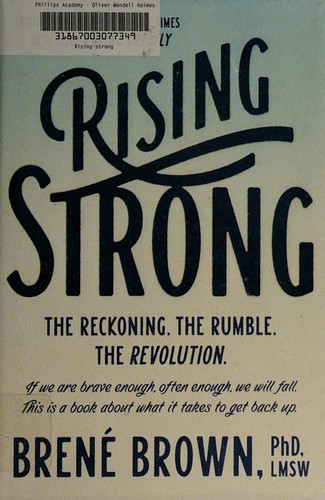
9. RISING STRONG BY BRENÉ BROWN
Brené Brown | ⭐ 4.4/5
Who it’s for: Anyone who has been knocked down and needs to get back up — not with a brave face, but with the messy, uncomfortable, honest process of actually recovering. If you’ve been pretending you’re fine when you’re not, this book gives you permission to not be fine.
“We don’t have to do it all alone. We were never meant to.”
Brown’s framework for recovery has three stages: the reckoning (recognizing your emotions), the rumble (wrestling with the story you’re telling yourself), and the revolution (writing a new, more honest ending). The rumble is the hard part. It means sitting with the uncomfortable truth — about yourself, about what happened, about your role in it — without running away.
For me, the rumble meant admitting that my identity as a coach had been so consuming that I’d let other parts of myself atrophy. The layoff didn’t just take my job. It took the version of me that only existed on a basketball court. The rumble was building a version of me that existed elsewhere.
My take: The best book for the emotional recovery process. Not about strategy. About the internal work that has to happen before strategy works.

10. WHEN BREATH BECOMES AIR BY PAUL KALANITHI
Paul Kalanithi | ⭐ 4.7/5
Who it’s for: Anyone who needs perspective. If your economic problems feel like the worst thing that could happen, this book will recalibrate your sense of what matters without minimizing your struggle.
“You can’t ever reach perfection, but you can believe in an asymptote toward which you are ceaselessly striving.”
Kalanithi was a neurosurgeon diagnosed with terminal lung cancer at 36. This memoir, written in the last years of his life, is about the search for meaning when the future you planned disappears. It’s not a self-help book. It’s a man deciding what matters when time runs out.
I’m including this because perspective is part of resilience. When I was in the library, reading about people who’d lost jobs, I also needed to read about people who’d lost more. Not to minimize my situation — losing your career at 38 is real — but to remember that the capacity to rebuild exists even in the worst circumstances. Kalanithi couldn’t rebuild. But he could decide what mattered. And that decision — what matters, right now, with whatever time and resources you have — is the foundation of resilience.
My take: The most beautiful book on this list. Read it when you need to remember what you’re building toward.
FREQUENTLY ASKED QUESTIONS
IS RESILIENCE SOMETHING YOU’RE BORN WITH OR CAN YOU BUILD IT?
Both, but mostly build it. Research shows that resilience has genetic and environmental components — some people start with a higher baseline. But resilience is also a skill that develops through practice. Every time you face a difficulty and come through it, your resilience strengthens. The books on this list are tools for building that muscle intentionally, not waiting for life to build it for you.
WHAT IF I CAN’T AFFORD TO BE RESILIENT RIGHT NOW?
Real talk: resilience requires a minimum level of stability. If you’re facing immediate financial crisis — can’t pay rent, can’t buy food — your first priority is practical survival, not reading books. Apply for assistance. Contact community resources. Do what you need to do to stabilize. Then, when you have a floor under you, come back to these books. Resilience is a long game. You need to be alive and housed to play it.
HOW DO I STAY RESILIENT WHEN THINGS KEEP GETTING WORSE?
This is the hardest question, and I don’t have a neat answer. What I can tell you from my own experience: when things kept getting worse — the layoff, the divorce, the failed job applications — I survived by narrowing my focus to what I could control that day. Not the future. Not the big picture. Today. Did I show up at the library? Did I write something? Did I eat? That’s it. Some days, resilience is just staying alive until tomorrow.
ARE THESE BOOKS ONLY FOR PEOPLE WHO’VE BEEN LAID OFF?
No. Economic tough times affect everyone — layoffs, recessions, industry changes, inflation, debt, medical bills. These books address the psychological and practical challenges of navigating instability, regardless of the specific trigger. If your income has dropped, your expenses have spiked, or your financial future feels uncertain, these books are for you.
CAN RESILIENCE BE TOXIC?
Yes. Toxic resilience is the idea that you should always be positive, always bounce back quickly, and never struggle. That’s not resilience — that’s denial. Real resilience includes grief, anger, confusion, and bad days. It includes asking for help. It includes admitting when you’re not okay. Brown’s “Rising Strong” and Sandberg’s “Option B” both address this: resilience without honesty is just performance.
HOW DO I HELP MY FAMILY STAY RESILIENT?
Start with honesty. Don’t pretend everything is fine when it isn’t. Kids and partners can sense when something is wrong, and the pretending makes it worse. Share age-appropriate truths: “We’re going through a hard time. We’re working on it. We’ll get through it together.” Establish routines — they create stability when everything else is unstable. And take care of yourself. You can’t help your family if you’re falling apart.
THE BOTTOM LINE
Tough economic times don’t ask permission. They arrive, they rearrange your life, and they leave you standing in the hallway trying to figure out what comes next. The books on this list don’t promise a five-step comeback. They promise something more honest: frameworks for staying functional, staying honest, and staying in the fight while you’re in the hallway.
If I had to hand you three books, I’d start with “Man’s Search for Meaning” by Viktor Frankl for the foundation, move to “Atomic Habits” by James Clear for the daily system, and finish with “Rising Strong” by Brené Brown for the emotional work that makes the other two possible.
I spent six months in that library. Some lessons hit different when they cost you something. These books cost me nothing at the DeKalb County Public Library. They gave me everything.
Which book are you grabbing first?
Disclosure: This post contains affiliate links. If you purchase through these links, ReadPlug may earn a small commission at no extra cost to you. We only recommend books we’ve personally found valuable.