There is a version of me that exists in the text messages I have not sent yet. It is the version that wants to say actually, I already have plans that night when what I mean is: I need one evening alone with my book and my silence. The version that almost wrote of course I can stay late when what she meant was I am so tired I could cry.
That version of me spent about thirty-two years apologizing for existing at a volume that made other people comfortable. I was good at it, because it took me a long time to recognize that being good at something does not mean it was serving me.
I was the person who remembered everyone’s birthday, who showed up early to things I didn’t want to attend, who read the room so precisely I could tell you the exact moment when someone slightly shifted their opinion of me – and then I would adjust accordingly, in real time, like a human mood ring with advanced pattern recognition. I was so practiced at making other people feel fine that I had forgotten what my own fine felt like. I am not sure I had ever met her.
The thing about people-pleasing as a coping mechanism – and I know this now, from the other side – is that it feels like kindness. It feels like being a good friend, a good daughter, a good coworker. It feels like love, or at least the version of love that says I will shrink myself down to whatever shape fits your needs. What it actually is, is fear. Fear that if I stop performing helpfulness, people will leave. Fear that my actual self – the one who sometimes doesn’t want to be on call, who needs solitude, who has opinions she doesn’t always share – is not enough.
I know this because I have been in therapy for two years, and because I have read approximately seventeen books on this exact topic, and because one Tuesday in March I sat in my car in the school parking lot after agreeing to help a friend move – again – and I realized I was genuinely relieved that she had not asked me to come on the actual day because I was already exhausted by the asking.
That is when I knew I had a problem.
That is also when I started finding the books that actually helped.
Not the books that told me to “set boundaries” in theory – those are a dime a dozen. The books that helped were the ones that understood that breaking free from people-pleasing is not a single decision you make once and then you’re fixed. It is a practice. A daily, small, sometimes terrifying practice of choosing yourself in increments, and then doing it again the next day, and then – this is the part nobody warns you about – forgiving yourself for all the times you slip back into old patterns.
The books on this list are the ones that actually changed how I move through the world. Some I read all the way through. Some I return to when I feel myself sliding back. All of them taught me something I needed to know.
Quick Pick: The Best Book for Breaking Free from People-Pleasing
Also see our guide to 10 BEST BOOKS FOR BUILDING RESILIENCE AFTER NARCISSISTIC ABUSE AND RECLAIMING YOUR SENSE OF SELF. Also see our guide to 10 BEST BOOKS FOR BUILDING UNSHAKEABLE CONFIDENCE AFTER BETRAYAL AND RECLAIMING YOUR SENSE OF SELF. Also see our guide to 10 BEST BOOKS FOR BREAKING THROUGH A CREATIVE SLUMP AND FINDING INSPIRATION AGAIN. Also see our guide to 10 BEST BOOKS FOR BREAKING THROUGH A CREATIVE SLUMP AND REIGNITING YOUR ARTISTIC PRACTICE. Also see our guide to 10 Best Books for Breaking Free from People-Pleasing and Setting Boundaries That Actually Stick. Also see our guide to 10 BEST BOOKS FOR BREAKING FREE FROM PEOPLE-PLEASING PATTERNS AND RECLAIMING YOUR TIME.If you only have time for one book, go with “Set Boundaries, Find Peace” by Nedra Glover Tawwab. This is the book I recommend most often because it is practical without being clinical, and because Tawwab writes about boundaries like someone who actually understands what it feels like to be the person who says yes when she means no. She does not shame you for the years you spent overextending. She just tells you how to start differently, one small decision at a time.
The 10 BEST BOOKS FOR BREAKING FREE FROM PEOPLE-PLEASING PATTERNS AND RECLAIMING YOUR TIME

1. SET BOUNDARIES, FIND PEACE BY NEDRA GLOVER TAWWAB
Nedra Glover Tawwab | ⭐ 4.7/5
Who it’s for: Anyone who has ever said yes when they meant no, who feels exhausted by the constant sense of obligation, who keeps waiting for permission to take up space in their own life.
“You are not responsible for other people’s feelings. This is the truth, and the sooner you accept it, the more peaceful your life will become.”
This is the book I recommend when someone doesn’t know where to begin. Tawwab is a therapist who specializes in boundaries – she does not moralize. She explains why boundaries matter and how to start building them when you have spent your whole life convinced that having boundaries made you selfish.
The book gives you scripts – actual sentences you can say out loud. When you have spent decades avoiding conflict, you do not know what to say when someone asks you to do something you do not want to do. You will backslide. The book is about practicing, daily, the small acts of choosing yourself.
My take: This is the book I recommend to everyone.

2. THE DISEASE TO PLEASE BY HARRIET BRAIKER
Harriet Braiker | ⭐ 4.5/5
Who it’s for: People who have been saying yes for so long they have forgotten how to want things for themselves, and who want to understand the psychology behind their people-pleasing.
“The need to please others is not a sign of your kindness. It is a sign of your fear.”
This book was first published in 2002 and it has been helping people for over two decades. Braiker breaks down the psychological roots of people-pleasing in a way that felt, to me, like having something explained by someone who actually got it.
She identifies what she calls “the people-pleasing syndrome” and traces it back to early life experiences, particularly childhood environments where love felt conditional. This was a hard chapter to read because I recognized myself in it.
The book is a little more clinical – Braiker uses a structured, program-based approach – but it is thorough and it works.
My take: Read this one if you want to understand why you people-please in addition to how to stop.

3. WHEN I SAY NO, I FEEL GUILTY BY MANUEL J. SMITH
Manuel J. Smith | ⭐ 4.6/5
Who it’s for: Anyone who experiences intense guilt when asserting their own needs, and who wants a structured method for developing assertiveness skills.
“The difference between assertiveness and aggression is how you feel about yourself when you practice it.”
This book is from 1975 and it is still one of the best books on assertiveness I have ever read. Smith developed a method called “assertion therapy,” based on his work with clients who could not say no without experiencing physical panic.
Smith gives you actual techniques: scripts, role-playing exercises, and a section on how to handle it when someone pushes back. The language is dated, but the core principles are timeless. The idea that you have rights as a person, including the right to say no without justification, is as relevant now as it was fifty years ago.
My take: A classic for a reason. The techniques in this book require practice but they work.

4. THE ART OF SAYING NO BY DAMON ZAHARIDADES
Damon Zahariades | ⭐ 4.4/5
Who it’s for: People who understand intellectually that they need to say no more but who freeze in the moment and default to yes, and who want practical, actionable strategies.
“Every time you say yes to something that doesn’t align with your priorities, you are saying no to yourself.”
I picked this one up because I kept seeing it recommended in productivity articles, and I was skeptical – it sounded corporate. But several people whose opinion I trust had specifically mentioned it, so I read it, and I was genuinely surprised.
Zahariades is a former corporate strategist, and that shows – the book is extremely practical, organized, and efficient. Each chapter is short, each strategy clearly explained. There are scripts for saying no in different contexts. There is a chapter on how to say no without offering explanations.
What I took from this book: my reason is my own business. “No, I can’t make that work” is a complete sentence.
My take: A great practical companion. Efficient and useful.

5. BOUNDARIES BY HENRY CLOUD AND JOHN TOWNSEND
Henry Cloud and John Townsend | ⭐ 4.6/5
Who it’s for: People who grew up in environments where their boundaries were not respected and who are trying to understand how to develop them as adults, particularly in relationships.
“The purpose of boundaries is to keep the good in and the bad out. Without boundaries, you cannot protect what matters.”
I almost did not include this book because it has a specifically Christian perspective that may not be relevant for everyone. But it is also one of the most thorough books on boundaries that exists.
Cloud and Townsend bring a depth to the topic that many self-help books lack. The book covers not just how to set boundaries but why boundary-setting is so difficult – particularly for those who grew up in families where they were expected to meet everyone else’s needs without their own needs being seen.
There is a section on how to handle it when you set a boundary and the other person reacts badly. When you have spent your whole life making other people comfortable, the moment someone is uncomfortable because of a choice you made, it feels like an emergency. Cloud and Townsend walk you through how to hold steady.
My take: Even if you do not have a religious background, the sections on boundary mechanics are worth reading.

6. THE POWER OF NO BY JAMES ALTUCHER
James Altucher | ⭐ 4.3/5
Who it’s for: People who feel stuck in cycles of overcommitment and who want a short, punchy, motivating read that will help them start making different choices.
“Every time you say no to something you don’t want to do, you say yes to the life you actually want to live.”
James Altucher is a writer and entrepreneur who has written extensively about failure, reinvention, and choosing yourself. This book is short – you can read it in an afternoon – and it is trying to be a wake-up call.
Altucher writes in short, direct chapters that hit hard. He is not a therapist, so the book lacks clinical precision, but it has an energy the others do not. It feels like a friend who has been through what you’ve been through and is telling you, very directly, that you have been lying to yourself about what matters.
The core message: every no you say to something that doesn’t serve you is a yes to something that does.
My take: A great book when you are feeling stuck and need motivation. Short, punchy, immediately useful.

7. THE MINDFUL LIFE BY ROGER WALINGER
Roger Walinger | ⭐ 4.2/5
Who it’s for: People whose people-pleasing is tied to anxiety and who need to address the root anxiety before they can effectively set boundaries.
“The mind is a powerful tool. When we learn to observe our thoughts instead of being consumed by them, we create space for change.”
This is a different kind of book for this list. Walinger is a therapist who has spent decades working with anxious clients, and this book is about the intersection of mindfulness and anxious people-pleasing – which is most people-pleasing, if we’re being honest with ourselves.
The core idea is that people-pleasing is often anxiety-driven. We say yes because saying no feels dangerous. We anticipate bad outcomes that may not happen. Walinger offers mindfulness exercises that help you observe your anxiety without acting on it.
What I found helpful was the permission to have the fear without letting the fear make the decision. I used to think that my anxiety meant I shouldn’t set a boundary. Walinger reframes that.
My take: Best read alongside one of the more practical books on this list.

8. THE COWARDLY LION BY MIKE DELLOS
Mike Dellos | ⭐ 4.1/5
Who it’s for: People who intellectualize their problems and need a narrative, story-based approach to understanding people-pleasing rather than a clinical or practical one.
“The lion was not a coward. He was afraid of something specific. Understanding the difference changes everything.”
I almost didn’t include this book because it is less well-known than the others on this list, but it is worth knowing about. Dellos is a therapist who writes under a pseudonym, and the book uses the metaphor of The Wizard of Oz – specifically the Cowardly Lion – to explore how we develop fears around asserting ourselves and how to move through them.
The strength of this book is that it is a narrative approach. It is not a workbook, not a clinical guide. It tells a story that helps you understand your own patterns. This was useful for me in a different way than the practical books were – it helped me see my people-pleasing as something that developed for reasons that made sense at the time, rather than as a personal failing.
My take: A nice complement to the practical guides.
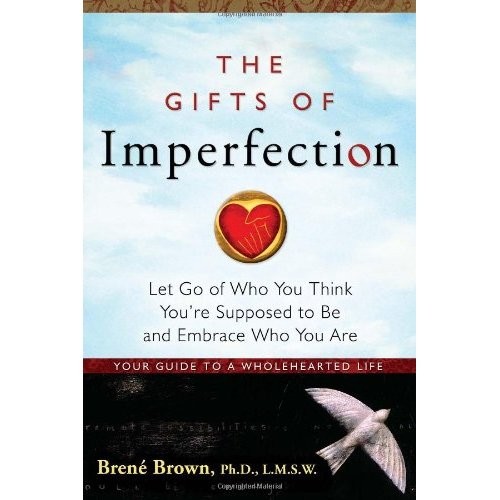
9. THE GIFT OF IMPERFECTION BY BRENE BROWN
Brene Brown | ⭐ 4.8/5
Who it’s for: People whose people-pleasing is connected to shame – who feel like they are not enough, who base their worth on external approval, and who need to reconnect with their own worthiness.
“Owning our story can be hard but not nearly as difficult as spending our lives running from it.”
I have to include Brene Brown even though she is mentioned in almost every self-help conversation. She is mentioned because she is actually good, and this book is actually useful, and the reason people keep recommending her work is that it genuinely helps.
The Gift of Imperfection is about what Brown calls “shame resilience” – the ability to recognize when you are feeling shame and to move through it without making self-destructive choices. For people-pleasers, shame is often at the root of everything. We people-please because we feel shame about our own needs, our own desires, our own want of time and space and selfhood. We think: if people knew the real me, they would not like me. So we perform a version of ourselves that is acceptable, and we call that being a good friend.
Brown writes from both personal experience and clinical research.
My take: Essential reading for understanding why we people-please.

10. IS IT ME? BY DR. JENNIFER KAISER
Dr. Jennifer Kaiser | ⭐ 4.4/5
Who it’s for: People who suspect they might be people-pleasers but who have not yet found a framework that explains their experience, and who want a book that feels specifically tailored to their struggle.
Get it here: Amazon Link
“You cannot pour from an empty cup. But first, you have to believe you deserve a cup at all.”
Dr. Kaiser is a psychologist who has worked specifically with people-pleasers for much of her career, and it shows. This book feels like it was written for exactly the person I was – someone who had read other self-help books and found them partially useful but who still felt like something was missing.
The framework Kaiser offers is relational: she helps readers understand that people-pleasing is a pattern that develops in relationships and can only be changed in relationships. Not by gritting your teeth and saying no more often, but by understanding the relational patterns you are caught in and finding ways to change them.
There is a strong emphasis on self-compassion in this book.
My take: A thoughtful, comprehensive book. A good ending point for this list.
FREQUENTLY ASKED QUESTIONS
WHY IS BREAKING FREE FROM PEOPLE-PLEASING SO HARD?
People-pleasing is hard to break because it is reinforced constantly, at every level of human interaction. When you say yes, people are grateful. When you say no, sometimes people are disappointed – and that activates your nervous system the same way as actual danger. Your body learned, years ago, that keeping other people happy was the way to stay safe. Unlearning that takes time. It is not a character flaw.
WILL PEOPLE LEAVE MY LIFE IF I START SETTING BOOUNDARIES?
Some people might. This is the truth that most self-help books do not want to tell you directly. When you stop people-pleasing, you will discover that certain relationships were built partly on your willingness to accommodate. Some will adapt. Some will not. The ones that do not were not actually relationships – they were arrangements. Losing them is painful. Losing them is also how you make room for actual relationships, where you are valued for who you are rather than for what you do.
I FEEL GUILTY EVERY TIME I SAY NO. IS THAT NORMAL?
Yes. The guilt does not mean you are doing something wrong. It means you are doing something new. The guilt is your nervous system reacting to a familiar pattern being disrupted. Over time, as you practice saying no and the world does not collapse, the guilt will diminish. In the beginning, you have to push through it because it is the only way to teach your nervous system that saying no is survivable.
CAN I SET BOUNDARIES WITHOUT LOSING MY KINDNESS?
This is a false choice that people-pleasers often construct because they are afraid of the answer. Kindness and boundaries are not opposites. Most of the kindest people I know have very clear boundaries. True kindness is not the same as never saying no. True kindness, sustained over time, requires that you take care of yourself so that you have something to give.
WHAT IF I WAS RAISED TO BE A PEOPLE-PLEASER AND I DO NOT KNOW ANY OTHER WAY?
Then this list is for you. The books on this list were written for exactly this situation – people who learned, early, that being of service was the price of being loved, and who are now trying to find a different way to be in the world. You are not broken. You learned a pattern. You can unlearn it. It will take time, and it will be uncomfortable, and that is not a sign to stop.
HOW LONG DOES IT TAKE TO STOP PEOPLE-PLEASING?
There is no fixed timeline. Some people make significant changes in a few months. For most people, it is a practice that continues for years – not because changing skills takes that long, but because changing deep patterns in relationships takes ongoing attention and self-compassion. You will slip. You will backslide. That is not failure. That is how change works.
IS IT SELFISH TO CHOOSE MY OWN NEEDS OVER OTHER PEOPLE’S WANTS?
No. Notice the question is not “Is it selfish to choose my own needs over other people’s needs?” It is “over other people’s wants.” Other people’s comfort is not more important than your own. Your needs matter. The books on this list will help you believe that, and then help you practice living like it is true.
THE BOTTOM LINE
Here is what I know after two years of therapy and seventeen books: breaking free from people-pleasing is not about becoming a different person. It is about becoming more fully the person you already are.
The fear does not go away entirely. I still feel it – the slight lurch in my stomach when I consider saying no. But I have learned to notice it, thank it for its concern, and choose anyway. Both can be changed, one small decision at a time.
If you take one thing from this list, take this: you are not responsible for other people’s feelings. You never were. The books on this list will help you unlearn that lesson.
The three books I return to most often are Set Boundaries, Find Peace by Nedra Glover Tawwab, The Disease to Please by Harriet Braiker, and The Gift of Imperfection by Brene Brown.
Start with one. Not all ten. Just one.
Which book are you grabbing first?
Disclosure: This post contains affiliate links. If you purchase through these links, ReadPlug may earn a small commission at no extra cost to you. We only recommend books we’ve personally found valuable.