Here’s what I used to think about optimism: it was for people who hadn’t paid attention.
I grew up in a household where hope was treated like a luxury — something you could afford after you handled the actual problem. My grandfather coached basketball for forty years. He believed in work. Not optimism, not visualization, not the power of positive thinking. Work. The scoreboard at the end of the game. That was the only optimism that mattered.
And then I got laid off at 38. Budget cuts. Nine-minute meeting. And I went home and sat on my couch and tried to figure out what came next, and I discovered something: pure work wasn’t enough. I’d spent fourteen years coaching, working harder than most people I knew, and when the thing I was working toward got eliminated, I didn’t have a framework for what came after. I had no optimism infrastructure.
Real talk: I spent six months in what I call the library period — basically living at the DeKalb County Public Library, reading everything I could find about starting over, reinvention, and yes, optimism. Most of it was garbage. But some of it actually helped. This list is the books that actually helped.
What I learned: optimism isn’t naivety. Optimism is a skill. It’s a practice. It’s something you build when you’ve seen enough to know that things can get better — not because the world is inherently fair, but because you’ve watched people make the choice to look forward instead of back.
Quick Pick: The Best Book for Building Optimism
Also see our guide to 10 Best Books for Building Confidence and Friendship in Tween Girls. Also see our guide to 10 Best Books for Building Confidence as a First-Time Manager. Also see our guide to 10 BEST BOOKS FOR BUILDING CONFIDENCE AS AN INTROVERT AND LEARNING TO THRIVE IN SOCIAL SITUATIONS. Also see our guide to 10 Best Books for Building Confidence in Your 40s. Also see our guide to 10 BEST BOOKS FOR BEING MORE OPTIMISTIC AND BUILDING A BRIGHTER OUTLOOK ON LIFE.If you only have time for one book, go with “Learned Optimism” by Martin Seligman. This is the book that changed how I understood optimism — not as a personality trait you’re born with, but as a habit you can practice. Seligman spent decades researching why some people bounce back from setbacks and others collapse, and the answer isn’t what I expected. It’s not about being positive. It’s about how you explain bad events to yourself. The book taught me to catch my own explanatory style — the way I told myself stories about why things happened — and to interrupt the patterns that were making me expect the worst. It’s a 4-star book. I’ve recommended it to thirty people. Make that make sense.
The 10 BEST BOOKS FOR BEING MORE OPTIMISTIC AND BUILDING A BRIGHTER OUTLOOK ON LIFE
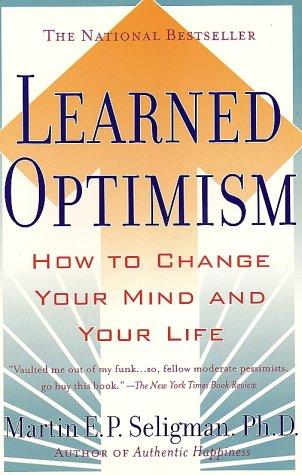
1. LEARNED OPTIMISM BY MARTIN SELIGMAN
Martin Seligman | ⭐ 4/5
Who it’s for: People whose first instinct when something goes wrong is to assume it’s permanent, pervasive, and personal — and who want to change that pattern.
“The optimistic style of explaining good events is the opposite: good events have temporary, specific, and external causes.”
Seligman is the guy who invented the concept of learned helplessness — the idea that people can learn to feel powerless even when they have the power to change their situation. This book is the other half of that research: learned optimism. The idea that you can learn to be hopeful the same way you learned to feel helpless.
The book walks through his research with dogs, then humans, then children in schools. The pattern is consistent: people who explanatory style (how they explain bad events to themselves) has a huge effect on whether they stay stuck or move forward. People who explain setbacks as temporary, specific, and external tend to recover faster. People who explain them as permanent, pervasive, and personal tend to stay down.
The “ABCDE” model is the practical tool: Adversity (what happened), Belief (what you told yourself about it), Consequence (what followed), Disputation (challenge your belief), Energization (the new result). It’s not about positive thinking. It’s about accurate thinking that happens to be more optimistic.
What it gets wrong: the book can feel academic in places, especially the research sections. Also, Seligman has evolved in his thinking since this was written — some of his later work is more nuanced. But the core framework is still useful.
My take: This is the book I needed at 38. I wish I’d had it at 28.

2. THE MIRACLE MORNING BY HAL ELROD
Hal Elrod | ⭐ 4/5
Who it’s for: People who know they need to change their morning routine but haven’t found a system that actually sticks.
“The quality of your morning determines the quality of your day.”
Let me say something about this book that most reviews don’t: the author’s story is inspiring but also kind of intense. Elrod was hit by a drunk driver at 51 mph, spent weeks in a coma, was told he might never walk again, and then rebuilt himself through this morning routine. That’s not a small thing. And some people find his intensity off-putting.
Here’s what I know: the SAVERS routine (Silence, Affirmations, Visualization, Exercise, Reading, Scribing) works. Not because the concepts are revolutionary — they’re not — but because having a specific sequence makes it harder to skip. When I started doing this at 39, I felt ridiculous for the first week. By the second week, I noticed I was handling stress differently. By month three, I noticed I had more good mornings than bad ones. That noticing was the beginning of optimism.
What it gets wrong: Elrod’s optimism can edge into toxic positivity territory. He doesn’t always acknowledge that some people have more reasons to struggle than others, and the “you can be anything you want” energy doesn’t always land for people who’ve been dealt harder hands. Take what works, leave the rest.
My take: The early morning time is non-negotiable for building anything. This gives you the structure.

3. MINDSET BY CAROL DWECK
Carol Dweck | ⭐ 4.5/5
Who it’s for: People who feel defined by their failures and want to develop a relationship with growth that isn’t just intellectual.
“Becoming is not about brilliant moments. It is about everyday victories.”
Dweck’s distinction between fixed mindset and growth mindset is one of the most useful frameworks I’ve encountered in twenty years of reading self-improvement. Fixed mindset: you have a certain amount of talent and your job is to prove you have it. Growth mindset: you have potential and your job is to develop it. The difference sounds simple. It’s not. It shows up everywhere — in how you handle criticism, how you respond to setbacks, how you view other people’s success.
What I appreciate about Dweck’s research: she didn’t just discover this framework. She spent decades testing it in schools, in businesses, in sports. The data is real. The interventions work. But here’s the part nobody talks about: you don’t just “get” a growth mindset. You practice it. You catch yourself in fixed mindset moments. You interrupt them. You choose to believe that you can grow, which requires the same muscle as optimism — the choice to believe things can change.
What it gets wrong: Dweck has acknowledged that some interpretations of her work have been weaponized into hustle culture (the “just have a growth mindset” dismissal of structural barriers). The book itself is more nuanced than its reception.
My take: This is the foundation. Without understanding mindset, you’re just rearranging furniture.

4. THE ALCHEMIST BY PAULO COELHO
Paulo Coelho | ⭐ 4/5
Who it’s for: People going through a transition who need to believe that following something — even without knowing where it leads — is worth it.
“When you want something, all the universe conspires in helping you to achieve it.”
I’m going to say something controversial: this book is better than its reputation suggests, and also more problematic than its reputation suggests. The “when you want something, the universe conspires” idea can lead people to wait for signs instead of taking action. That’s dangerous. Coelho knows this — the shepherd actually has to walk to Egypt — but the framing doesn’t always land correctly.
That said: the core lesson is real. The shepherd has to actually take the journey. The omens are useless without action. And the idea that meaning is discovered through following, not planning, has genuine value for people who’ve spent their whole life planning and have nothing to show for it.
What it gets wrong: the mystical elements can feel heavy-handed for skeptical readers. Also, some people read it and become dreamers instead of walkers. That’s on the reader, but the book doesn’t do enough to prevent it.
My take: Read it for what it actually says, not what people say it says. The journey is the point.

5. CAN’T HURT ME BY DAVID GOGGINS
David Goggins | ⭐ 3.5/5
Who it’s for: People who need a kick in the teeth to get moving and who can separate intensity from applicability.
“The only way out is through.”
Goggins is the ultramarathon runner and former Navy SEAL whose life story includes childhood abuse, massive obesity, and becoming one of the hardest men alive. His book is about what he calls “mental toughness” — the willingness to do hard things when every part of you wants to quit.
Here’s my real talk: I have a complicated relationship with this book. Goggins is genuinely impressive. His story is real. But his approach is not for everyone. Some people read this and find the push they needed. Some people read this and feel inadequate for not being able to do what he does. The book doesn’t acknowledge that different people have different starting points, different resources, different burdens.
What it gets right: the 40% rule (you only know 40% of what you’re capable of) is useful. The idea that your mind quits before your body does is useful. The permission to be uncomfortable is useful.
What it gets wrong: Goggins treats his approach as the only valid one, which isn’t true. Also, the book can trigger people with trauma backgrounds. Your body is not the enemy.
My take: Use this as a supplement, not a foundation. There’s value in the edge. You don’t need to live on the edge to benefit from standing near it.

6. MAN’S SEARCH FOR MEANING BY VIKTOR FRANKL
Viktor Frankl | ⭐ 5/5
Who it’s for: People who are trying to understand why they should keep going — especially people who have lost something they built their identity around.
“Everything can be taken from a man but one thing: the last of the human freedoms—to choose one’s attitude in any given set of circumstances.”
Frankl survived the Holocaust and spent years in concentration camps. He watched people lose everything — family, possessions, health, dignity — and he observed that the ones who lived were not the ones who had the most to live for in the usual sense. They were the ones who had found meaning in the suffering itself.
His concept of logotherapy: the idea that the primary human motivation is not pleasure (Freud) or power (Adler) but meaning. And that meaning can be found even in suffering — especially in suffering — if you choose to find it.
What it gets right: the insight that meaning is not something you find but something you make, often through your attitude toward unavoidable suffering. This is not comfortable. It’s not easy. But it’s true.
What it gets wrong: Frankl is sometimes opaque in a way that feels like the translation is doing heavy lifting. Also, the context is so extreme that applying it to modern life can feel like a stretch. But the stretch is worth making.
My take: This is the book for when everything is falling apart and you need to understand why you should stay in the fight.

7. THE OPTIMISTIC CHILD BY MARTIN SELIGMAN
Martin Seligman | ⭐ 4.5/5
Who it’s for: Parents who want to help their kids develop optimism as a habit — and who recognize their own patterns might need work too.
“Children learn to be pessimistic from their parents and teachers in a process called ‘negative feedback.’”
This is the sequel to Learned Optimism, focused specifically on children and adolescents. Seligman researched how kids learn explanatory style — how they come to explain good and bad events in optimistic or pessimistic ways — and how parents and teachers can intervene to help them develop more adaptive patterns.
What makes this valuable: it shows that optimism is teachable. It’s not just adult fixed habits — kids are still forming these patterns, and the intervention window is real. If you have kids, this book gives you tools to help them develop resilience before they need it desperately.
What it gets wrong: the book skews toward certain demographics. The research was done primarily with certain populations, and some of the interventions don’t translate perfectly to kids from different backgrounds. Seligman has acknowledged this in later work.
My take: If you have kids, read this. The investment in their optimism now is an investment in your future relationship with them.

8. THE HAPPINESS ADVANTAGE BY SHAWN ACHOR
Shawn Achor | ⭐ 4/5
Who it’s for: High-achieving professionals who think happiness is something you earn after success — and who are starting to suspect that logic is backwards.
“Happiness is not the belief that we don’t need to change; it is the belief that we can.”
Achor was a researcher at Harvard who noticed something the field was missing: most psychology research focused on what went wrong and how to fix it. He wanted to study what went right and how to build on it. The result was The Happiness Advantage — seven principles for improving performance and life satisfaction.
His core argument: happiness is not the result of success. Success is the result of happiness. This is the reverse of what most high-achievers believe, and the research supporting it is substantial.
What I appreciate about Achor’s work: he’s not saying happiness is easy or that you can just decide to be happy. He’s saying that there are specific practices that build the neurological habit of positivity, and those practices produce real-world results. The “success gap” — the distance between your current reality and your potential — narrows when you practice happiness habits first.
What it gets wrong: some readers find the optimism too polished. Achor doesn’t have the edge of someone who’s been through real devastation. This book works best for people who are functioning but stuck, not for people in crisis.
My take: Good for the functional-but-stuck crowd. Not a fit for crisis. Know which one you are.

9. OPTION B BY SHERYL SANDBERG AND ADAM GRANT
Sheryl Sandberg & Adam Grant | ⭐ 4/5
Who it’s for: People rebuilding after adversity who need to understand that resilience is not about bouncing back — it’s about bouncing forward.
“Option B is facing adversity and finding the strength to grow.”
Sandberg lost her husband Dave Goldberg to cardiac arrest while they were on vacation. She wrote this book with organizational psychologist Adam Grant about building resilience in the face of tragedy — her own and others’. Grant’s research on post-traumatic growth informs the psychological framework; Sandberg’s raw honesty provides the emotional anchor.
The key insight: people who find post-traumatic growth don’t bounce back to where they were before. They bounce forward to something different, often something that contains both grief and gratitude simultaneously. The goal isn’t to recover what was lost. The goal is to build something new.
What it gets right: the nuance around grief and resilience. Sandberg doesn’t pretend she figured it out. She documents the mess. The research on “finding benefit” — the psychological phenomenon of finding meaning and growth after trauma — is powerful.
What it gets wrong: the book skews toward people with resources. Finding post-traumatic growth is harder when you’re dealing with structural disadvantages. The book doesn’t say that explicitly, but it’s there.
My take: Useful for people in the middle of rebuilding — especially after loss. The mess is in the book, which is the point.

10. THE POWER OF NOW BY ECKHART TOLLE
Eckhart Tolle | ⭐ 4/5
Who it’s for: People whose optimism is undermined by anxiety about the future or rumination about the past — who need to find a different relationship with the present moment.
“Realize deeply that the present moment is all you have. Make the ‘Now’ the primary focus of your life.”
Tolle writes about what he calls “the pain-body” — the accumulated weight of unprocessed emotional pain that creates a kind of second self living inside you, feeding on negative energy. His argument: most people are not living in the present. They’re living in the past (regret, resentment, rumination) or the future (anxiety, fear, planning), and both are forms of avoidance. The present moment is where life happens. Learning to inhabit it is the path to ending suffering.
For optimism specifically: Tolle’s contribution is the insight that anxiety is a form of time-binding. When you’re anxious, you’re mentally living in a future that hasn’t happened yet and may never happen. Learning to come back to now — to the actual present moment — breaks the cycle of anticipatory dread that makes optimism feel impossible.
What it gets wrong: Tolle’s spiritual framing is not for everyone. Some readers find it too esoteric; others find it too dense. Also, the book doesn’t engage with structural causes of suffering — poverty, oppression, real discrimination. Living in the now won’t solve those. But it can help with the mental patterns that make everything worse.
My take: Not the foundation. Maybe the complement. Use it to understand why your brain won’t stay in the present, and to practice letting go of future-tripping.
FREQUENTLY ASKED QUESTIONS
ISN’T OPTIMISM JUST DELUSION?
No — and this is the most important distinction. Delusion is ignoring reality. Optimism is seeing reality clearly and choosing to believe that your actions can change outcomes. The research on learned optimism is clear: optimistic people don’t deny that bad things happen. They explain bad things in ways that don’t paralyze them — as temporary, specific, and external rather than permanent, pervasive, and personal. That’s not delusion. That’s accuracy with a forward lean.
WHAT IF I’VE BEEN HURT TOO MANY TIMES AND CAN’T TRUST OPTIMISM ANYMORE?
Then you’re in the library period, like I was. The solution isn’t to force optimism. It’s to build the specific skill gradually. Start with Seligman’s explanatory style work. Pay attention to how you explain setbacks to yourself. Practice disputing the permanent, pervasive, personal explanations. The optimism isn’t about pretending bad things don’t hurt. It’s about not letting the explanation of a bad event become its own second.
CAN OPTIMISM BE TAUGHT OR IS IT JUST PERSONALITY?
Optimism is absolutely teachable. The research on explanatory style shows that it’s a habit — a pattern of thinking that can be changed through practice. Seligman’s school programs demonstrated that children who learned optimism skills had significantly lower rates of depression. The same applies to adults. Your current explanatory style isn’t a trait — it’s a practice, and practices can be changed.
WHAT IF I’M A REALIST AND OPTIMISM FEELS FAKE TO ME?
Then you’re probably doing optimism wrong. Real optimism — the kind that produces actual resilience — isn’t about pretending everything is fine. It’s about seeing clearly and choosing to engage. A realist who understands that effort matters, that recovery is possible, that setbacks are temporary — that’s an optimist with better foundations than someone who just feels good about things.
HOW LONG DOES IT TAKE TO DEVELOP AN OPTIMISTIC OUTLOOK?
The research suggests you can notice shifts within six weeks of consistent practice. But “developed” is the wrong word. Optimism is not a destination — it’s a daily practice. The books on this list give you tools. You practice them. Some days you win. Some days you don’t. The practice is the point.
WHAT’S THE DIFFERENCE BETWEEN OPTIMISM AND TOXIC POSITIVITY?
Toxic positivity is “everything happens for a reason” when someone’s child is sick. Toxic positivity is “good vibes only.” Toxic positivity is refusing to acknowledge pain, difficulty, or legitimate negative emotions. Real optimism acknowledges the full reality of a situation — including the pain — while maintaining the belief that you can move forward. The difference is honesty. Optimism is compatible with grief. Toxic positivity suppresses it.
THE BOTTOM LINE
Here’s what I know about optimism after the library period: the people who maintain it are not the ones who never got knocked down. They’re the ones who learned to explain their knockdowns differently — not as permanent, not as pervasive, not as a reflection of who they are. They learned to interrupt the story they told themselves and to replace it with something more accurate and more useful.
The books on this list gave me that framework. Start with Seligman’s “Learned Optimism” — it’s the foundation. Move to Dweck’s “Mindset” when you’re ready to understand why the foundation matters. And keep Frankl’s “Man’s Search for Meaning” close for the days when you need to understand why you’re still fighting.
Optimism is not the absence of hard things. It’s the presence of something harder: the choice to believe you can get through them.
Which book are you grabbing first?
Disclosure: This post contains affiliate links. If you purchase through these links, ReadPlug may earn a small commission at no extra cost to you. We only recommend books we’ve personally found valuable.