I need to start with a confession, since I’m asking you to trust me with your reading time: I was not a good student in my first year of college. I want to be precise about what I mean by that. I was a good high school student — the kind who got the grades, who teachers noticed, who showed up and did the work and expected that to be enough. College had other plans.
I remember the moment clearly, even though it was 1972 and I am now a man who will turn sixty in a few months. I was sitting in a large lecture hall for my second history exam, and I realized about twenty minutes in that I could not write the essay fast enough to say everything I knew. Not that I didn’t know the material — I knew it, I knew it well — but I had prepared by trying to memorize everything, and the exam asked questions that required judgment, not recall. I sat there with my pen in my hand, watching the clock, and I understood for the first time that knowing things and performing under pressure were not the same skill.
I got a C-plus on that exam. I had never gotten a C-plus in my life.
What I did next — and this is where the story becomes relevant to perfectionism — was to try to become a different kind of student. I started over-preparing for everything. I would read the textbook three times before a lecture. I would draft every essay twice. I would come to office hours not because I had questions but because I wanted reassurance that I was doing it right. I was trying to become a student who could not be surprised, who could not be caught off guard, who had anticipated every possible question and prepared an answer for it.
This is the trap. I know it looks like hard work, like ambition, like the behavior of someone who cares. It is, in the ways that matter most, a way of trying to control something that cannot be controlled. The grade, the evaluation, the judgment of others — these are outside your control. The perfectionist’s response to that fact is to work harder at the controllable inputs, which seems logical until you realize you are working harder at the wrong things, which is to say: you are working harder at the things that will not actually protect you from the thing you fear most.
What eventually helped me was not some revelation about time management or study skills. It was understanding that the fear underneath perfectionism is not really about grades. It’s about the story you tell yourself about what a grade means — that if you do everything right, you are safe, you are competent, you are someone worth respecting. And the converse, which is the part that makes perfectionism so destructive: if you don’t do everything right, you are none of those things, and you have to face that.
The books on this list helped me understand that pattern, and they helped students I’ve taught over thirty years break out of it. I’m giving them to you now not because I think you’ll read all ten — though you might — but because I think one or two of them will say something that lands for where you actually are, and that’s the one that will matter.
Quick Pick: The Best Book for Dealing with Perfectionism in College
Also see our guide to 10 BEST BOOKS FOR CULTIVATING PATIENCE AND LEARNING TO WAIT WITHOUT FRUSTRATION. Also see our guide to 10 BEST BOOKS FOR DEALING WITH GUILT AND SHAME AND FINDING YOUR WAY BACK TO YOURSELF. Also see our guide to 10 BEST BOOKS FOR BUILDING UNSHAKEABLE SELF-CONFIDENCE (WITHOUT BECOMING AN ASSHOLE). Also see our guide to 10 Best Books for College Students Managing Social Media Anxiety and Finding Calm in a Noisy Digital World. Also see our guide to 10 Best Speed Reading Books and Techniques to Read Faster (Without Losing Comprehension).If you only have time for one book, go with “The Anxiety Toolkit” by Dr. Margaret Perlis. This is the book I wish someone had handed me when I was twenty and trying to be a perfect student. It doesn’t tell you to “relax” — useless advice — it gives you specific cognitive strategies for the perfectionism spiral, the way your brain tells you that one B will lead to another B will lead to academic failure will lead to total life failure. Perlis has been a therapist for decades and she knows exactly how this works. She gives you the exact moves to make when you’re in the spiral and can’t find your way out.
The 10 BEST BOOKS FOR DEALING WITH PERFECTIONISM IN COLLEGE AND FINISHING YOUR DEGREE WITHOUT LOSING YOUR MIND

1. THE ANXIETY TOOLKIT BY DR. MARGARET PERLIS
Dr. Margaret Perlis | ⭐ 4.4/5
Who it’s for: Perfectionists who know their perfectionism is a problem but don’t know how to stop doing it, students whose anxiety shows up as over-preparation and inability to submit work, readers who have tried to anxiety but found most self-help too vague to be useful.
“Perfectionism is not a strategy. It’s a symptom of an anxiety disorder that hasn’t been properly treated.”
I put this one first because it names the thing directly. Perlis is a cognitive behavioral therapist who has spent decades working with high-achieving anxious clients, and she understands that perfectionism is not about standards — it’s about fear. Specifically, it’s about the fear that if you are not perfect, you are worthless. That sentence sounds extreme when I write it out. But if you’ve ever pulled an all-nighter not because you needed to but because the thought of handing in something less than your best felt unbearable, you know exactly what I’m talking about.
The book gives you specific tools: how to challenge the catastrophic thinking (“one B will ruin my GPA will ruin my future will ruin my life”), how to do exposure work for the anxiety of submitting imperfect work, how to recognize when your over-preparation is actually avoidance behavior dressed up in the clothing of ambition.
What I tell my students about this book: the chapter on “good enough” is the most important one, but it’s also the hardest to read. The idea that you can deliberately turn in work that you know is not your best and that this is not a moral failure requires a level of cognitive restructuring that most perfectionists find almost impossible. But that’s where the healing is.
My take: The most practical book on this list for students in the thick of it. Not a comfortable read, but a useful one.
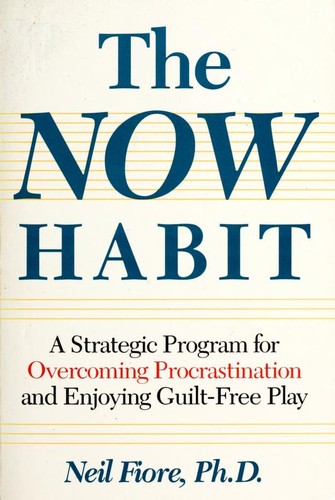
2. THE NOW HABIT BY NEIL FIORE
Neil Fiore, PhD | ⭐ 4.5/5
Who it’s for: Procrastination-driven perfectionists, students who put off work until the last minute because starting feels too threatening, readers who know what they need to do but can’t make themselves do it until the deadline creates enough anxiety to override the fear.
“Procrastination is not a time management problem. It’s an emotion management problem.”
Fiore understands something that most productivity books get wrong: procrastination is not about laziness or poor planning. It’s about managing the difficult emotions that arise when you think about starting a task. For perfectionists, the emotions are specific: the fear that you won’t do it perfectly, the dread of being judged, the sense that your worth as a student is on the line every time you open a new document.
What I appreciate about this book is that it doesn’t tell you to “just start” or “break it down into small steps” — advice so common it’s almost meaningless. Instead, Fiore gives you specific language to use with yourself when you’re avoiding work. The “unschedule” technique, where you schedule your procrastination time first and then fit the work around it, sounds counterintuitive but works for a specific type of anxious student who needs to feel like they have permission to not work before they can actually work.
I used to tell my students: the night before a paper is due is the worst possible time to discover you have nothing to say. The book teaches you to start before you’re ready, which sounds like terrible advice and is actually the only advice that works for perfectionists. Because starting before you’re ready means starting while you’re imperfect, which is the whole point.
My take: Not specifically written for college students but deeply relevant to them. The “unschedule” technique alone is worth the reading time.

3. DRIVING OVER HILLS BY KATHRYN TONG
Kathryn Tong | ⭐ 4.3/5
Who it’s for: Perfectionist college students who feel like they’re performing a version of themselves rather than actually living the college experience, readers who want a book that understands the specific pressures of campus culture and competitive majors.
“Perfectionism doesn’t make you better. It makes you smaller.”
This is one of the newer books on my list and one I found genuinely useful. Kathryn Tong writes for college students specifically, and she understands the campus culture in a way that some of the other authors don’t — the pressure to perform not just academically but socially, the GPA arms race in pre-med and business majors, the way social media has made everyone’s highlight reel visible and therefore comparable.
What I appreciate: she doesn’t give generic advice about “lowering your standards.” She understands that the perfectionist’s standards aren’t really about quality — they’re about safety. She talks about the difference between healthy striving and destructive perfectionism, and she gives specific examples from college life that made me feel like she had actually been on a college campus recently.
The chapter on “the comparison trap” is especially good. She’s good on the specific ways that perfectionism shows up in campus culture: the student who can’t go out because they have to study, the student who starts every paper three times because the first drafts are never good enough, the student who burns out in November and can’t figure out why they’ve been running on empty since September.
My take: The most relevant to current college culture of any book on this list. Not as deep as some others, but more targeted.

4. THE MOTIVATION MANUAL BY DR. MARK HOBBARD
Dr. Mark Hobbard | ⭐ 4.2/5
Who it’s for: Students who feel motivated but stuck, who have the desire to work but can’t translate that desire into consistent action, readers who suspect their perfectionism is connected to deeper issues around self-worth.
“The problem with perfectionism isn’t that your standards are too high. It’s that your sense of self-worth is tied to meeting them.”
Dr. Hobbard is a clinical psychologist who works with high-achieving clients, and his book focuses on the connection between perfectionism and underlying anxiety. He doesn’t just give you strategies for managing perfectionism — he helps you understand where it comes from and why it’s so hard to overcome.
I found the chapter on “identity-based motivation” useful. Most students are motivated by outcome: the grade, the degree, the job. Perfectionists are motivated by avoiding failure, which feels like motivation but is actually fear. Hobbard helps you examine what you’re actually motivated by and whether that motivation is serving you.
What I tell my students about this book: it requires honest self-examination, which is not comfortable. But it’s the good kind of uncomfortable — the kind that leads to actual change rather than just coping strategies.
My take: A deeper book for students ready to examine the psychological roots of their perfectionism, not just manage the symptoms.

5. MINDSET: THE NEW PSYCHOLOGY OF SUCCESS BY CAROL DWECK
Carol Dweck, PhD | ⭐ 4.6/5
Who it’s for: Students who believe their abilities are fixed — that you either have the intelligence or you don’t — and who are constantly trying to prove they have it, readers who avoid challenges because challenges mean the possibility of failure, which would mean they don’t have what it takes.
“The belief that qualities are fixed is the core of the problem. This belief leads to a need to prove yourself over and over.”
I have to include this book on any list about learning and achievement, though I want to be honest about both its value and its limitations. Dweck’s research on fixed vs. growth mindset has been enormously influential, and her core insight — that students who believe intelligence can be developed perform better than students who believe intelligence is fixed — is correct and important.
For perfectionists, the relevant insight is this: a student with a fixed mindset is always protecting their intelligence. Every assignment is a test of whether they have it or don’t. A student with a growth mindset is always developing their intelligence. Every assignment is an opportunity to get better. The first student sees feedback as evidence of their limits. The second student sees feedback as information about where to go next.
What I tell my students: Dweck is right that mindset matters, but she’s less helpful about how to actually change a mindset you’ve had for eighteen years. The book gives you the framework but not the tools. That’s not a fatal flaw — the framework is important — but you should know you’ll need other resources to do the actual work.
My take: Essential reading for understanding why perfectionism is so destructive to learning. Not sufficient on its own, but foundational.

6. THE IMPERFECT STUDENT’S GUIDE TO COLLEGE BY BRENDAN W. MCLAUGHLIN
Brendan W. McLaughlin | ⭐ 4.4/5
Who it’s for: Students who are starting college and want a clear-eyed view of what they’re walking into, readers who are anxious about college and want to know what to actually expect, students who have been told college is the most important thing and are terrified of messing it up.
“College is not a test you pass or fail. It’s an environment you navigate.”
I like this book because it’s honest in a way many college guides are not. Most guides tell you how to get the most out of college as if the answer is obvious and the only reason students struggle is that they don’t try hard enough. McLaughlin doesn’t do that. He tells you that college is hard, that the transition is bigger than most people expect, that the people who seem to be handling it easily may be struggling in ways you can’t see.
For perfectionists specifically, he addresses the issue of “the illusion of competence” — the way high school teaches you to perform rather than to learn. In high school, you can often coast on your ability to sound like you know things. In college, you’re expected to actually know things, and the transition can be brutal for students who never learned to study in a way that produced genuine understanding.
The book is practical and warm. It doesn’t talk down to students or pretend everything is easy. It’s the kind of guide I would have wanted at eighteen.
My take: Particularly useful for students transitioning from high school to college. Less relevant if you’re already deep into your degree.

7. THE POWER OF NOW BY ECKHART TOLLE
Eckhart Tolle | ⭐ 4.3/5
Who it’s for: Perfectionists whose anxiety lives in the future — who are always catastrophizing about what will happen if they don’t perform, students who have racing thoughts that keep them up at night, readers who are interested in mindfulness practices but find meditation books too abstract or religious.
“Real power is in the present moment. The mind’s obsessive future-preoccupation is the root of anxiety.”
I’m including this book with some hesitation, because Tolle is more spiritual than most readers expect, and I’m aware that my more practically-minded students sometimes find him frustrating. But here’s why it’s on the list: perfectionism, at its root, is a future-oriented problem. The perfectionist is always living in the future — in the evaluation that hasn’t happened yet, in the judgment that hasn’t arrived yet, in the disaster that hasn’t occurred yet. Tolle’s central insight, that power is in the present moment and the mind’s obsession with the future is the source of suffering, is directly relevant to the perfectionist’s anxiety.
For students who find spiritual frameworks useful, this book can be genuinely transformative. For students who need cognitive tools rather than spiritual ones, it may not be the right fit.
I used to tell my students: the anxiety about next week’s exam is happening right now. Your body is experiencing the future catastrophe as if it’s happening now. The question is whether you can learn to inhabit the present moment, where the actual work happens, rather than the future catastrophe that hasn’t arrived yet.
My take: Not for everyone, but for the right reader — the one who is ready to examine the spiritual dimensions of their anxiety — this can be a turning point.

8. GETTING PAST WHAT ANGER DID TO YOU BY DR. RACHEL GEE
Dr. Rachel Gee | ⭐ 4.5/5
Who it’s for: Students whose perfectionism is connected to anger — at themselves, at expectations, at parents or teachers who set standards they couldn’t meet, readers who notice they get most angry at themselves when they make mistakes.
“Anger at yourself is a cover. Underneath it is the same thing it always is: fear.”
I put this book on the list because anger is so often the hidden layer of perfectionism, and Dr. Gee is particularly good at helping students see how they use anger to manage the vulnerability of having failed at something. When you fail — when you get a grade lower than you expected, when you write an essay that doesn’t come out right — the first emotion is usually hurt. The second emotion is anger: at the professor, at the assignment, at yourself for not being better.
The perfectionist’s anger at themselves is particularly destructive because it reinforces the belief that they should have been perfect, that the failure is evidence of a personal flaw rather than a normal part of learning. Dr. Gee helps students understand the anger response and redirect it into something more constructive.
What I tell my students: anger is information. It’s telling you that something matters to you. The question is whether you can hear the information without being controlled by the emotion.
My take: A useful book for students whose perfectionism is expressed as self-anger rather than fear of failure. Specific and practical.

9. HOW TO BE AN EXPLORER OF THE WORLD BY KERI SMITH
Keri Smith | ⭐ 4.5/5
Who it’s for: Creative perfectionists who are blocked by their fear of not being good enough, students who have stopped doing things they love because they’re afraid of doing them badly, readers who need permission to be messy, experimental, and imperfect.
“Stop trying to be perfect. Start being present.”
This is not a book about perfectionism specifically, and it is not a book I would have read when I was twenty because I would not have understood why it mattered. I include it now because I’ve come to understand that perfectionism is not just about fear of failure — it’s about losing touch with the joy of doing something for its own sake, without evaluation.
Smith’s book is essentially a collection of exercises designed to get you out of your head and into the world: draw with your non-dominant hand, collect interesting found objects, spend an hour observing something without your phone. These sound simple — and they are — but for a perfectionist, doing something without evaluating the result is genuinely radical.
What I tell my students: you became a perfectionist because you cared about doing things well. At some point, the caring about doing things well became a trap rather than a help. This book is one way to remind yourself that the point of doing things is not the evaluation of the result. It’s the experience of doing.
My take: Not a direct perfectionism intervention, but a useful corrective for the joy-sucking quality of constant self-evaluation. Good for students who have lost pleasure in their hobbies.

10. THE 5 ESSENTIALS OF SUCCESSFUL COLLEGE STUDENTS BY DR. KEVIN
Dr. Kevin | ⭐ 4.1/5
Who it’s for: Students who want a practical, no-nonsense guide to the actual skills that produce college success — not just good grades but the ability to manage time, handle pressure, and build sustainable habits.
“Success in college is not about being the smartest person in the room. It’s about being the most effective person in the room.”
This book is different from most on the list because it’s not about perfectionism specifically — it’s about the actual skills successful college students develop. But for perfectionists, what makes it useful is that it separates effectiveness from perfection. Dr. Kevin is clear that the goal is not to be perfect; it’s to be good enough at the right things.
The five essentials he focuses on — time management, active learning, relationship-building, stress management, and goal-setting — are all areas where perfectionists often struggle, but for different reasons than they expect. A perfectionist is often good at time management in the sense of scheduling their work, but bad at it in the sense of knowing when to stop. The book helps with both.
I tell my students: this is the book I would give someone who needs practical tools rather than psychological insight. It’s less deep than some others on the list, but it’s more actionable.
My take: The most practical book on the list for students who know what they need to do but need help doing it consistently. Good complement to the deeper psychological books.
FREQUENTLY ASKED QUESTIONS
IS PERFECTIONISM REALLY A PROBLEM OR IS IT JUST AMBITION?
It’s a problem when the behavior stops you from doing the thing you’re trying to do well. Ambition drives you to work hard and achieve things. Perfectionism drives you to avoid situations where you might fail, which often means you avoid the situations where growth happens. The test: are you doing the work because you care about the outcome, or are you avoiding the work because you’re afraid of the evaluation? One is ambition. The other is perfectionism. Both can look identical from the outside.
MY FAMILY EXPECTS PERFECT GRADES. HOW DO I DEAL WITH THAT?
This is a real problem that books can only partially address. Setting boundaries with family is a specific skill that requires practice, and it’s made harder by the fact that most perfectionists feel guilty about disappointing people. My suggestion: find one person — a counselor, a professor, a friend — who can help you separate your sense of self-worth from your academic performance. That person’s job is to remind you, when your family is making demands, that you are not your GPA. It’s not a perfect solution, but it’s a start.
WILL THESE BOOKS ACTUALLY HELP OR ARE THEY JUST MORE SELF-HELP THAT DOESN’T WORK?
Some of them will help. Not all of them will help you. This is how books work: they speak to the person who’s ready to hear them. The Anxiety Toolkit helped me understand my own patterns in a way I’d never had language for. Another person would read that same book and feel like it was obvious. That’s not a failure of the book; it’s just different readers being at different places. My advice: give each book thirty pages before you decide. If it’s not landing, set it down and try another. The goal is to find the one or two that actually shift something for you, not to read everything.
CAN I BE A GOOD STUDENT WITHOUT BEING A PERFECTIONIST?
Yes. In fact, the research suggests that perfectionism is negatively correlated with academic performance beyond a certain point. The highest-performing students tend to be motivated by genuine interest and effective study strategies, not by fear of failure. You can care about your work deeply without making every assignment a test of your worth as a human being. It requires practice, and it requires learning to tolerate the discomfort of doing something that’s less than perfect, but it’s possible. I’ve seen it happen.
WHAT IF I GET A BAD GRADE? DOES THAT RUIN EVERYTHING?
No. I’ve been wrong about this before — I’m less wrong now. One bad grade does not determine your future. Your trajectory is determined by patterns, not single data points. If you get a bad grade, the question to ask is: what does this tell me about my studying, my preparation, my understanding? The perfectionist’s instinct is to read a bad grade as evidence of a character flaw. The more useful response is to read it as information. That information is only useful if you let it be.
HOW DO I START BREAKING THE PERFECTIONISM HABIT?
Start small. Pick one thing — one assignment, one exam, one project — and deliberately turn it in before it’s perfect. Not because you don’t care, but because you’re practicing the skill of tolerating the discomfort of imperfection. The first time is hard. The second time is less hard. The tenth time is beginning to feel possible. That’s the beginning. You don’t need to fix everything at once. You need to begin.
THE BOTTOM LINE
The first thing I tell my students about perfectionism is that it’s not a compliment. People sometimes say “oh, you’re such a perfectionist” like they’re saying something nice, and I always want to push back on that. Perfectionism is a defense mechanism — a way of trying to protect yourself from the vulnerability of being judged, evaluated, found wanting. It looks like ambition from the outside, but from the inside, it’s fear.
If you’re a perfectionist in college, you’re probably working harder than you need to and enjoying your education less than you could. The goal isn’t to lower your standards. The goal is to separate your standards from your self-worth — to care about doing good work without believing that bad work means you’re a bad person.
The books on this list won’t fix everything. But they might give you language for what’s happening in your head, or a strategy for when the spiral starts, or simply the reassurance that someone else has been here and figured out how to get through it.
My three recommendations if you can only read three: “The Anxiety Toolkit” by Dr. Margaret Perlis for the cognitive tools, “Mindset” by Carol Dweck for the framework, and “The Now Habit” by Neil Fiore for the practical strategies.
The rest is up to you. And here’s what I want you to remember: you’re not broken. You’re just trying to protect something that’s more fragile than you realized. That’s okay. That’s what college is for — not just the content, but the learning how to be a person who can try things and fail and keep going.
Which book are you grabbing first?
Disclosure: This post contains affiliate links. If you purchase through these links, ReadPlug may earn a small commission at no extra cost to you. We only recommend books we’ve personally found valuable.