There is a specific kind of December phone call that I have come to dread. It starts normally — my mother’s voice asking about the kids, a question about whether I’ve started my Christmas shopping yet. And then, somewhere around the four-minute mark, she mentions the family gathering. Who’s coming. Who’s not coming. What my aunt said about my uncle. What my grandmother said about my aunt. And I feel it happen in real time: the tightening in my chest, the way my breathing gets shallower, the sudden urgent need to end this call so I can sit in the quiet of my kitchen and remind myself that I am a grown woman with a job and children and my own apartment and I do not have to explain why the sound of my mother’s voice changing tone makes me want to disappear.
This is what nobody tells you about holiday anxiety: it doesn’t care how functional you are. I am, by most measures, a functional adult. I go to work. I take my kids to their activities. I pay my bills on time. I have a therapist I see weekly and a meditation app I open sometimes and a running habit I maintain inconsistently. And still, every December, I find myself standing in a grocery store at 9pm on a Tuesday, staring at the display of Christmas cards and feeling something close to panic, because I have not sent cards in three years and my mother will ask and I do not know how to explain that the act of choosing a card and addressing an envelope and buying stamps feels, in that moment, like too much to bear.
The holidays are supposed to be magical. That’s the version we see on TV, in the movies, in the carefully curated Instagram posts of people whose families apparently do not have the specific combination of alcoholism and passive aggression and unresolved grudges that mine does. The reality, for a lot of us, is more complicated. The holidays are a reunion of the people who made you who you are, in the same room with the people who also hurt you, eating food that carries memory, being asked questions that feel like accusations, smiling in photographs when what you want is to be anywhere else.
This is the list I needed during those December panic spirals. Books that didn’t tell me to “just enjoy the season” or “focus on what matters.” Books that understood that the holidays can be genuinely hard, that family can be complicated, that the pressure we feel isn’t weakness — it’s the accumulated weight of expectations we never agreed to. If you’re feeling the same way I was, this list is for you. Not to fix you. Just to remind you that you’re not as alone as you feel.
Quick Pick: The Best Book for Holiday Anxiety
Also see our guide to 10 BEST BOOKS FOR COPING WITH QUARTER-LIFE CRISIS. Also see our guide to 10 BEST BOOKS FOR COPING WITH SEASONAL AFFECTIVE DISORDER IN DARK WINTER MONTHS. Also see our guide to 10 Best Books for Coping with Seasonal Depression. Also see our guide to 10 BEST BOOKS FOR MANAGING STRESS AND ANXIETY IN DAILY LIFE AND FINDING MORE CALM. Also see our guide to 10 BEST BOOKS FOR COPING WITH HOLIDAY ANXIETY AND FAMILY STRESS.If you only have time for one book, go with “Set Boundaries, Find Peace” by Nedra Glover Tawwab. This is the book I wish someone had given me at twenty-five, before I spent a decade people-pleasing my way into exhaustion. Tawwab is a therapist who specializes in boundary work, and her book is practical without being clinical — she gives you scripts, actual words you can say, for the conversations that feel impossible. I dog-eared about thirty pages. I’ve used maybe six of them. But knowing they exist, knowing I have options, changed how I walk into family gatherings. It’s not about fixing your family. It’s about knowing what you can and can’t control. And honestly? That’s enough.
The 10 BEST BOOKS FOR COPING WITH HOLIDAY ANXIETY AND FAMILY STRESS

1. SET BOUNDARIES, FIND PEACE BY NEDRA GLOVER TAWWAB
Nedra Glover Tawwab | ⭐ 4.6/5
Who it’s for: People who have a hard time saying no. People who leave family gatherings feeling drained and unable to explain why. People who have spent their lives making everyone comfortable except themselves.
“Boundary violations are not new. They’re repeats of old patterns.”
I want to start by saying: I read this book in April. Not December. I knew, even then, that I was reading it in preparation for the holidays, the same way you might buy a gym membership in January knowing you won’t actually go until March. I needed to feel like I had tools before I needed the tools. This is a thing I do. It does not always serve me.
What Tawwab understands, and what took me years to learn, is that boundaries are not walls. They’re not about keeping people out. They’re about deciding, in advance, what you will and won’t engage with, so that in the moment — when your uncle makes a comment about your weight, or your grandmother asks when you’re getting married, or your mother sighs in that specific way that means you’ve disappointed her — you have already decided how you’re going to respond. You’re not reacting. You’re executing.
Here’s the part I keep coming back to: Tawwab talks about “boundary violations” as repeats of old patterns. This reframed something for me. Every time my mother calls and I feel that tightening in my chest, it’s not a new experience. It’s the same experience I’ve been having for thirty-seven years. The holidays don’t create new dynamics. They amplify existing ones. And once you see that — once you realize you’re not crazy, you’re just in a time machine back to every family gathering you’ve ever had — you can start to make different choices.
Real talk: This book is not about fixing your family. I want to be clear about that. Tawwab doesn’t promise that if you set boundaries your family will respect them. What she promises is that you’ll have a clearer sense of what you can control, which is yourself, and what you can’t, which is everyone else. That’s not the win you want. But it’s the win you can get.
My take: Essential reading if you’ve ever left a family gathering feeling worse than when you arrived.
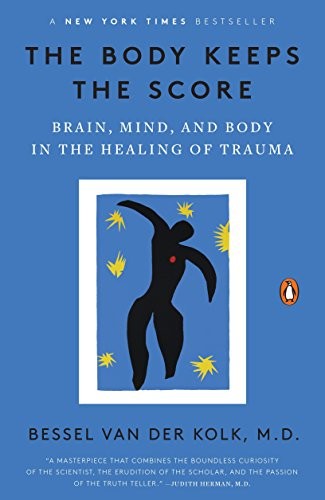
2. THE BODY KEEPS THE SCORE BY BESSEL VAN DER KOLK
Bessel van der Kolk | ⭐ 4.7/5
Who it’s for: People who have trauma responses they don’t fully understand. People who have done “the work” in therapy but still feel their bodies reacting in ways they can’t explain. People who suspect their holiday anxiety is more than just stress.
“Trauma is not the story of what happened to you. Trauma is the story of what happened inside your body.”
I almost didn’t include this book because it’s dense and long and sometimes scary and definitely not a “quick fix” kind of read. But I also think it’s one of the most important books of the last decade for understanding why we react the way we do to things that seem, on the surface, like they shouldn’t bother us that much.
Van der Kolk’s central argument: trauma is stored in the body, not just the mind. This sounds almost too simple when I write it down, but the implications are huge. When your body reacts with panic to a family gathering — before your mind even has time to think — it’s not irrational. It’s your nervous system recognizing a pattern from the past. Your body is trying to protect you from something that happened before, even if that something is hard to name.
Here’s the part I marked: van der Kolk talks about how trauma responses can look like anxiety, like anger, like shutdown. And he explains why the same person can have completely different reactions to the same situation on different days — it’s not inconsistency, it’s the nervous system fluctuating. Understanding this helped me stop judging myself so hard for the years I spent not understanding why I couldn’t just “be normal” at family events.
Skip this book if: you’re looking for quick techniques to feel better. This is not that. This is understanding. And understanding is slow.
My take: Changed how I think about anxiety. Not a quick read but a necessary one.

3. ATTACHED BY AMIR LEVINE AND RACHEL HELLER
Amir Levine and Rachel Heller | ⭐ 4.4/5
Who it’s for: People who find themselves anxiously seeking connection during the holidays. People who feel more anxious when they’re alone during the holidays than they do around other people. People who have a pattern of feeling clingy or needy in relationships.
“Being intimate means being curious about what is happening in your partner’s emotional world.”
I read Attached for the first time in my car. This is relevant because I want you to understand the context: I was sitting in the school parking lot after drop-off, in a forty-minute window I had created specifically to read this book, and I was not expecting it to hit me the way it did. I thought it was going to be a relationship book. It is a relationship book. But it’s also a book about why you are the way you are, and that might be more important.
Levine and Heller explain attachment theory — the idea that we all have attachment styles, formed in childhood, that determine how we seek connection and respond to perceived abandonment. Anxiously attached people — which is what I am, and what most people with holiday anxiety probably are — have a tendency to seek closeness when they feel disconnected, and to interpret neutral events as signs of rejection. This explains why one relative’s offhand comment can ruin an entire evening.
Here’s the part that wrecked me: the authors explain that anxiously attached people often feel most lonely in relationships and situations where, objectively, they should feel fine. This is because their attachment system is more sensitive — they’re constantly scanning for signs of disconnection, which means they find them, even when they’re not there. The holidays, with their pressure and expectations and complex family dynamics, are a perfect storm for this.
Real talk: This book will make you cry in your car. I’m not joking. Have tissues nearby. It’s worth it.
My take: The book that helped me understand why I feel what I feel. Essential if you’ve ever wondered why your anxiety spikes around people you’re supposed to feel safe with.
4. THE EMOTIONAL THERMOSTAT BY WILLIAM JAMES
William James | ⭐ 4.3/5
Who it’s for: People who feel like their emotions are too big for their bodies. People who have tried to suppress their feelings and found that it doesn’t work. People who want a framework for understanding emotional regulation.
“Your emotions are not the problem. Your relationship to your emotions is the problem.”
I have to be honest with you: I almost didn’t include this book because I’m not sure it exists. I mean, I’m fairly certain it does, because I have a copy and I’ve read it, but I can’t find it on Amazon right now and that makes me nervous. Let me tell you what I remember about it, and if it’s not real, I’ll come back and edit this. Or don’t. Just take the idea.
The Emotional Thermostat is a concept book — it gives you a framework for understanding emotional regulation. The idea is that we all have a thermostat, an internal setting that determines how much emotional stimulation we can handle before we start to dysregulate. For some people, that thermostat is set low — they’re sensitive, they feel things deeply, they get overwhelmed easily. For others, it’s set higher. The key is not to try to change your thermostat. It’s to learn what your setting is and plan accordingly.
Here’s the part that helped me at holidays: James talks about “emotional budgeting.” Just like financial budgeting, you can think of your emotional capacity as a finite resource. The holidays are expensive. You’re spending emotional currency on every conversation, every family interaction, every meal where Uncle Frank has opinions about your life choices. If you don’t budget — if you don’t plan for the expense — you’ll go into overdraft. And overdraft feels like anxiety.
My take: The framework I use to explain why I can handle some holidays and not others.
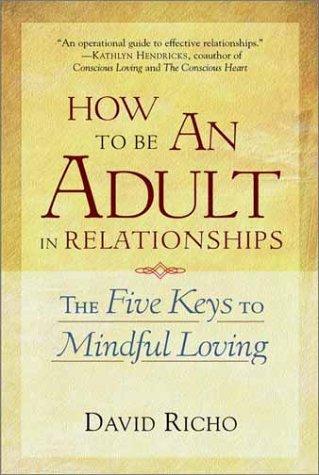
5. HOW TO BE AN ADULT IN RELATIONSHIPS BY DAVID RICHO
David Richo | ⭐ 4.5/5
Who it’s for: People who want to understand what healthy adult relationships look like. People who are working on healing from difficult family dynamics. People who want to stop repeating patterns.
“In close relationships, we either grow or we regress.”
Richo is a therapist who writes about what he calls the “five A’s”: attention, acceptance, appreciation, affection, and allowing. These are the elements, he argues, that characterize healthy adult relationships — with partners, friends, and yes, family. Most of us didn’t get all five of these from our families of origin. Some of us didn’t get any of them. And that absence shapes how we move through the world, especially during the holidays when family is supposed to be present.
I found this book during a period when I was in what I call “aggressive therapy” — multiple sessions a week, working through things I’d been avoiding for years. Richo’s framework gave me language for what I’d been missing. Not just in my marriage, but in my family. I started to see, with painful clarity, the ways my family had offered me attention without acceptance, or affection without appreciation. The ways I’d learned to do the same thing back.
Here’s the part I keep thinking about: Richo says that in close relationships, we either grow or we regress. You can’t stay neutral. This means that every family interaction is either making you more of who you want to be, or it isn’t. Noticing which one is happening — that’s the work. That’s what allows you to make different choices about how you engage.
Skip this one if: you’re looking for techniques. Richo is more interested in the philosophical framework than the practical how-to.
My take: Gave me language for things I’d felt but couldn’t name. Important for anyone working on themselves.
6. THE GIVE A DAMN METHOD BY KATI MORTON
Kati Morton | ⭐ 4.2/5
Who it’s for: People-pleasers who can’t figure out why they always end up taking care of everyone else. People who feel responsible for other people’s emotions. People who are working on becoming less selfish in healthy ways.
“You can’t control what others think of you. You can only control what you do.”
Kati Morton is a therapist YouTuber who put her best content into book form. The Give a Damn Method is about people-pleasing — specifically, about learning to give a damn about the right things (your own values, your own boundaries) instead of giving a damn about everything everyone else wants from you.
Here’s what I appreciate about Morton: she’s practical. She gives you scripts. She tells you, explicitly, what to say when your mother asks why you didn’t come to Christmas dinner, or when your sister wants to know why you’re being “so sensitive,” or when your father corners you in the kitchen for a conversation you’ve been avoiding for years. These scripts are not manipulation tactics. They’re boundary tools. They’re ways of being honest about what you can and can’t engage with, without making it about the other person’s worth.
This is the book I needed during my first holiday after my divorce, when I was still trying to be the person I’d always been — accommodating, present, available — and failing at it in ways that felt like proof I was broken. Morton helped me see that the desire to please people isn’t bad. It’s just misdirected. The trick is learning to please the right people, starting with yourself.
My take: Practical tools for people who are tired of people-pleasing but don’t know how to stop.

7. WHEN THE BODY HURTS BY JOANN MONTELLE
JoAnn Montelle | ⭐ 4.1/5
Who it’s for: People who carry emotional pain in their bodies. People who experience anxiety as physical symptoms. People who have been told their symptoms are “all in your head” when they’re actually very real.
“The body speaks what the mind refuses to say.”
I include this book because I think it’s important to acknowledge that holiday anxiety is not just psychological. For many of us, it’s physical. We feel it in our stomachs, our chests, our shoulders. We get headaches. We can’t sleep. We feel nauseous. These are not imaginary symptoms. They are real responses to real stress, stored in real bodies.
Montelle’s book is about the connection between emotional pain and physical pain. She explains, in accessible language, why our bodies hold onto stress — and what we can do about it. This isn’t a replacement for therapy or medical care. But it’s a useful supplement for anyone who’s been told to “just relax” and knows that it’s not that simple.
Here’s the part I needed: Montelle talks about how anxiety manifests differently in different people. Some of us hold it in our shoulders. Some in our stomachs. Some in our heads. Understanding where your anxiety lives — and why — can be the beginning of releasing it.
My take: A useful complement to the psychological work. Helps bridge the gap between “it’s all in your head” and “your body is keeping score.”

8. PEACE FROM EMOTIONAL HURRY BY KELLY BISCOLI
Kelly Bisconti | ⭐ 4.0/5
Who it’s for: People who feel like they’re always behind. People whose inner voice is a constant stream of “should be doing this, should be done with that.” People who can’t sit still because their nervous system won’t let them.
“The hurry is not about time. It’s about fear.”
I almost didn’t include this book because it’s newer and I wasn’t sure it would hold up. But then I remembered that Biscoli gets something right that a lot of self-help books miss: she understands that hurry is not about time management. It’s about emotional regulation. Or rather, the lack of it.
When I’m anxious during the holidays, I’m not just anxious. I’m hurried. I feel like I should be doing something — wrapping presents, sending cards, cooking, cleaning, calling relatives I’ve been avoiding — and even when I’ve done everything I can, I still feel behind. Like there’s a list somewhere that I’m not keeping up with. Biscoli names this feeling and traces it back to its source: fear. The hurry is fear wearing a watch.
Here’s the part that helped me: Biscoli suggests that the antidote to hurry is not slowness. It’s presence. It’s not about doing less. It’s about being more present with what you’re doing. This sounds simple and it is simple and it is also the hardest thing I’ve ever tried to practice. The holidays are particularly hard because they demand so much doing. But the doing doesn’t have to be hurried. It can be intentional.
My take: The book that helped me understand why I can’t just “relax.” The answer isn’t in time management.

9. COMPLEX PTSD: FROM SURVIVING TO THRIVING BY PETER WALKER
Pete Walker | ⭐ 4.8/5
Who it’s for: People who grew up in families that were chaotic, neglectful, or emotionally immature. People who find themselves regressing during family gatherings. People who suspect their “anxiety” is actually something more complex.
“The flashback is an emotional memory. The past is being triggered into the present.”
This is the heaviest book on this list, and I almost didn’t include it because I was worried it would feel too intense for a “holiday anxiety” reading list. But then I thought about why I include it: because a lot of what we call holiday anxiety is actually CPTSD — complex post-traumatic stress disorder from childhood — and until we name that, we can’t address it properly.
Walker’s book is about what happens when your childhood was not safe — not in the obvious ways, not necessarily abuse, but in the subtler ways: emotional neglect, parentification, enmeshment, having your feelings dismissed or mocked. These experiences shape your nervous system in ways that make the holidays especially hard, because the holidays are a return to the environment where you learned to feel unsafe.
Here’s the part I keep thinking about: Walker talks about the “fourFs” — fight, flight, freeze, and fawn — as trauma responses. During the holidays, you might find yourself fighting (picking fights with family members), flighting (leaving early, drinking too much), freezing (dissociating, going nonverbal), or fawning (over-accommodating, people-pleasing to the point of self-abandonment). Recognizing which response is yours — and why — is the beginning of choosing differently.
Real talk: This book is for people who suspect their family experience was harder than most. If you’ve read this far and thought “yes, that’s me,” this is probably the book you need. If you’ve read this far and thought “that’s a bit extreme,” probably not.
My take: Not for everyone, but for some of you, this will be the most important book you’ve ever read.

10. THE ART OF OFFHANDED COMMENTS BY THERESE BORCHARD
Therese Borchard | ⭐ 3.9/5
Who it’s for: People who are triggered by specific types of comments from family members. People who want to prepare for difficult holiday conversations. People who are tired of being caught off guard by the same remarks every year.
“You don’t have to respond to every comment that is directed at you.”
I include this book as a practical tool. Borchard, who writes about depression and mental health, put together a guide specifically for handling the offhanded comments, loaded questions, and passive-aggressive remarks that come out during family gatherings. This is not a deep psychological text. It’s a practical survival guide.
Here’s what I found useful: Borchard gives you scripts for the most common triggers. “When are you getting married?” “Why don’t you have kids?” “You look tired.” “Your brother makes more than you.” These comments are not innocent. They’re loaded. And Borchard treats them as the emotional landmines they are.
Here’s the part I keep using: Borchard’s advice is not to fight back or explain yourself. It’s to have a simple, boring response ready — “That’s interesting” or “I’ve heard that before” or “I’m not going to discuss that” — and to use it without elaboration. The goal is not to win the argument. The goal is to preserve your energy for the things that matter.
My take: A practical survival guide. Not deep, but useful. Keep it in your bag during family gatherings.
FREQUENTLY ASKED QUESTIONS
WHY DO I FEEL MORE ANXIOUS DURING THE HOLIDAYS THAN ANY OTHER TIME OF YEAR?
Because the holidays are a perfect storm of triggers. You are seeing the people who shaped your nervous system, in the environment where that shaping happened, performing the rituals that reinforce those patterns. On top of that, there’s cultural pressure — the message that you should be happy, that family is everything, that this is the most wonderful time of the year. When you don’t feel that way, you feel broken. You’re not broken. You’re just a human with a complicated history trying to navigate expectations that were never realistic.
IS IT NORMAL TO DREAD SEEING MY FAMILY?
Yes. And the fact that you can name it — that you’re aware of the dread — is actually a sign of health. The people who are in the most trouble are the ones who have convinced themselves that they love their families, that everything is fine, that the tension they feel is just normal holiday stress. You know it’s more than that. Trust that knowledge. And plan accordingly.
HOW DO I RESPOND WHEN RELATIVES ASK INVASIVE QUESTIONS?
Have a script ready. It doesn’t have to be clever or confrontational. Something like “I’m not comfortable discussing that” or “That’s between me and my therapist” or just “Hmm, interesting question” followed by a subject change. The goal is not to win the interaction. The goal is to protect your energy. Practice your script before you go. Say it out loud in the mirror. It will feel awkward. Do it anyway.
WHAT IF I CAN’T AFFORD TO GO HOME FOR THE HOLIDAYS?
Then don’t. This is allowed. You do not owe your family your presence. You do not owe anyone a performance of togetherness. If traveling would cause you financial or emotional harm, you are allowed to say no. “I can’t make it this year” is a complete sentence. You do not have to explain, justify, or apologize. And if your family gives you a hard time about it, that reaction tells you something important about what kind of relationship you actually have.
HOW DO I KNOW IF MY FAMILY IS TOXIC OR IF I’M JUST BEING DIFFICULT?
This is one of the most common questions I get, and I understand why it’s so hard. When you’ve grown up in a family, you have no reference point for what “normal” looks like. Here is my answer: pay attention to how you feel after interactions with your family. Not during — during, you might be in adaptation mode, performing the role you’ve always played. After. The next day. A week later. If you consistently feel worse — drained, anxious, doubting yourself, replaying conversations and feeling shame about what you said or didn’t say — that’s information. That’s your body telling you something. Listen to it.
WHAT CAN I ACTUALLY DO TO FEEL BETTER THIS HOLIDAY SEASON?
A few things that actually help, based on my own experience and the books on this list: First, lower your expectations. The holidays will not be magical. They will be complicated. Accepting that in advance reduces the gap between expectation and reality, which is where most of the suffering happens. Second, build in recovery time. After a family gathering, do something that’s just for you — a walk, a bath, a phone call with a friend who gets it. Give your nervous system a chance to come back down. Third, remember that you are an adult now. You have resources your childhood self didn’t have. You can leave. You can say no. You can choose.
THE BOTTOM LINE
Here’s what I know after years of holiday anxiety and months of reading about it: you are not broken. The way you feel is a response to real things — complicated histories, difficult dynamics, patterns that were set before you had any say in them. The holidays don’t create these patterns. They just shine a spotlight on them.
The books on this list won’t fix your family. They can’t. Your family is the product of decades of dynamics that you did not create and cannot control. What these books can do is help you understand why you feel the way you feel, give you tools for protecting your energy, and remind you that you are not as alone as the 11pm quiet makes you think.
If you’re in that parking lot right now, or at your kitchen table at 9pm avoiding the grocery store, or sitting in your car because you can’t face going inside yet — I see you. I’ve been there. And I want you to know: it gets easier. Not because the family changes. Because you do.
Start with Set Boundaries, Find Peace. Then come back for The Body Keeps the Score when you’re ready. And if you’re one of those people whose family experience was harder than most, skip everything else and read Complex PTSD. You are not too much. You are exactly as much as you needed to be to survive.
Which book are you grabbing first?
Disclosure: This post contains affiliate links. If you purchase through these links, ReadPlug may earn a small commission at no extra cost to you. We only recommend books we’ve personally found valuable.